Sponsored
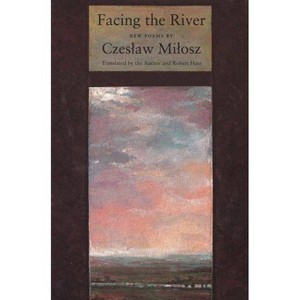
Facing the River - by Czeslaw Milosz (Paperback)
In Stock
Sponsored
About this item
Highlights
- In the spring of 1989, exactly fifty years after he last saw - and seemed irrevocably cut-off from - the river valley he grew up in, Czeslaw Milosz was invited to return for a visit.
- Author(s): Czeslaw Milosz
- 84 Pages
- Poetry, European
Description
About the Book
A poet of immense moral authority, Milosz writes with the amazing clarity that issues from a precise vision. In these later poems, the poems of older age, he takes a long look back at the catastrophic upheavals of the 20th century; yet despite the soberness of his themes, he writes with the lightness of touch found only in the great masters.Book Synopsis
In the spring of 1989, exactly fifty years after he last saw - and seemed irrevocably cut-off from - the river valley he grew up in, Czeslaw Milosz was invited to return for a visit. The new government of independent Lithuania welcomed him back to the region of his childhood. Many of the poems in Facing the River record his experiences there. Here, the river of the Issa Valley symbolizes the river of time and also the river of mythology over which one cannot step twice. This is the river Milosz, the 1980 Nobel Laureate for Literature, faces while exploring ancient themes. He reflects upon the nature of imagination, human experience, good and evil, and the wonders of life on earth. A poet of immense moral authority, in these later poems, the poems of old age, of a long look back at the catastrophic upheavals of the twentieth century, Milosz writes with amazing clarity and a precise vision. Despite the preponderance of his themes, he writes with the lightness of touch found only in the great masters. Using his own translations and those of Robert Hass, with whom he has worked closely, this volume achieves the one task that seems necessary and at the same time impossible - to invent a language comprehensible "to both the living and the dead."From the Back Cover
Czeslaw Milosz did not believe he would ever return to the river valley in which he grew up. But in the spring of 1989, exactly fifty years after he left, the new government of independent Lithuania welcomed him back to that magical region of his childhood. Many of the poems in Facing the River record his experiences there, where the river of the Issa Valley symbolizes the river of time as well as the river of mythology, over which one cannot step twice. This is the river Milosz faces while exploring ancient themes. He reflects upon the nature of imagination, human experience, good and evil--and celebrates the wonders of life on earth.
In these later poems, the poems of older age, this Nobel laureate takes a long look back at the catastrophic upheavals of the twentieth century; yet despite the soberness of his themes, he writes with the lightness of touch found only in the great masters.
Review Quotes
"I have no hesitation whatsoever in stating that Czeslaw Milosz is one of the greatest poets of our time, perhaps the greatest."-- Joseph Brodsky"The work of Milosz reminds us of how much power poetry gains from bearing within itself an unforced, natural, and longranging memory of past customs; a sense of the strata of ancient and modern history; a wide visual experience; and a knowledge of many languages and literatures."-- Helen Vendler
Shipping details
Return details
Frequently bought together


Discover more options