Sponsored
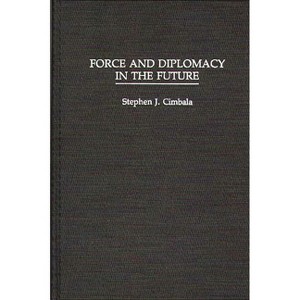
Force and Diplomacy in the Future - by Stephen J Cimbala (Hardcover)
In Stock
Sponsored
About this item
Highlights
- This study is an initial effort to assess the post-Cold War international environment in terms of its implications for the relationship between force and policy.
- About the Author: STEPHEN J. CIMBALA is Professor of Political Science at Pennsylvania State University, Delaware County Campus.
- 256 Pages
- Political Science, International Relations
Description
About the Book
This study is an initial effort to assess the post-Cold War international environment in terms of its implications for the relationship between force and policy. This relationship between force and policy in the future, based on a retrospective look at U.S., allied NATO, and Soviet doctrine strategy is one of uncertain fidelity and potentially destabilizing content. Assuming that informed speculation about the post-Cold War world requires a sense of connection to the historical past, Cimbala sees that issues with which Europe was forced to deal prior to the Second World War will reappear in the aftermath of a socially reconstructed Soviet Union, a defunct Warsaw Pact, and a newly reunited Germany. He finds that nationalism and economic competition will contend for the attention of policymakers along with traditional security issues for the remainder of the 1990s and thereafter. The peace and stability provided for more than forty years by U.S.-Soviet strategic nuclear bipolarity and the bloc politics of the Cold War will no longer be taken for granted.
Cimbala sees that opportunities exist for collaboration between Washington and Moscow, and among other major powers, toward the development of a systems consciousness in favor of international peace and stability. Military security was not only the cause of peace in post-World War II Europe it was also the product of political stability made possible by economic prosperity. The economic prosperity of Western Europe eventually proved too embarrassing for the regimes of Eastern Europe to maintain their political legitimacy and the demise of communism in part came from the process of transformation from an industrial to a post-industrial age. This work will interest students and scholars in security and international studies, as well as policy analysts and policy makers concerned with world affairs.
Book Synopsis
This study is an initial effort to assess the post-Cold War international environment in terms of its implications for the relationship between force and policy. This relationship between force and policy in the future, based on a retrospective look at U.S., allied NATO, and Soviet doctrine strategy is one of uncertain fidelity and potentially destabilizing content. Assuming that informed speculation about the post-Cold War world requires a sense of connection to the historical past, Cimbala sees that issues with which Europe was forced to deal prior to the Second World War will reappear in the aftermath of a socially reconstructed Soviet Union, a defunct Warsaw Pact, and a newly reunited Germany. He finds that nationalism and economic competition will contend for the attention of policymakers along with traditional security issues for the remainder of the 1990s and thereafter. The peace and stability provided for more than forty years by U.S.-Soviet strategic nuclear bipolarity and the bloc politics of the Cold War will no longer be taken for granted.
Cimbala sees that opportunities exist for collaboration between Washington and Moscow, and among other major powers, toward the development of a systems consciousness in favor of international peace and stability. Military security was not only the cause of peace in post-World War II Europe it was also the product of political stability made possible by economic prosperity. The economic prosperity of Western Europe eventually proved too embarrassing for the regimes of Eastern Europe to maintain their political legitimacy and the demise of communism in part came from the process of transformation from an industrial to a post-industrial age. This work will interest students and scholars in security and international studies, as well as policy analysts and policy makers concerned with world affairs.Review Quotes
?Cimbala focuses on the relationship between force and policy as it might be viewed by the major powers in the future. In a world permissive of nuclear technology diffusion and the spread of other weapons of mass destruction to states outside the developed world, the very term "major powers" acquires a different meaning. No doubt the collapse of the Soviet Union in 1991 symbolized the passage into a new world of strategy and diplomacy. The stability of the bipolar world may collapse with the end of the Cold War. The role of military threat and sanction in preserving international peace and stability therefore remains important, as the 1991 Gulf War and efforts to contain nationalism and irredentism, which threaten to spread from the Balkans and the new states in the former Soviet Union, have demonstrated. In the first two of four expertly researched and persuasively argued chapters the author treats the role of NATO in the new age of nuclear escalation and the role of coercive strategy in the Gulf Crisis of 1991. Chapter 3 discusses Clausewitz's argument that war and politics are inseparable; given the friction and uncertainty in any military conflict, optimism about the process of nuclear crisis management may be misplaced. Punishment and denial in nuclear deterrence strategy are analyzed in Chap. 4. The concluding chapter summarizes the implications of the study for the role of force and policy in the future.?-Choice
?This is a thoughtful analysis of the complex and confounding current world environment, with rich historical allusion and requisite stress on nationalism and economics as global security concerns. It is a welcome addition.?-Military Review
"This is a thoughtful analysis of the complex and confounding current world environment, with rich historical allusion and requisite stress on nationalism and economics as global security concerns. It is a welcome addition."-Military Review
"Cimbala focuses on the relationship between force and policy as it might be viewed by the major powers in the future. In a world permissive of nuclear technology diffusion and the spread of other weapons of mass destruction to states outside the developed world, the very term "major powers" acquires a different meaning. No doubt the collapse of the Soviet Union in 1991 symbolized the passage into a new world of strategy and diplomacy. The stability of the bipolar world may collapse with the end of the Cold War. The role of military threat and sanction in preserving international peace and stability therefore remains important, as the 1991 Gulf War and efforts to contain nationalism and irredentism, which threaten to spread from the Balkans and the new states in the former Soviet Union, have demonstrated. In the first two of four expertly researched and persuasively argued chapters the author treats the role of NATO in the new age of nuclear escalation and the role of coercive strategy in the Gulf Crisis of 1991. Chapter 3 discusses Clausewitz's argument that war and politics are inseparable; given the friction and uncertainty in any military conflict, optimism about the process of nuclear crisis management may be misplaced. Punishment and denial in nuclear deterrence strategy are analyzed in Chap. 4. The concluding chapter summarizes the implications of the study for the role of force and policy in the future."-Choice
About the Author
STEPHEN J. CIMBALA is Professor of Political Science at Pennsylvania State University, Delaware County Campus. He is the author of numerous books, including The Soviet Challenge in the 1990s (Praeger, 1989), Conflict Termination in Europe: Games Against War (Praeger, 1990), and Strategy After Deterrence (Praeger, 1991). He has also written articles on arms control, nuclear strategy and deterrence, and other areas dealing with the relationship between force and policy.Shipping details
Return details
Trending Non-Fiction





Discover more options