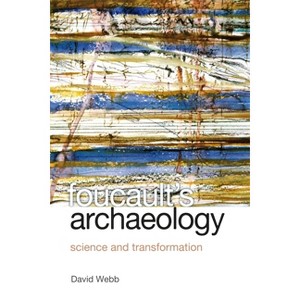
David Webb reveals the extent to which Foucault's approach to language in The Archaeology of Knowledge was influenced by the mathematical sciences, adopting a mode of thought indebted to thinkers in the scientific and epistemological traditions such as Cavailles and Serres.
About the Author: David Webb is Senior Lecturer at the Staffordshire University
192 Pages
Philosophy, Epistemology
Description
About the Book
Reveals the extent to which Foucault's approach to language in The Archaeology of Knowledge was influenced by the mathematical sciences, adopting a mode of thought indebted to thinkers in the scientific and epistemological traditions such as Cavailles and Serres.
Book Synopsis
David Webb reveals the extent to which Foucault's approach to language in The Archaeology of Knowledge was influenced by the mathematical sciences, adopting a mode of thought indebted to thinkers in the scientific and epistemological traditions such as Cavailles and Serres. By aligning his thought with the challenge to Kantian philosophy from mathematics and science in the late 19th and early 20th centuries, he shows how Foucault established his own perspective on the future of critical philosophy.
From the Back Cover
'David Webb makes one of the biggest advances in our understanding of Foucault's archeological thinking. He identifies with the utmost lucidity the problem to which Foucault's 1969 The Archaeology of Knowledge really responds. Archaeology, Webb shows, attempts to determine conditions of knowledge that are historical (and not transcendental) and non-empirical (but formal). Foucault's Archaeology is a great achievement.' Leonard Lawlor, Sparks Professor of Philosophy, Penn State University Sheds new light on a crucial period of Foucault's work This commentary places Michel Foucault's The Archaeology of Knowledge in the context of the philosophy of mathematics and science. A series of short essays outline key ideas in the work of Jean Cavaillès, Michel Serres and Gaston Bachelard. Webb then shows how these resources defined Foucault's response to Kant, and his attempt to release thinking in modernity from the impasse he describes at the end of The Order of Things. As such, it provides valuable insight into ideas such as the 'historical a priori', and into the radical and experimental nature of Foucault's philosophy. David Webb re-situates the interpretation of Foucault's archaeology, providing a new perspective on his thought, its background and direction of travel. David Webb is Senior Lecturer in Philosophy at Staffordshire University. Cover image: Strata (c) Tom Hefko, http: //opening.hefko.net Cover design: [insert logo file] www.euppublishing.com ISBN


About the Author
David Webb is Senior Lecturer at the Staffordshire University
Dimensions (Overall): 9.21 Inches (H) x 6.14 Inches (W) x .41 Inches (D)
Weight: .61 Pounds
Suggested Age: 22 Years and Up
Number of Pages: 192
Genre: Philosophy
Sub-Genre: Epistemology
Publisher: Edinburgh University Press
Format: Paperback
Author: David Webb
Language: English
Street Date: August 31, 2026
TCIN: 1009312822
UPC: 9781399567619
Item Number (DPCI): 247-52-5854
Origin: Made in the USA or Imported
If the item details aren’t accurate or complete, we want to know about it.
Shipping details
Estimated ship dimensions: 0.41 inches length x 6.14 inches width x 9.21 inches height
Estimated ship weight: 0.61 pounds
We regret that this item cannot be shipped to PO Boxes.
This item cannot be shipped to the following locations: American Samoa (see also separate entry under AS), Guam (see also separate entry under GU), Northern Mariana Islands, Puerto Rico (see also separate entry under PR), United States Minor Outlying Islands, Virgin Islands, U.S., APO/FPO, Alaska, Hawaii
Return details
This item can be returned to any Target store or Target.com.
This item must be returned within 90 days of the date it was purchased in store, delivered to the guest, delivered by a Shipt shopper, or picked up by the guest.