Sponsored
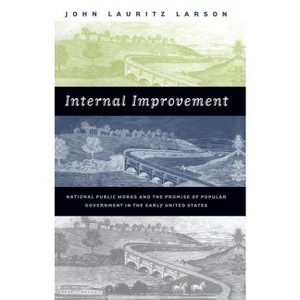
Internal Improvement - by John Lauritz Larson (Paperback)
In Stock
Sponsored
About this item
Highlights
- When the people of British North America threw off their colonial bonds, they sought more than freedom from bad government: most of the founding generation also desired the freedom to create and enjoy good, popular, responsive government.
- About the Author: John Lauritz Larson, professor of history at Purdue University, is coeditor of the Journal of the Early Republic and author of the award-winning Bonds of Enterprise: John Murray Forbes and Western Development in America's Railway Age.
- 352 Pages
- Political Science, Public Policy
Description
About the Book
Internal Improvement: National Public Works and the Promise of Popular Government in the Early United StatesBook Synopsis
When the people of British North America threw off their colonial bonds, they sought more than freedom from bad government: most of the founding generation also desired the freedom to create and enjoy good, popular, responsive government. This book traces the central issue on which early Americans pinned their hopes for positive government action -- internal improvement.
The nation's early republican governments undertook a wide range of internal improvement projects meant to assure Americans' security, prosperity, and enlightenment -- from the building of roads, canals, and bridges to the establishment of universities and libraries. But competitive struggles eventually undermined the interstate and interregional cooperation required, and the public soured on the internal improvement movement. Jacksonian politicians seized this opportunity to promote a more libertarian political philosophy in place of activist, positive republicanism. By the 1850s, the United States had turned toward a laissez-faire system of policy that, ironically, guaranteed more freedom for capitalists and entrepreneurs than ever envisioned in the founders' revolutionary republicanism.
Review Quotes
"Internal Improvement is the single most important contribution to our understanding of antebellum American political economy in the last generation. Larson's history of public works 'brings the state back in, ' or, perhaps more accurately, enables us to see more clearly how the development of democratic politics led to the disappearance of the state, thus clearing the way for new concentrations of irresponsible private power. Improvement-minded Americans crowded the political trough, clamoring for an equalization and escalation of benefits that preempted and discredited long-term planning. Larson's lucid account of improvement politics is necessary reading for all students of the period -- or for anyone interested in the history of American democracy."--Peter S. Onuf, University of Virginia
"An engaging, gracefully written, and provocative study of internal improvement in antebellum America."--Journal of the Early Republic
"Indispensable reading for students interested in internal improvements, antebellum politics, and, more broadly, the evolution of republicanism and its transition to democracy in the United States. . . . A fine piece of scholarship."---North Carolina Historical Review
"Larson deftly expands the story of the rise of capitalism against the background of the political imbroglios that made such a portentous change possible."--American Historical Review
"Larson has crafted a detailed study of one of the most enduring issues of early American politics, federal involvement in internal improvements. . . . A work necessary to the understanding of early America."--Southern Historian
"Larson has given us a masterful monograph that embraces a far wider range of serious questions than its seemingly technical subject might imply. Scholars of the early republic will remain in his debt for many years to come."--H-Net
"Larson has produced a well-researched history of national public works initiatives from 1788 to 1850."--CHOICE
"Larson tells this important story well."--Journal of American History
About the Author
John Lauritz Larson, professor of history at Purdue University, is coeditor of the Journal of the Early Republic and author of the award-winning Bonds of Enterprise: John Murray Forbes and Western Development in America's Railway Age.