Sponsored
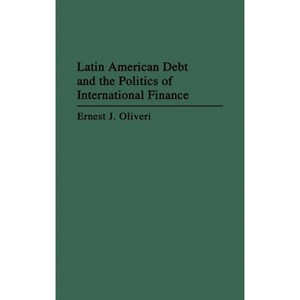
Latin American Debt and the Politics of International Finance - (Contributions in Drama and Theatre) by Ernest J Oliveri (Hardcover)
In Stock
Sponsored
About this item
Highlights
- The dynamics of the International Monetary Fund are examined here in terms of how the system coped in the 1980s with the crises resulting from events in Mexico, Brazil, and Argentina, the three most heavily indebted developing countries in the world.
- About the Author: ERNEST J. OLIVERI is currently teaching as an adjunct assistant professor at New York University.
- 256 Pages
- Business + Money Management, Public Finance
- Series Name: Contributions in Drama and Theatre
Description
About the Book
The dynamics of the International Monetary Fund are examined here in terms of how the system coped in the 1980s with the crises resulting from events in Mexico, Brazil, and Argentina, the three most heavily indebted developing countries in the world. Ernest J. Oliveri offers three case studies that demonstrate levels of cooperation and defection in the world of international finance. The Mexican case offers the richest example of cooperation by a Latin American borrower. At the other extreme is Brazil, which adamantly refused to recognize the legitimacy of the IMF as a participant in its economy. In between is Argentina, which took a hard line until 1985 but recently softened its resistance to international pressure. These three countries provide the reader with the widest possible scope of behavior within the confines of an interdependent world economy in crisis. In each of the studies under consideration, the primary independent variable is the system of inter-American finance itself. While Oliveri focuses on separate actors and their roles at different points during the crisis, the final considerations are how they relate to systemic maintenance, the threats they may pose to it, and their efforts to preserve it.
Oliveri observes that international finance in the 1970s was anarchic. By 1982, the system was ill-equipped to accommodate the serious stress caused by de facto defaults. What happens when a severe financial crisis threatens this precarious stability? Can the system's behavioral boundaries constrain short-term self-interested actions? The Latin American debt crisis provides such a challenge to the system. Oliveri finds that accommodation by players involves skillful, though capricious and arbitrary, coordination by creditors and borrowers; the IMF is not a manager of an international debt regime, but only one of its players. He concludes that adjustments have indeed been short-term and that at present no mechanism exists to coordinate this volatile system with stable long-term objectives. Latin American specialists, business managers, and political scientists will find this book provocative and informative reading.
Book Synopsis
The dynamics of the International Monetary Fund are examined here in terms of how the system coped in the 1980s with the crises resulting from events in Mexico, Brazil, and Argentina, the three most heavily indebted developing countries in the world. Ernest J. Oliveri offers three case studies that demonstrate levels of cooperation and defection in the world of international finance. The Mexican case offers the richest example of cooperation by a Latin American borrower. At the other extreme is Brazil, which adamantly refused to recognize the legitimacy of the IMF as a participant in its economy. In between is Argentina, which took a hard line until 1985 but recently softened its resistance to international pressure. These three countries provide the reader with the widest possible scope of behavior within the confines of an interdependent world economy in crisis. In each of the studies under consideration, the primary independent variable is the system of inter-American finance itself. While Oliveri focuses on separate actors and their roles at different points during the crisis, the final considerations are how they relate to systemic maintenance, the threats they may pose to it, and their efforts to preserve it.
Oliveri observes that international finance in the 1970s was anarchic. By 1982, the system was ill-equipped to accommodate the serious stress caused by de facto defaults. What happens when a severe financial crisis threatens this precarious stability? Can the system's behavioral boundaries constrain short-term self-interested actions? The Latin American debt crisis provides such a challenge to the system. Oliveri finds that accommodation by players involves skillful, though capricious and arbitrary, coordination by creditors and borrowers; the IMF is not a manager of an international debt regime, but only one of its players. He concludes that adjustments have indeed been short-term and that at present no mechanism exists to coordinate this volatile system with stable long-term objectives. Latin American specialists, business managers, and political scientists will find this book provocative and informative reading.Review Quotes
?Oliveri cogently and elegantly weaves a complex tapestry of the intricate relations among the three central actors of the 1980s debt crisis in Latin America: official institutions, debtors, and commerical banks. He challenges interpretations of the system of international finance as a regime with shared principles and rules and institutionalized decision making. This balanced and well-crafted explanation of the debt crisis and the lessons learned is strongly recommended. All levels.?-Choice
"Oliveri cogently and elegantly weaves a complex tapestry of the intricate relations among the three central actors of the 1980s debt crisis in Latin America: official institutions, debtors, and commerical banks. He challenges interpretations of the system of international finance as a regime with shared principles and rules and institutionalized decision making. This balanced and well-crafted explanation of the debt crisis and the lessons learned is strongly recommended. All levels."-Choice
About the Author
ERNEST J. OLIVERI is currently teaching as an adjunct assistant professor at New York University. He has taught at Connecticut College, St. Lawrence University, Fordham University, and with the Graduate Faculty of the New School for Social Research.Shipping details
Return details
Trending Non-Fiction






Discover more options