Target New ArrivalsGift Ideas for MomClothing, Shoes & AccessoriesHome & DecorKitchen & DiningOutdoor Living & GardenGroceryHousehold EssentialsBabyBeautyPersonal CareHealthWellnessLuggageSports & OutdoorsToysElectronicsVideo GamesMovies, Music & BooksSchool & Office SuppliesParty SuppliesGift IdeasGift CardsPetsUlta Beauty at TargetShop by CommunityTarget OpticalDealsClearanceTarget New ArrivalsSpring OutfitsGift Ideas for MomWomen’s Festival OutfitsTop DealsTarget Circle DealsWeekly AdShop Order PickupShop Same Day DeliveryRegistryRedCardTarget CircleFind Stores
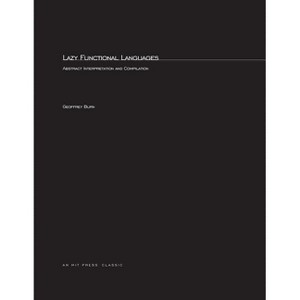
Lazy Functional Languages - (Research Monographs in Parallel and Distributed Computing) by  Geoffrey Burn (Paperback) - 1 of 1

Lazy Functional Languages - (Research Monographs in Parallel and Distributed Computing) by Geoffrey Burn (Paperback)

$35.49

In Stock

Free & easy returns

Free & easy returns

Return this item by mail or in store within 90 days for a full refund.
Eligible for registries and wish lists

About this item

Highlights

  • This book explores a subclass known as lazy functional languages, beginning with the theoretical issues and continuing through abstract interpretation and offering improved techniques for implementation.The class of programming languages commonly known as functional includes Lisp, Scheme, ML, and Miranda TM.
  • About the Author: Geoffrey Burn is Lecturer at Imperial College of Science, Technology, and Medicine, London.
  • 254 Pages
  • Computers + Internet, Programming
  • Series Name: Research Monographs in Parallel and Distributed Computing

Description


About the Book


This book explores a subclass known as lazy functional languages, beginning with the theoretical issues and continuing through abstract interpretation and offering improved techniques for implementation.


Book Synopsis


This book explores a subclass known as lazy functional languages, beginning with the theoretical issues and continuing through abstract interpretation and offering improved techniques for implementation.

The class of programming languages commonly known as functional includes Lisp, Scheme, ML, and Miranda TM. This book explores a subclass known as lazy functional languages, beginning with the theoretical issues and continuing through abstract interpretation and offering improved techniques for implementation. Now that advanced compiler technology has made it possible for lazy functional languages to compare favorably in run-time with more traditional languages such as C and Pascal, this monograph tackles problems of implementation such as time and memory overheads and restrictions on parallelism. Specifically, it describes a more efficient implementation model, the evaluation transformer model, that can be used when information is known about how functions use their arguments, develops a semantically sound analysis technique called abstract interpretation, which can determine this information, and shows how to use the information to compile more efficient code for sequential and parallel machines.

Contents
Introduction - Operational and Denotational Semantics of the Typed Lambda Calculus - A Framework for the Abstract Interpretation of Functional Languages - Some Example Abstract Interpretations - Evaluation Transformers - Implementing Functional Languages on Sequential and Parallel Machines - Relationship to Other Work - Epilogue - Appendixes: Additional Proofs - The Spineless G-Machine


About the Author


Geoffrey Burn is Lecturer at Imperial College of Science, Technology, and Medicine, London.

Dimensions (Overall): 9.6 Inches (H) x 6.75 Inches (W) x .54 Inches (D)
Weight: .87 Pounds
Suggested Age: 22 Years and Up
Number of Pages: 254
Genre: Computers + Internet
Sub-Genre: Programming
Series Title: Research Monographs in Parallel and Distributed Computing
Publisher: MIT Press
Theme: General
Format: Paperback
Author: Geoffrey Burn
Language: English
Street Date: August 28, 1991
TCIN: 1006377096
UPC: 9780262521604
Item Number (DPCI): 247-06-0281
Origin: Made in the USA or Imported
If the item details aren’t accurate or complete, we want to know about it.

Shipping details

Estimated ship dimensions: 0.54 inches length x 6.75 inches width x 9.6 inches height
Estimated ship weight: 0.87 pounds
We regret that this item cannot be shipped to PO Boxes.
This item cannot be shipped to the following locations: American Samoa (see also separate entry under AS), Guam (see also separate entry under GU), Northern Mariana Islands, Puerto Rico (see also separate entry under PR), United States Minor Outlying Islands, Virgin Islands, U.S., APO/FPO, Alaska, Hawaii

Return details

This item can be returned to any Target store or Target.com.
This item must be returned within 90 days of the date it was purchased in store, delivered to the guest, delivered by a Shipt shopper, or picked up by the guest.
See the return policy for complete information.

Q: What is the primary focus of the evaluation transformer model?

submitted by AI Shopping Assistant - 2 months ago
  • A: The evaluation transformer model focuses on improving the efficiency of lazy functional language implementations based on function argument usage.

    submitted byAI Shopping Assistant - 2 months ago
    Ai generated

Q: What programming languages are discussed as part of functional languages?

submitted by AI Shopping Assistant - 2 months ago
  • A: The book discusses functional programming languages such as Lisp, Scheme, ML, and Miranda TM.

    submitted byAI Shopping Assistant - 2 months ago
    Ai generated

Q: Who is the author of this research monograph?

submitted by AI Shopping Assistant - 2 months ago
  • A: The author is Geoffrey Burn, a lecturer at Imperial College of Science, Technology, and Medicine in London.

    submitted byAI Shopping Assistant - 2 months ago
    Ai generated

Q: What topics does the book cover regarding lazy functional languages?

submitted by AI Shopping Assistant - 2 months ago
  • A: The book covers theoretical issues, abstract interpretation, implementation techniques, and efficiency models for lazy functional languages.

    submitted byAI Shopping Assistant - 2 months ago
    Ai generated

Q: What is the main purpose of abstract interpretation in the book?

submitted by AI Shopping Assistant - 2 months ago
  • A: Abstract interpretation is developed to analyze how functions use their arguments, aiding in optimization for code compilation.

    submitted byAI Shopping Assistant - 2 months ago
    Ai generated

Additional product information and recommendations
Discover more options

Trending Computers & Technology Books

Get top deals, latest trends, and more.

Privacy policy