Sponsored
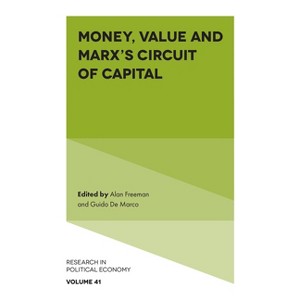
Money, Value and Marx's Circuit of Capital - (Research in Political Economy) by Alan Freeman & Guido de Marco (Hardcover)
Pre-order
Sponsored
About this item
Highlights
- The twelve papers collected in this volume of Research in Political Economy mark a new phase in the study of capitalism, centred on the reproduction of total social capital.
- About the Author: Alan Freeman is a former principal economist with the Greater London Authority and is now a research affiliate of the University of Manitoba, Canada.
- 280 Pages
- Business + Money Management, Economics
- Series Name: Research in Political Economy
Description
About the Book
The twelve papers collected in this volume mark a new phase in the study of capitalism, centred on the reproduction of total social capital. They address the widely felt need to reconnect political economy with real-world phenomena, including financial crises, long-term stagnation, poverty, inequality, and economic injustice.
Book Synopsis
The twelve papers collected in this volume of Research in Political Economy mark a new phase in the study of capitalism, centred on the reproduction of total social capital. They address the widely felt need to reconnect political economy with real-world phenomena, including financial crises, long-term stagnation, poverty, inequality, and economic injustice.
Seeking to renew pluralist dialogue among all currents critical of the dominant neoclassical paradigm--particularly those aiming to move beyond the equilibrium framework that permeates it--the volume offers important new insights into Marx's value theory. These constitute a significant addition to both the existing body of Marx studies and to a broader understanding of capitalist reproduction, accumulation, and the sources of their recurrent failures.
This shared engagement rests on the recognition that the study of the circuit of capital can shed fresh light on the fundamental concepts of money, price, value, and credit, and on their role in explaining capitalism's 'laws of motion' accumulation, historical origins, and reproduction itself. The volume thus advances critical debates and paves the way for future research on the dynamics of capitalist reproduction.
Review Quotes
Money, Value and Marx's Circuit of Capital is an indispensable intellectual resource which provides a critical alternative to the general equilibrium paradigm that has dominated economics for over a century. It brings together leading Marxist and heterodox scholars in an impressive effort to overcome the inability of mainstream theory to offer a scientifically sound explanation of phenomena that are part and parcel of the realities of capitalism, such as its recurrent crises, inequality and stagnation. To do so, these contributions shift the focus of economic analysis to fundamental yet undeservedly under-researched themes which Marx studies in Volume II of Capital: the circuit of capital, its turnover and the reproduction of the total social capital.
The different chapters thus re-examine value, money and other economic categories in light of the intrinsically sequential and temporal motion which characterises the contradictory dynamics of capital´s expanded reproduction. Moreover, not only do the authors undertake this endeavour with scholarly rigour, but they also establish a genuinely pluralist and fruitful dialogue between Marxist political economy and post-Keynesian, circuitist, and institutionalist traditions.
I firmly believe that this collection of essays will become a point of reference for anyone seeking a critical understanding of the workings of contemporary capitalism. Indeed, there is no doubt that Money, Value and Marx's Circuit of Capital will turn into essential reading for economists and other social scientists who are dissatisfied with the theoretical irrelevance of the neoclassical paradigm for the comprehension of the present-day crisis of modern society.
--Guido Starosta, Department of Economics and Business, National University of Quilmes (Argentina) & National Research Council for Scientific and Technical Research (CONICET)Money, Value, and Marx's Circuit of Capital is that fortunate work that re-links the theory of value to experience. By placing the reproduction of total social capital and requiring money, time, and turnover as constitutive rather than as a residuum, the book decisively broke with sterile single-period equilibria. Throughout the collection of works, there is one steady presence who finds readers macro-monetary analyses of the labor theory of value, careful attention to turnover and continuous-time reproduction, and crisp bridges to stock-flow consistent thought. The prize is a pluralist research agenda that is coherent and explains crises, stagnation, and the uneven predominance of finance without stripping class or history. Regardless of where one begins in Marxian, post-Keynesian, or institutional schools of thought, the book provides analytical concepts that really explain our era's chronic imbalances. It deserves to be a touchstone for scholars and policymakers who need political economy to stand up to hard reality tests.
--Anthony William Donald Anastasi, Ph.D."Those who consider the autonomization [Verselbstständigung] of value as a mere abstraction forget that the movement of industrial capital is this abstraction in action [Abstraktion in actu]", writes Marx analyzing the three forms of the circuit of industrial capital: the circuit of money-capital, of productive capital, and of commodity-capital.
What does it mean that capital is a "real abstraction"? It means that capital is the subject that creates its own objectivity or, in other words, that capital is the economic and social logic that produces and structures its own reality. In this epistemological or dialectical framework, it is not possible to have, on the one hand, a theory based on the idea of equilibrium, and, on the other hand, an economic and social reality in which crises (financial, economic, and social crises) occur as a periodic phenomenon and, in many cases, as a long-term stagnation.
This divorce of economic theory and real world-phenomena concerns not only the non-Marxist equilibrium theories, but also, paradoxically, some Marxist approaches as well, including the Bortkiewicz-Sweezy-Morishima interpretation. Focusing on the reproduction of capital, this volume of Research in Political Economy, entitled Money, Value and Marx's Circuit of Capital, edited by Alan Freeman and Guido De Marko, presents a pluralist contribution with a clear and concrete aim: "to identify those flaws in those basic concepts that are responsible for its empirical failures", as the editors point out in their Introduction.
--Stavros Tombazos, University of CyprusCapital is not a thing, but a social relationship of production on which the process of valorization is based in a monetary economy of production such as capitalism. The contributions collected in this special issue of Research in Political Economy show, first and foremost, the topicality and relevance of Marx's critique of political economy for the present day. This should come as no surprise: even at the highest levels of economic theory, Marx's ideas are impossible to shake off. Just think of the trend toward secular stagnation proposed by Larry Summers, the trend toward growing inequality in the distribution of wealth that Thomas Piketty presented in his famous book "Capital in the Twenty-First Century", and the great attention that the international financial elite has paid to the centralization of capital since the Great Recession. The contributions you will read focus on money, value, and Marx's circuit of capital and are above all testimony to the plurality of positions reflected upon by critical economists of various backgrounds around the world, not necessarily Marxists: from monetary circuit theorists to scholars of structural economic dynamics, from institutionalists to diehards of the theme of the transformation of values into prices, to those who strive to bring economics into dialogue with political philosophy.
--Stefano Lucarelli, Full Professor in Economic Policy, University of BergamoFor many years, Marx's theory of value and exploitation has been debated, both in terms of its descriptive and explanatory power (i.e., can labor values explain prices) and in terms of its conceptual set-up (how can we define value in relation to production and circulation). The Sraffian part of the debate is stalemated between the Steedman-Roemer critique of redundancy and the Okishio-Morishima-Shaikh iterative solutions, eventually focusing more on the technical and empirical aspects in pursuit of the first question.
At the same time, the Rubinian and the Althusserian strands focused on the second, yielding serious questions about the form of value and its relation to money and labour. The volume at hand, collecting contributions from some of the focal scholars of these debates (like Fred Moseley, Ricardo Bellofiore and Andrew Kliman), attempts to bridge the gap between the quantitative advantages of the former and the deep methodological considerations of the latter in a worthy attempt to revive the discussion around value.
By doing so, they expand from the theory of value to the theory of money, the definition (and measurement) of capital, the interplay between distribution and growth, the emergence of crises, etc. Despite any possible doubts or arguments with these contributions, the revival of these discussions from a Marxist perspective is more than important and we should all hope that more such research will follow.
--Nikolaos Chatzarikis, New School for Social ResearchFor much too long, too much of what claims to be Marxian economics has been devoted to the sterile manipulation of simultaneous equation systems, often in pursuit of a so-called 'fundamental Marxian theorem', quite forgetting that Marx's fundamental concerns were quite different. As he clearly stated, his 'ultimate aim' in Capital was to 'lay bare the economic law of motion of modern society'. It is high time scholarship shifted its focus to the dynamics of capitalism, to understanding the root causes of its instability, growing inequality and current stagnation. This timely collection points the way.
--Matthew Warburton, Independent ResearcherThe crisis of the 1970s led to a growing critique of capitalism and a resurgence of interest in Marx's work. This return to Marx was quite fruitful in many areas, but this was not the case with political economy. Here, the works of Samuelson, Sraffa, and Sweezy, among others, had supposedly shown that Marx's economic theory was logically inconsistent and empirically irrelevant to analyzing modern capitalism. Predictably, the focus of discussions within political economy shifted towards the 'transformation problem' and the 'law of the tendency of the rate of profit to decline', and away from employing Marx's theory to analyze real-world phenomena. However, these results were obtained by substituting Marx's temporal methodology for a general equilibrium one. Therefore, an inherently dynamic theory was substituted by a static one. However, as demonstrated by the Temporal Single System Interpretation (TSSI), which employs Marx's own temporal methodology, the criticisms of Marx's economic theory are shown to be unfounded. That is to say, contrary to Marx's critics, it has been demonstrated that his economic theory is, after all, logically consistent and relevant to understanding modern capitalism.
One of the consequences of the abandonment of Marx's dynamic theory was that the crucial concept of the circuit of capital remained largely outside political economy. One of the most significant contributions of this book is to bring back this crucial Marxian concept to the forefront. By doing this, this book is a much-needed and welcome contribution to the development of political economy as a means to understand real-world phenomena. In my opinion, it is a must-read.
--Eduardo Maldonado-Filho, Professor of Economics at PPGE/UFRGS (retired)The 41st volume of Research in Political Economy, Money, Value, and Capital: Rethinking Marxian Political Economy, represents a major contribution to the renewal of critical political economy. In an era of capitalism defined by the growing importance of finance and persistent systemic instability, this collection of essays revisits the foundational categories of value, money, and capital circulation with remarkable analytical clarity and contemporary relevance.
Featuring pioneering contributions by leading scholars, the volume engages the evolving logics of twenty-first-century capitalism with exceptional rigor and theoretical depth. From an ambitious proposal for a General Theory of Value, Money, and the State to incisive refinements of the theory of prices of production, from a novel conception of crisis as "arrhythmia" to a penetrating critique of "technofeudalism" theses, the book combines intellectual boldness with methodological precision
By rigorously re-examining fundamental debates, such as Grossman's breakdown theory to the ever-present transformation problem, the contributors simultaneously sharpen classical frameworks and chart bold new trajectories for research. Synthesizing core value theory with cutting-edge analyses of finance, institutions and the role of the state, this volume powerfully demonstrates the enduring critical capacity of Marx's political economy. It is an indispensable resource for any scholar or student seeking to decipher the dynamics of accumulation, crisis, and class struggle in our time.
--Lefteris Tsoulfidis, University of MacedoniaThis book presents the latest development in the Temporal Single System Interpretation (TSSI), widely regarded as one of the most epochal theoretical innovations in the history of the Marxian critique of political economy. While previous TSSI contributions focused mainly on the so-called 'transformation problem' in Volume 3 of Marx's Capital, the authors of this book build upon the dynamic non-equilibrium approach unique to TSSI. They newly expand this framework by actively incorporating Marx's theory of circuit of capital from Volume 2 of Capital--a theory largely overlooked by traditional Marxist economics. They also integrate the 'Stock-Flow Consistency' approach implied by this theory and related research from Post-Keynesian economics. Furthermore, the authors apply this expanded framework to diverse theoretical and empirical analyses of 21st-century capitalism's contradictions, such as the financialization, 2008 global crisis, and global polarization. This book demonstrates that, in contrast to both neoclassical mainstream economics and traditional Marxist economics (e.g., Soviet political economics, Neo-Ricardian (Sraffian) economics, etc.), which share a common fatal flaw in their reliance on static equilibrium models and have thus failed comprehensively after the 2008 global crisis, the Marxian critique of political economy--revived through the TSSI's dynamic non-equilibrium approach--remains a valid alternative economic theory.
--Seongjin Jeong, Gyeongsang National UniversityThis collection offers a wide-ranging effort to reopen foundational questions in Marxian political economy. Readers interested in debates on the reproduction of capitalism and the circuit of capital will find much here to engage with.
--Junshang Liang, School of Economics, Nankai UniversityThis important volume takes up the challenge posed by Volume II of Marx's Capital -- to elaborate in today's circumstances the conditions for the reproduction and growth of the capitalist economy, and the consequences when reproduction falters: financial crisis, stagnation, poverty, inequality and injustice.
The international team of contributors offer new insights into old controversies derived from Marx's analysis of capital's endless circuits between money, production and commodity. Among these I found particularly valuable the discussions of (allegedly) 'inevitable' breakdown and of the inherent co-ordination problems of disproportionate growth and unequal turnover time.
--Julian Wells, Department of Economic HistoryThis volume is a remarkable contribution to the continuing renewal of Marxian political economy in the twenty-first century. Bringing together an impressive group of scholars, it revisits Marx's theory of value, money, and the circuit of capital with both analytical rigor and historical depth. Each chapter engages critically with key figures, from Sraffa and Grossman to Pasinetti and Foley, while advancing original perspectives that connect Marx's theoretical insights to contemporary capitalism, including financialization, the rise of shadow banking, and the contradictions of neoliberal accumulation.
What makes this book stand out is its intellectual coherence across diverse contributions. The chapters share a common commitment to re-establishing the unity between monetary and real processes, between theory and empirical reality, or between the logic of value and the instability of modern finance, all through the lens of the circuit of capital. In doing so, the volume not only reinterprets classical debates such as the transformation problem and the organic composition of capital but also demonstrates their continuing relevance for understanding crises in our financialized world.
Scholars, students, and policymakers interested in political economy, heterodox macroeconomics, or the dynamics of the capitalist system will find in this volume visions that transcend capitalism and the neoliberal paradigm. It is a timely and indispensable resource for anyone seeking to understand how the circuit of capital continues to shape and destabilize the global economy today.
--Hyun Woong Park, Denison University, Department of EconomicsThis volume of Research in Political Economy marks a desirable crucial redirection in critical political economy by concentrating on the reproduction of total social capital. Challenging the dominance of the equilibrium paradigm, this collection provides forensic inquiry into the foundational concepts of money, price, value, and credit. This inquiry constitutes a scientifically innovative set of chapters primarily due to its methodological focus on overcoming the dominant equilibrium paradigm. There is still a long way to go before the various critiques presented here can constitute both a unified vision of Marx's scientific work and a step forward toward unifying the vast panorama of critiques of neoclassical theory. However, the volume constitutes an in-depth attempt to define certain areas of criticism, thus laying the foundations for further reflection and criticism of the paradigm that still dominates due to its inability to explain the normal movements of the economy during the capitalist era.
--Gabriele Serafini, Niccolò Cusano University, Rome, ItalyThis volume represents a significant step forward in the research on Marx's Critique of Political Economy. The contributions deal with key technical aspects, moving beyond the oversimplified version of Marx's work that prevailed in the 20th century. The understanding of capitalism as a dynamic stock-flow system of both commodities and money overcomes generations of flows- and barter-economy models in which Marx's hypotheses have been typically confined. Different interpretative traditions enrich the volume and show an unusual convergence towards a more complex and nuanced appraisal of Marx's understanding of capitalism. Theoretical pluralism is key in times in which the darkest impulses of capitalism, both economic and political, need to be contained.
--Alejandro Ramos MartinezAbout the Author
Alan Freeman is a former principal economist with the Greater London Authority and is now a research affiliate of the University of Manitoba, Canada.
Guido De Marco is an independent researcher for ARELA (Association for the Redistribution of Labor) in Rome, Italy.Shipping details
Return details
Frequently bought together


Trending Non-Fiction