Sponsored
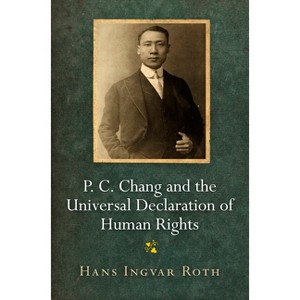
P. C. Chang and the Universal Declaration of Human Rights - (Pennsylvania Studies in Human Rights) by Hans Ingvar Roth (Paperback)
$39.95
In Stock
Eligible for registries and wish lists
Sponsored
About this item
Highlights
- The Universal Declaration of Human Rights is one of the world's best-known and most translated documents.
- About the Author: Hans Ingvar Roth is Professor of Human Rights at Stockholm University.
- 320 Pages
- Biography + Autobiography, Lawyers & Judges
- Series Name: Pennsylvania Studies in Human Rights
Description
Book Synopsis
The Universal Declaration of Human Rights is one of the world's best-known and most translated documents. When it was presented to the United Nations General Assembly in December in 1948, Eleanor Roosevelt, chair of the writing group, called it a new "Magna Carta for all mankind." The passage of time has shown Roosevelt to have been largely correct in her prediction as to the declaration's importance. No other document in the world today can claim a comparable standing in the international community.
Roosevelt and French legal expert René Cassin have often been represented as the principal authors of the declaration. But in fact, it resulted from a collaborative effort involving a number of individuals in different capacities. One of the declaration's most important authors was the vice chairman of the Human Rights Commission, Peng Chun Chang (1892-1957), a Chinese diplomat and philosopher whose contribution has been the focus of growing attention in recent years. Indeed, it is Chang who deserves the credit for the universality and religious ecumenism that are now regarded as the declaration's defining features. Despite this, Chang's extraordinary contribution has been overlooked by historians. Peng Chun Chang was a modern-day Renaissance man--teacher, scholar, university chancellor, playwright, diplomat, and politician. A true cosmopolitan, he was deeply involved in the cultural exchange between East and West, and the dramatic events of his life left a profound mark on his intellectual and political work. P. C. Chang and the Universal Declaration of Human Rights is the first biography of this extraordinary actor on the world stage, who belonged to the same generation as Mao Zedong and Chiang Kai-shek. Drawing on previously unknown sources, it casts new light on Chang's multifaceted life and involvement with one of modern history's most important documents.Review Quotes
"[A]n excellent book that made accessible an otherwise arcane subject to the general reader and specialist alike. Roth's book is a landmark study in its field and deserves a broad readership."-- "Connections"
"A fine and deeply engaging book. P. C. Chang and the Universal Declaration of Human Rights is quite the page turner, with a unique and novel angle into a much-researched topic, which is timely, both among practitioners and scholars, and Hans Ingvar Roth's approach fits well with the new generation of transnational historians of human rights."-- "Thomas Gammeltoft-Hansen, Raoul Wallenberg Institute, Sweden"
"In this unprecedented work, Hans Ingvar Roth casts a spotlight on the life and times of Chinese philosopher Peng Chun Chang, who has remained in the shadows too long-in spite of his signal contributions to the making of the Universal Declaration of Human Rights (1948). Gathering much new evidence and insisting on Chang's relevance even today to a movement that seeks cross-cultural and global purchase, Roth has made a noteworthy contribution to the history and theory of human rights."-- "Samuel Moyn, author of Not Enough: Human Rights in an Unequal World"
"This volume is an important addition to the literature on the history of the United Nations' Universal Declaration of Human Rights (UDHR) and also a fascinating biography of the complex, multitalented, cosmopolitan P. C. Chang (1892-1957)."-- "Choice"
About the Author
Hans Ingvar Roth is Professor of Human Rights at Stockholm University.Dimensions (Overall): 9.0 Inches (H) x 6.0 Inches (W) x .72 Inches (D)
Weight: 1.04 Pounds
Suggested Age: 22 Years and Up
Number of Pages: 320
Genre: Biography + Autobiography
Sub-Genre: Lawyers & Judges
Series Title: Pennsylvania Studies in Human Rights
Publisher: University of Pennsylvania Press
Format: Paperback
Author: Hans Ingvar Roth
Language: English
Street Date: August 8, 2023
TCIN: 1008498905
UPC: 9781512825541
Item Number (DPCI): 247-27-8557
Origin: Made in the USA or Imported
If the item details aren’t accurate or complete, we want to know about it.
Shipping details
Estimated ship dimensions: 0.72 inches length x 6 inches width x 9 inches height
Estimated ship weight: 1.04 pounds
We regret that this item cannot be shipped to PO Boxes.
This item cannot be shipped to the following locations: American Samoa (see also separate entry under AS), Guam (see also separate entry under GU), Northern Mariana Islands, Puerto Rico (see also separate entry under PR), United States Minor Outlying Islands, Virgin Islands, U.S., APO/FPO
Return details
This item can be returned to any Target store or Target.com.
This item must be returned within 90 days of the date it was purchased in store, shipped, delivered by a Shipt shopper, or made ready for pickup.
See the return policy for complete information.
Trending Non-Fiction



$18.28
was $19.58 New lower price
4.7 out of 5 stars with 17 ratings



Discover more options
$18.28
was $19.58 New lower price
4.7 out of 5 stars with 17 ratings