Sponsored
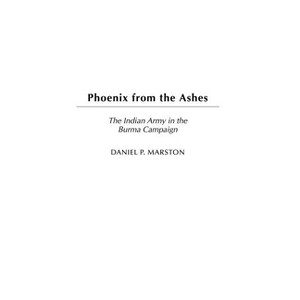
Phoenix from the Ashes - by Daniel Marston (Hardcover)
In Stock
Sponsored
About this item
Highlights
- In June 1942 the Indian Army suffered a major defeat at the hands of the Japanese Army and subsequently endured its longest retreat ever.
- About the Author: DANIEL P. MARSTON is Senior Lecturer in War Studies at the Royal Military Academy, Sandhurst and a Fellow of the Royal Historical Society.
- 312 Pages
- History, Europe
Description
About the Book
In June 1942 the Indian Army suffered a major defeat at the hands of the Japanese Army and subsequently endured its longest retreat ever. The Japanese forces had proved more mobile in tactics and more motivated and seasoned in warfare. As a result, the Indian Army assessed its mistakes to determine what changes were needed to rebuild itself into a more capable fighting force. Marston looks at the Indian Army as a reform-minded organization, one that was able to take lessons from this major defeat, implement the necessary reforms, and ultimately defeat the Japanese soundly in 1945.
Army leaders instigated analysis of the defeat at all levels of command. Innovations in operational procedure, organization, and tactics were compared, discussed, then implemented. An ongoing reassessment continued both during and after subsequent engagements. By analyzing the changes made in tactical doctrine, reinforcement procedure, Indianization of the officer corps, and the quality of nonmartial race units, Marston demonstrates that the Indian Army of 1945 was vastly different from that of 1939. The Indian Army's transformation into a highly professional force contradicts the commonly held belief that it was too conservative a force to reform itself thoroughly in the face of new challenges.
Book Synopsis
In June 1942 the Indian Army suffered a major defeat at the hands of the Japanese Army and subsequently endured its longest retreat ever. The Japanese forces had proved more mobile in tactics and more motivated and seasoned in warfare. As a result, the Indian Army assessed its mistakes to determine what changes were needed to rebuild itself into a more capable fighting force. Marston looks at the Indian Army as a reform-minded organization, one that was able to take lessons from this major defeat, implement the necessary reforms, and ultimately defeat the Japanese soundly in 1945.
Army leaders instigated analysis of the defeat at all levels of command. Innovations in operational procedure, organization, and tactics were compared, discussed, then implemented. An ongoing reassessment continued both during and after subsequent engagements. By analyzing the changes made in tactical doctrine, reinforcement procedure, Indianization of the officer corps, and the quality of nonmartial race units, Marston demonstrates that the Indian Army of 1945 was vastly different from that of 1939. The Indian Army's transformation into a highly professional force contradicts the commonly held belief that it was too conservative a force to reform itself thoroughly in the face of new challenges.Review Quotes
"An innovative account of the Indian army in the closing years of the British raj, which focuses on the internal dynamics of the army and its capacity as a social institution to adapt and to learn from its mistakes and its environment, as much as on its record in war. It paves the way for deeper understanding of the nature of the army in independent India. A most valuable contribution to a new kind of military history."-Professor Judith Brown, Beit Professor of Imperial and Commonwealth History University of Oxford
"Daniel Marston has produced a superb study of how the defeated British and Indian Armies learned from their experience in 1942 and regenerated a force capable of taking the offensive and crushing their Japanese opponents. Marston illuminates the key role of young Indian soldiers in achieving this end, thereby laying the foundation of the new, post-independence Indian Army. He excels in describing and analysing individual experience in jungle warfare through vivid interviews with survivors. His book is an exciting read for both specialists and nonspecialists in the study of warfare."-Robert O'Neill Chichele Professor of the History of War Emeritus University of Oxford
"Impressive, and very scholarly. Interviews with veterans complement his thorough archival research. His book adds considerably to our understanding of the Indian Army's achievements in the Burma campaigns."-David Omissi author of The Sepoy and the Raj
"This is a fascinating book, filled with detail, and probably not for those who like their history in broad strokes. It is supremely well researched, from both documentary sources and interviews; it is perhaps the last time such a book could have been written, as fewer and fewer witnesses are left to provide that richness which is so evident here....[a]ny interested in the Burma Campaign will certainly find this book of value; more importantly I would recommend it to any serving officer responsible for training, lessons, or analysis of operations in today's army. In the space of two years the Indian Army underwent a genuine and comprehensive transformation that mocks contemporary uses of the term. One hopes that the British army can be as openly self-critical and ready to learn as the Indian Army of 1942-1945."-British Army Review
?[A] detailed and scholarly account of the development of the Indian Army from a small professional army orientated towards the defence of the North West Frontier and internal security, to a large, modern fighting force.?-"Piffer" Residual Committee Newsletter
?[A] valuable, deeply researched amd scholarly study of th elittle known creation of a great army....an essential reference book for those interested in the remarkable last days of the British/Indian army, and for historians interested in that army's subsequent impact on politics in the sub-continent.?-Dekho! Journal of the Burma Star Association
?[I]t is a pleasure to see Phoenix from the Ashes.... provide[s] a unique insight into this little-known aspect of the last war.?-The Bulletin of the Military Historical Society
?Phoenix from the Ashes succeeds admirably in analyzing the evolution of the Indian Army, and it's a worthy addition to any WWII library.?-Stone & Stone
?This is a fascinating book, filled with detail, and probably not for those who like their history in broad strokes. It is supremely well researched, from both documentary sources and interviews; it is perhaps the last time such a book could have been written, as fewer and fewer witnesses are left to provide that richness which is so evident here....[a]ny interested in the Burma Campaign will certainly find this book of value; more importantly I would recommend it to any serving officer responsible for training, lessons, or analysis of operations in today's army. In the space of two years the Indian Army underwent a genuine and comprehensive transformation that mocks contemporary uses of the term. One hopes that the British army can be as openly self-critical and ready to learn as the Indian Army of 1942-1945.?-British Army Review
"ÝA¨ detailed and scholarly account of the development of the Indian Army from a small professional army orientated towards the defence of the North West Frontier and internal security, to a large, modern fighting force."-"Piffer" Residual Committee Newsletter
"ÝA¨ valuable, deeply researched amd scholarly study of th elittle known creation of a great army....an essential reference book for those interested in the remarkable last days of the British/Indian army, and for historians interested in that army's subsequent impact on politics in the sub-continent."-Dekho! Journal of the Burma Star Association
"ÝI¨t is a pleasure to see Phoenix from the Ashes.... provideÝs¨ a unique insight into this little-known aspect of the last war."-The Bulletin of the Military Historical Society
"[A] detailed and scholarly account of the development of the Indian Army from a small professional army orientated towards the defence of the North West Frontier and internal security, to a large, modern fighting force."-"Piffer" Residual Committee Newsletter
"[A] valuable, deeply researched amd scholarly study of th elittle known creation of a great army....an essential reference book for those interested in the remarkable last days of the British/Indian army, and for historians interested in that army's subsequent impact on politics in the sub-continent."-Dekho! Journal of the Burma Star Association
"[I]t is a pleasure to see Phoenix from the Ashes.... provide[s] a unique insight into this little-known aspect of the last war."-The Bulletin of the Military Historical Society
"Phoenix from the Ashes succeeds admirably in analyzing the evolution of the Indian Army, and it's a worthy addition to any WWII library."-Stone & Stone
About the Author
DANIEL P. MARSTON is Senior Lecturer in War Studies at the Royal Military Academy, Sandhurst and a Fellow of the Royal Historical Society. He was the Beit Senior Research Scholar and the General D.K. Palit Fellow at Balliol College, Oxford.Shipping details
Return details
Trending Non-Fiction






Discover more options