Sponsored
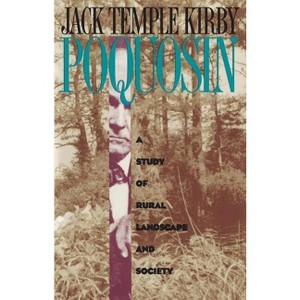
Poquosin - (Studies in Rural Culture) by Jack Temple Kirby (Paperback)
In Stock
Sponsored
About this item
Highlights
- Jack Temple Kirby charts the history of the low country between the James River in Virginia and Albemarle Sound in North Carolina.
- About the Author: Jack Temple Kirby is W. E. Smith Professor of History at Miami University and editor of the series Studies in Rural Culture.
- 320 Pages
- Business + Money Management, Real Estate
- Series Name: Studies in Rural Culture
Description
About the Book
Poquosin: A Study of Rural Landscape and SocietyBook Synopsis
Jack Temple Kirby charts the history of the low country between the James River in Virginia and Albemarle Sound in North Carolina. The Algonquian word for this country, which means 'swamp-on-a-hill, ' was transliterated as 'poquosin' by seventeenth-century English settlers. Interweaving social, political, economic, and military history with the story of the landscape, Kirby shows how Native American, African, and European peoples have adapted to and modified this Tidewater area in the nearly four hundred years since the arrival of Europeans. Kirby argues that European settlement created a lasting division of the region into two distinct zones often in conflict with each other: the cosmopolitan coastal area, open to markets, wealth, and power because of its proximity to navigable rivers and sounds, and a more isolated hinterland, whose people and their way of life were gradually -- and grudgingly -- subjugated by railroads, canals, and war. Kirby's wide-ranging analysis of the evolving interaction between humans and the landscape offers a unique perspective on familiar historical subjects, including slavery, Nat Turner's rebellion, the Civil War, agricultural modernization, and urbanization.From the Back Cover
In this unique work, Jack Temple Kirby charts the history of the low country between the James River in Virginia and Albemarle Sound in North Carolina.Review Quotes
"Poquosin has created a genre for itself, weaving social, economic, and political history into a chronicle of the way human beings and landscape changed, to be in turn changed by, each other. Kirby's prose is masterful, moving with ease between poetry, scientific directness, dry humor, and the unpretentious telling of good stories." -- Barbara J. Fields, Columbia University
"A charming book that fuses scholarship to art." -- Journal of Southern History
"A thoroughly referenced, entertaining, and thought-provoking work." -- CHOICE
"An ambitious environmental history. . . . An important and valuable book for historians, both public and academic." -- Public Historian
"Intriguing and highly readable. . . . Will be welcomed by all who seek to understand the way life was and is in this unique part of the American South." -- American Historical Review
"Jack Kirby has written a beautiful, enjoyable, and valuable study about a little-known part of America. In so doing, he vividly illustrates the powerful but often overlooked connections among land, topography, and water in the shaping of human society. This is a fine work and highly recommended to all with any interest in environmental history." -- Journal of American History
"This is ecological history with verve. . . . A human geography of a complex region." -- Agricultural History
About the Author
Jack Temple Kirby is W. E. Smith Professor of History at Miami University and editor of the series Studies in Rural Culture. His books include Media-Made Dixie: The South in the American Imagination and Rural Worlds Lost: The American South, 1920-1960.
Shipping details
Return details
Frequently bought together






Trending Non-Fiction






Discover more options