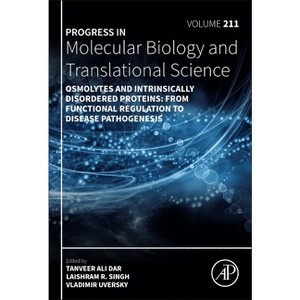
Osmolytes and Intrinsically Disordered Proteins: From Functional Regulation to Disease Pathogenesis, Volume 112 delves into the fascinating interplay between osmolytes and intrinsically disordered proteins (IDPs), exploring their pivotal roles in cellular function and disease mechanisms.
312 Pages
Science, Life Sciences
Series Name: Progress in Molecular Biology and Translational Science
Description
Book Synopsis
Osmolytes and Intrinsically Disordered Proteins: From Functional Regulation to Disease Pathogenesis, Volume 112 delves into the fascinating interplay between osmolytes and intrinsically disordered proteins (IDPs), exploring their pivotal roles in cellular function and disease mechanisms. This volume brings together experts to present cutting-edge research on how osmolytes regulate functional behavior of IDPs and ensure cellular stability and adaptability under stress conditions. Specific chapters cover Functional diversity of IDPs and their structural heterogeneity: Protein structure-function continuum, Osmolytes as structure-function regulators of intrinsically disordered casein, Synergism of the effects of osmolytes and crowders on structure and function of IDPs/IDRs: The natural habitat, and more. Additional chapters delve into Osmolyte-IDP Interactions during Desiccation, Modulation of aggregation/fibrillation propensity of IDPs by osmolytes, Osmolytes in modulating the structural and functional integrity of α-synuclein: a study based on Parkinson's disease, Regulation of the structural dynamics, aggregation, and pathogenicity of polyQ-expanded Huntingtin by osmolytes, Aggregation and inhibitory strategies of amyloid fibrillation, and much more.
Dimensions (Overall): 9.18 Inches (H) x 6.38 Inches (W) x .85 Inches (D)
Weight: 1.39 Pounds
Suggested Age: 22 Years and Up
Number of Pages: 312
Genre: Science
Sub-Genre: Life Sciences
Series Title: Progress in Molecular Biology and Translational Science
Publisher: Academic Press
Theme: Molecular Biology
Format: Hardcover
Language: English
Street Date: May 22, 2025
TCIN: 1001845676
UPC: 9780443293207
Item Number (DPCI): 247-11-9235
Origin: Made in the USA or Imported
If the item details aren’t accurate or complete, we want to know about it.
Shipping details
Estimated ship dimensions: 0.85 inches length x 6.38 inches width x 9.18 inches height
Estimated ship weight: 1.39 pounds
We regret that this item cannot be shipped to PO Boxes.
This item cannot be shipped to the following locations: American Samoa (see also separate entry under AS), Guam (see also separate entry under GU), Northern Mariana Islands, Puerto Rico (see also separate entry under PR), United States Minor Outlying Islands, Virgin Islands, U.S., APO/FPO, Alaska, Hawaii
Return details
This item can be returned to any Target store or Target.com.
This item must be returned within 90 days of the date it was purchased in store, delivered to the guest, delivered by a Shipt shopper, or picked up by the guest.
A: The volume features research from various experts in the field of molecular biology and translational science.
submitted byAI Shopping Assistant - 27 days ago
Ai generated
Q: What topics are covered regarding intrinsically disordered proteins?
submitted by AI Shopping Assistant - 27 days ago
A: Topics include structural heterogeneity, aggregation propensity, and the modulation of functions by osmolytes.
submitted byAI Shopping Assistant - 27 days ago
Ai generated
Q: What is the intended audience for this book?
submitted by AI Shopping Assistant - 27 days ago
A: The book is suggested for readers aged 22 years and up, particularly those interested in life sciences.
submitted byAI Shopping Assistant - 27 days ago
Ai generated
Q: What details are provided about the book's format?
submitted by AI Shopping Assistant - 27 days ago
A: It is published in hardcover, contains 312 pages, and is written in English.
submitted byAI Shopping Assistant - 27 days ago
Ai generated
Q: What is the primary focus of the book?
submitted by AI Shopping Assistant - 27 days ago
A: The book explores the interplay between osmolytes and intrinsically disordered proteins, emphasizing their roles in cellular function and disease mechanisms.