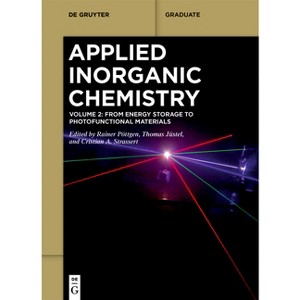
Many elements and inorganic compounds play an extraordinary role in daily life for numerous applications, e. g., construction materials, inorganic pigments, inorganic coatings, steel, glass, technical gases, energy storage and conversion materials, fertilizers, homogeneous and heterogeneous catalysts, photofunctional materials, semiconductors, superconductors, soft- and hard magnets, technical ceramics, hard materials, or biomedical and bioactive materials.
About the Author: Rainer Pöttgen and Cristian A. Strassert, U Münster, Münster, Germany; Thomas Jüstel, University of Applied Sciences, Münster, Germany.
525 Pages
Science, Chemistry
Series Name: de Gruyter Textbook
Description
About the Book
This work provides the broad range of applications of inorganic compounds. Due to their well defined properties they play an important role in many fields either on a large scale in our daily life or as niche products. Experts from industry and acad
Book Synopsis
Many elements and inorganic compounds play an extraordinary role in daily life for numerous applications, e. g., construction materials, inorganic pigments, inorganic coatings, steel, glass, technical gases, energy storage and conversion materials, fertilizers, homogeneous and heterogeneous catalysts, photofunctional materials, semiconductors, superconductors, soft- and hard magnets, technical ceramics, hard materials, or biomedical and bioactive materials. The present book is written by experienced authors who give a comprehensive overview on the many chemical and physico-chemical aspects related to application of inorganic compounds and materials in order to introduce senior undergraduate and postgraduate students (chemists, physicists, materials scientists, engineers) into this broad field.
Volume 2 discusses energy storage, ionic solids, catalytic materials and photofunctional materials.
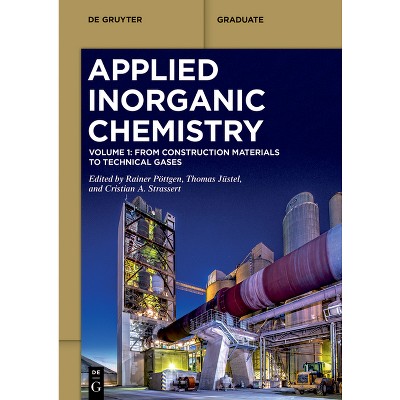
Vol. 1. From Construction Materials to Technical Gases.
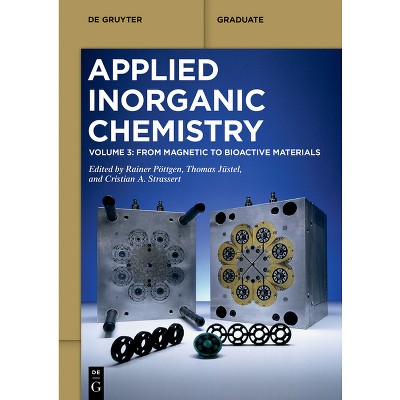
Vol. 3. From Magnetic to Bioactive Materials.
About the Author
Rainer Pöttgen and Cristian A. Strassert, U Münster, Münster, Germany; Thomas Jüstel, University of Applied Sciences, Münster, Germany.
Dimensions (Overall): 9.61 Inches (H) x 6.69 Inches (W) x 1.06 Inches (D)
Weight: 1.83 Pounds
Suggested Age: 22 Years and Up
Number of Pages: 525
Genre: Science
Sub-Genre: Chemistry
Series Title: De Gruyter Textbook
Publisher: De Gruyter
Theme: Inorganic
Format: Paperback
Author: Rainer Pöttgen & Thomas Jüstel & Cristian A Strassert
Language: English
Street Date: December 5, 2022
TCIN: 1003469834
UPC: 9783110798784
Item Number (DPCI): 247-18-8158
Origin: Made in the USA or Imported
If the item details aren’t accurate or complete, we want to know about it.
Shipping details
Estimated ship dimensions: 1.06 inches length x 6.69 inches width x 9.61 inches height
Estimated ship weight: 1.83 pounds
We regret that this item cannot be shipped to PO Boxes.
This item cannot be shipped to the following locations: American Samoa (see also separate entry under AS), Guam (see also separate entry under GU), Northern Mariana Islands, Puerto Rico (see also separate entry under PR), United States Minor Outlying Islands, Virgin Islands, U.S., APO/FPO, Alaska, Hawaii
Return details
This item can be returned to any Target store or Target.com.
This item must be returned within 90 days of the date it was purchased in store, delivered to the guest, delivered by a Shipt shopper, or picked up by the guest.
Q: What is the suggested age for readers of this textbook?
submitted by AI Shopping Assistant - 27 days ago
A: The suggested age for readers is 22 years and up, targeting senior undergraduates and postgraduate students.
submitted byAI Shopping Assistant - 27 days ago
Ai generated
Q: Who are the authors of this textbook?
submitted by AI Shopping Assistant - 27 days ago
A: The authors are Rainer Pttgen, Thomas Jstel, and Cristian A. Strassert, all affiliated with institutions in Germany.
submitted byAI Shopping Assistant - 27 days ago
Ai generated
Q: How many pages does this textbook contain?
submitted by AI Shopping Assistant - 27 days ago
A: The textbook contains 525 pages, providing a detailed exploration of the subject matter.
submitted byAI Shopping Assistant - 27 days ago
Ai generated
Q: What topics does this volume cover?
submitted by AI Shopping Assistant - 27 days ago
A: This volume discusses energy storage, ionic solids, catalytic materials, and photofunctional materials, providing comprehensive insights.
submitted byAI Shopping Assistant - 27 days ago
Ai generated
Q: What is the main focus of this textbook?
submitted by AI Shopping Assistant - 27 days ago
A: The textbook explores the applications of inorganic compounds in various fields such as energy storage, construction materials, and biomedical uses.