
About this item
Highlights
- Named a Best Book of 2025 by the Guardian, Scientific American, and the Washington Independent Review of BooksProto is a revelatory portrait of world history in its own words.Daughter.
- About the Author: Laura Spinney is the author of Pale Rider: The Spanish Flu of 1918 and How It Changed the World, which has been translated into more than a dozen languages, and two novels.
- History, Civilization
Description
About the Book
Named a Best Book of 2025 by the Guardian, Scientific American, and the Washington Independent Review of Books
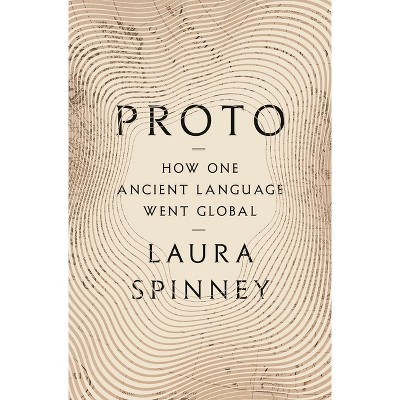
Proto is a revelatory portrait of world history in its own words.Book Synopsis
Named a Best Book of 2025 by the Guardian, Scientific American, and the Washington Independent Review of Books
Proto is a revelatory portrait of world history in its own words.
Daughter. Duhitár-. Dustr. Dukte. Listen to these English, Sanskrit, Armenian and Lithuanian words, all meaning the same thing, and you hear echoes of one of history's most unlikely journeys. All four languages-along with hundreds of others, from French and Gaelic, to Persian and Polish-trace their origins to an ancient tongue spoken as the last ice age receded. This language, which we call Proto-Indo-European, was born between Europe and Asia and exploded out of its cradle, fragmenting as it spread east and west. Its last speaker died thousands of years ago, yet Proto-Indo-European lives on in its myriad linguistic offspring and in some of our best loved works of literature, including Dante's Inferno and the Rig Veda, The Lord of the Rings and the love poetry of Rumi. How did this happen?
Review Quotes
"A compelling portrait of a people thought lost to time...a remarkable account of humanity's quest to rediscover its ancient origins, using modern methods to illuminate the world as it was before the advent of written history. For Ms. Spinney, this distant and obscure past holds lessons for the future, as the preservation and purity of language is increasingly a contemporary concern." --Michael Patrick Brady, Wall Street Journal
"Fluid... a global scientific odyssey." --Anjana Ahuja, The Guardian "Best Science and Nature Books of 2025" "The great leap in genetic analysis of late has meant that the story of how one language left the steppes of Ukraine and became the earth's dominant language family has become clearer and more exciting than ever before. Hooray for a book where the author's curiosity, diligence, and literary craft gets it all down in what will stand as the go-to source for a generation." --John McWhorter, author of THE LANGUAGE HOAX "An impressive piece of work . . . Rewarding." --Dennis Duncan, Washington Post "Laura Spinney tells engaging tales of archeologists traipsing through fields, linguists working toward professional vindication and many others active in the search for understanding of how these ancient languages traveled, fragmented, warred and traded to eventually became the dominant Indo-European languages today." --Rich Hunt, Scientific American "Proto is a rich and well-researched study of language development across thousands of miles and tens of thousands of years. But most importantly, it shows that we are more connected than we might have been led to believe." --Zuzanna Lachendro, The New Statesman "[PROTO traces] the origins of that great carrier of ideas, our shared language. Although it might read like a historical narrative, it's really a brilliant-and well researched-argument: about the ways in which the spoken word has spread; about what we can and can't know about the very distant past; about genetics, linguistics and science." --Prospect Magazine "Best Books of 2025" "Ancient Greek and Latin can't hold a candle to Proto-Indo-European as far as scope of influence is concerned. The latest from journalist Spinney aims to show just how great the impact of this little-remembered language still is." --John H. Maher, The Millions "In this thought-provoking book Laura Spinney shows how recent advances in genetics and archaeological discoveries have thrown new light on the history of the Indo-European languages that a great part of the world now speaks ... A lively and fascinating account of how these languages split from their root, developed in different ways, mingled with each other, crossed tracks, flourished and died. I loved it!" --David Bellos, author of IS THAT A FISH IN YOUR EAR? "Proto is a real detective story told with a compelling combination of academic rigour, human interest, vivid description, and personal biography. A tour de force." --David Crystal, author of A DATE WITH LANGUAGE "Formidably researched but lightly written, I put down this book with the pleasurable sense that the world around me had become a little stranger and richer." --Helen Gordon, author of NOTES FROM DEEP TIME "Superb. With style and panache, Laura Spinney tells a truly extraordinary detective story." --Matt Ridley, author of THE EVOLUTION OF EVERYTHING "This beautifully researched and written book is about far more than language; it is a history of the world in microcosm, drawing together a diversity of subjects from genetics and religion to warfare and boozing. I highly recommend this wholly absorbing book." --Douglas Preston, author of #1 New York Times bestselling THE LOST CITY OF THE MONKEY GOD "Spinney charts an extraordinary journey through human history with words as a compass. It is a sweeping story beautifully told. Profound and illuminating." --Moudhy Al-Rashid, author of BETWEEN TWO RIVERS "Journalist and novelist Spinney (Pale Rider) explains how a single language family spread across the world in this astute account. Combining the discoveries of linguists, archaeologists, and geneticists-"barbarians to each other" in their mutual unintelligibility-Spinney aims to take the most holistic approach yet to the topic...Impressively weaving raw data and disparate academic conjectures into a sweeping saga, this rivets." --Publishers Weekly (starred review)About the Author
Laura Spinney is the author of Pale Rider: The Spanish Flu of 1918 and How It Changed the World, which has been translated into more than a dozen languages, and two novels. Her science writing has appeared in The Atlantic, National Geographic, Nature, The Economist, The Guardian, and elsewhere. She lives in Paris.