Sponsored
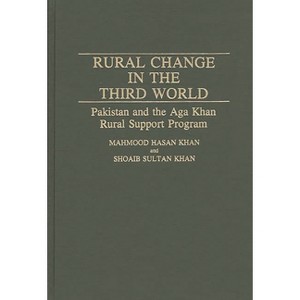
Rural Change in the Third World - (Contributions in Economics and Economic History) by Mahmood Hasan Khan & Shoaib Sultan Khan & Mahmood Hasan Khan
In Stock
Sponsored
About this item
Highlights
- This study examines a particularly successful rural development program: the partnership of the Aga Khan Rural Support Program (AKRSP) and the small farmers of northern Pakistan.
- About the Author: MAHMOOD HASAN KHAN is Professor of Economics at Simon Fraser University in Burnaby, British Columbia.
- 200 Pages
- Political Science, Public Policy
- Series Name: Contributions in Economics and Economic History
Description
About the Book
This study examines a particularly successful rural development program: the partnership of the Aga Khan Rural Support Program (AKRSP) and the small farmers of northern Pakistan. The Aga Khan Rural Support Program was established in 1982 to act as a catalyst for the development of rural people living in the high mountain valleys of the Himalayas, Karakorum, and Hindu Kush. The experiment is based upon the premise that rural people can improve their economic and social status through organization at the village level. This experiment in regional development--affecting the lives of nearly 500,000 people--has been outstandingly successful and should provide a model with generalizable lessons for policymakers, practitioners, and researchers in economic development.
The World Bank has concluded that the Aga Khan Rural Support Program continues to be remarkably successful . . . [and] provides a hopeful prospect that rural development can be made to work. The authors demonstrate that the organizational model found in the AKRSP is sustainable provided prospective beneficiaries participate fully, and that the AKRSP experiment can be used successfully in other rural underdeveloped areas--that the rural poor can be organized to promote their own economic and social development.
Book Synopsis
This study examines a particularly successful rural development program: the partnership of the Aga Khan Rural Support Program (AKRSP) and the small farmers of northern Pakistan. The Aga Khan Rural Support Program was established in 1982 to act as a catalyst for the development of rural people living in the high mountain valleys of the Himalayas, Karakorum, and Hindu Kush. The experiment is based upon the premise that rural people can improve their economic and social status through organization at the village level. This experiment in regional development--affecting the lives of nearly 500,000 people--has been outstandingly successful and should provide a model with generalizable lessons for policymakers, practitioners, and researchers in economic development.
The World Bank has concluded that the Aga Khan Rural Support Program continues to be remarkably successful . . . [and] provides a hopeful prospect that rural development can be made to work. The authors demonstrate that the organizational model found in the AKRSP is sustainable provided prospective beneficiaries participate fully, and that the AKRSP experiment can be used successfully in other rural underdeveloped areas--that the rural poor can be organized to promote their own economic and social development.Review Quotes
?Khan and Khan analyze a process of planned development in northern Pakistan's provinces of Gilgit, Chitral, and Baltistan by the Aga Khan Rural Support Program (AKRSP). They offer an excellent, organized, critical presentation of the model developed, including objectives, stages of development from formative period to institutional maturity, and the declining role of AKRSP, while integrating the area to other links in a rapidly expanding Pakistani economy. Except for its vision of a self-reliant community based on the principle of participatory social organization, the AKRSP model is not based on a blueprint but is evolutionary. The specific form of the AKRSP response rests almost entirely on what best suits the villagers to achieve their ultimate goals: i.e., resource management, sustainable forests, sanitation, improved water supply, and special emphasis on aiding the role of women in the entire developmental process. AKRSP efforts have proved highly successful, if incomplete, and have been given high rating from World Bank evaluators. The authors argue convincingly that the model is replicable even in the diverse social and economic environments of Africa and Asia. Select bibliography, important statistical data.?-Choice
"Khan and Khan analyze a process of planned development in northern Pakistan's provinces of Gilgit, Chitral, and Baltistan by the Aga Khan Rural Support Program (AKRSP). They offer an excellent, organized, critical presentation of the model developed, including objectives, stages of development from formative period to institutional maturity, and the declining role of AKRSP, while integrating the area to other links in a rapidly expanding Pakistani economy. Except for its vision of a self-reliant community based on the principle of participatory social organization, the AKRSP model is not based on a blueprint but is evolutionary. The specific form of the AKRSP response rests almost entirely on what best suits the villagers to achieve their ultimate goals: i.e., resource management, sustainable forests, sanitation, improved water supply, and special emphasis on aiding the role of women in the entire developmental process. AKRSP efforts have proved highly successful, if incomplete, and have been given high rating from World Bank evaluators. The authors argue convincingly that the model is replicable even in the diverse social and economic environments of Africa and Asia. Select bibliography, important statistical data."-Choice
About the Author
MAHMOOD HASAN KHAN is Professor of Economics at Simon Fraser University in Burnaby, British Columbia. He has authored or co-authored five books on economic development, including The Economics of the Green Revolution in Pakistan (Praeger, 1975).
SHOAIB SULTAN KHAN has served as general manager of the Aga Khan Rural Support Program in Pakistan since 1982. Previously, he served with UNICEF in Sri Lanka, the UN Center for Regional Development in Japan, and the Pakistan Academy for Rural Development.Shipping details
Return details
Frequently bought together





Trending Non-Fiction