Sponsored
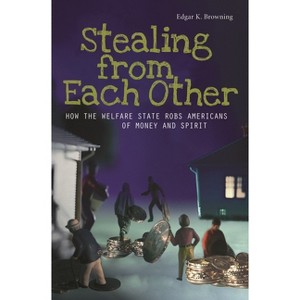
Stealing from Each Other - by Edgar K Browning (Hardcover)
In Stock
Sponsored
About this item
Highlights
- Almost all Americans would be better off if none of the federal welfare-state policies of the last century--including Social Security--had ever been enacted.
- About the Author: Edgar K. Browning is Professor of Economics at Texas A&M University.
- 240 Pages
- Business + Money Management, Economics
Description
About the Book
Almost all Americans would be better off if none of the federal welfare-state policies of the last century--including Social Security--had ever been enacted. So argues economist Edgar Browning, and with good reason: In 1900, government played a very small role in the day-to-day activities of American citizens. There was no income tax. No Social Security. No federal welfare programs. No minimum wage laws. No federal involvement in education. Government was small, spending well under 10 percent of our incomes. But now, federal, state, and local governments spend more than 33 percent of our incomes. Why has government grown so much over the past century? The answer, in Browning's devastating critique of the modern welfare state, is simple: the rise of egalitarian ideology--an ideology that has not just harmed the economy but made us all poorer.
This book examines all facets of the welfare state in the U.S. and its egalitarian underpinnings. Egalitarians claim, for instance, that markets are unfair and that we must have redistributive policies to produce social justice. This reasoning supposedly justifies the two-thirds of federal spending that simply robs Peter to pay Paul. We are stealing from each other. Browning's research and trenchant analysis show that: -Almost all U.S. citizens are harmed by the welfare state--even many of its apparent beneficiaries. -Welfare-state policies have large hidden costs which all told have reduced the average income of Americans by about 25 percent. -There is much less inequality and poverty than is commonly believed. -Most taxpayers will receive less back from Social Security than they put in. Provocative? Indeed. But such conclusions result from the most thoroughgoing economic analysis of the modern welfare state yet written. Written for a general audience, Stealing from Each Other covers everything informed citizens need to know about inequality, poverty, welfare, Social Security, taxation, and the true costs of government redistributive policies.
Book Synopsis
Almost all Americans would be better off if none of the federal welfare-state policies of the last century--including Social Security--had ever been enacted. So argues economist Edgar Browning, and with good reason: In 1900, government played a very small role in the day-to-day activities of American citizens. There was no income tax. No Social Security. No federal welfare programs. No minimum wage laws. No federal involvement in education. Government was small, spending well under 10 percent of our incomes. But now, federal, state, and local governments spend more than 33 percent of our incomes. Why has government grown so much over the past century? The answer, in Browning's devastating critique of the modern welfare state, is simple: the rise of egalitarian ideology--an ideology that has not just harmed the economy but made us all poorer.
This book examines all facets of the welfare state in the U.S. and its egalitarian underpinnings. Egalitarians claim, for instance, that markets are unfair and that we must have redistributive policies to produce social justice. This reasoning supposedly justifies the two-thirds of federal spending that simply robs Peter to pay Paul. We are stealing from each other. Browning's research and trenchant analysis show that: -Almost all U.S. citizens are harmed by the welfare state--even many of its apparent beneficiaries. -Welfare-state policies have large hidden costs which all told have reduced the average income of Americans by about 25 percent. -There is much less inequality and poverty than is commonly believed. -Most taxpayers will receive less back from Social Security than they put in. Provocative? Indeed. But such conclusions result from the most thoroughgoing economic analysis of the modern welfare state yet written. Written for a general audience, Stealing from Each Other covers everything informed citizens need to know about inequality, poverty, welfare, Social Security, taxation, and the true costs of government redistributive policies.Review Quotes
"A collection of unique, but financially sound ideas for America, Stealing From Each Other is a must for community library economics and social issues collections." --Midwest Book Review/Internet Bookwatch
"The rise of equalitarian ideology has driven Americans to steal from one another. Browning explains that certain kinds of equality have been a cherished value in America. Equality under the law and, within reason, equality of opportunity is consistent with a free society. Equality of results is an anathema to a free society and within it lie the seeds of tyranny." --Townhall.com "Browning (economics, Texas A&M Univ.) is unafraid of reaching definite conclusions on a whole host of contested issues in the general areas of income distribution and redistribution...Browning supports his arguments with empirical research. This work, which is accessible to a wide audience, is likely to provoke debate on this important, controversial topic. Recommended. All readership levels." --Choice "Browning's criticism of the minimum wage as a job destroyer is right on target. [...] I must also commend Browning for not making his book exclusively about the economics of redistribution. He also questions its morality. [...] It may be politically impossible to escape from the quicksand of the redistributive state, but Professor Browning has made it clear that everyone would benefit if we could do so - everyone except for the interest groups that have a stake in maintaining the status quo." --RegulationAbout the Author
Edgar K. Browning is Professor of Economics at Texas A&M University. He has published extensively on issues related to government expenditure and tax policies and is the co-author of two bestselling economics textbooks. In 1987, he was elected President of the Southern Economics Association.Shipping details
Return details
Trending Non-Fiction



Discover more options