Sponsored
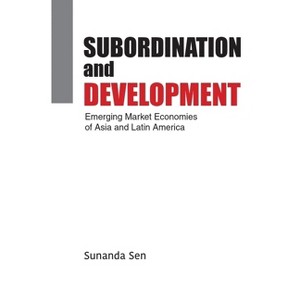
Subordination and Development - by Sunanda Sen (Hardcover)
Pre-order
Sponsored
About this item
Highlights
- Sunanda Sen provides, in the present book, an analysis of subordination faced by the developing countries of the global South, with implications which include their retarded development.
- About the Author: Sunanda Sen is a former professor of economics at the Centre for Economic Studies and Planning, Jawaharlal Nehru University, New Delhi.
- 220 Pages
- Business + Money Management, Development
Description
About the Book
This book provides an analysis of the impact of subordination in the major EMEs. Distinct from 'dependence' under official aid till 1970s, subordination prevailed over developing nations with liberalization of capital-flows by the 1990s when markets used as agents for overseas capital for extracting surpluses.Book Synopsis
Sunanda Sen provides, in the present book, an analysis of subordination faced by the developing countries of the global South, with implications which include their retarded development. Imposed by the advanced industrial countries, subordination of these countries includes an implicit compulsion on their part to follow neoliberal economic policies having broad acceptance from corporate capital as well as the Bretton Woods institutions from the global North.
Compliance with policies as above on the part of the subordinated countries is ensured by the liberalized global market, operating as an agent of corporate capital and the state overseas. Deviations, if any, from the prescribed neoliberal policies in the developing countries often encounter reprisals by the market with reversals of capital flows, mediating signals for the subordinated countries to look for conformity with remedial measures. Subordination as spelt out above is distinct from 'dependence' which prevailed in the post-war years till the mid-1970s, when official aid was the major string for overseas governments to exercise direct control over aid-receiving countries. Moving from dependence, subordination faced by the developing nations came up along with liberalization of capital flows during the 1990s. It achieved for the overseas partners a steady flow of surpluses, while ensuring continuity of the prescribed policies with harmful consequences in the subordinated nations. The book also dwells on the economic dynamics of the structural changes which let finance attain dominance for those economies with deleterious consequences for the real economy. Analysis in the book includes the conceptual aspects of both mainstream neoliberal policies and their heterodox critiques. The observed links between economic policies and the enabling sociopolitical environment supplement the arguments in the book which hopefully will open up a new dimension for analysing subordination and the lack of development.Review Quotes
Subordination and Development is an outstanding study of our current phase of capitalist development, brilliantly characterized as a modern blend of financialization and neo-imperialism. Using a highly informative analytical economic framework, rigorously and insightfully based on Keynes's and post-Keynesian contributions, the book shows how the global South is caught in a web of unequal financial and trade relationships with Northern countries and their multinational corporations, to the detriment of workers and communities. Subordination and Development is truly enlightening and compelling because Sunanda Sen applies her analytical framework in detailed and highly informative case studies of Argentina, Brazil, Mexico, India and China. These studies show the financialized subordination in practice and their highly negative impacts on these southern countries.
I highly recommend this book to teachers, students and all those interested in understanding the underlying dynamics of finance and unequal development in today's world.--Gerald Epstein Professor of Economics and Co-Director, Political Economy Research Institute (PERI), University of Massachusetts, AmherstThe global interdependence of economies through international markets is historically associated with the exploitation of differences and the generation of asymmetries. Sunanda Sen's book highlights the role of expanding markets in triggering cumulative processes of subordination of certain economies (or groups of economies) relative to others. The book is an ambitious exploration of the multi-faceted character of subordination as it unfolds through the various layers of economic interdependence from international division of labour to global financial flows.
Sunanda Sen's exploration proposes asymmetry as a fundamental benchmark for interpreting the long-run dynamics of market relationships in the world economy. Her book is an invaluable contribution to understanding the relationship between market globalization and structural dynamics, and to assessing the complex trajectories along which patterns of subordination are currently challenged and transformed.--Roberto Scazzieri, Italian National Lincei Academy and University of BolognaSunanda Sen successfully interweaves Gramscian concepts of hegemony and subordination with Marxian ideas of fictitious capital to analyse the nexus between corporates, finance, the state, and global regulatory and finance institutions, as they coalesce into an embryonic global elite. This domination by 'new capital' involves the detachment of finance from the real economy, with money chasing its own tail for artificial profits, an emerging scenario that has severe negative implications for sustainability, stability and for generating inclusive economic growth with progressive features in the global South. Combining perspectives drawn from heterodox theoretical traditions with applied statistical analysis, this pioneering, innovative and erudite exploration illuminates key contemporary economic policy issues dominating national and international discourse. A very valuable contribution that will surely catalyse much creative investigation; strongly recommended for researchers, policy makers, teachers and advanced students in the wide-ranging fields of finance and development.--Ashwani Saith Emeritus Professor, Institute of Social Studies, The Hague
About the Author
Sunanda Sen is a former professor of economics at the Centre for Economic Studies and Planning, Jawaharlal Nehru University, New Delhi. She is also a research associate at the Levy Economics Institute, Bard College, USA and a life member of Clare Hall, Cambridge. Her publications include a number of books of which the last two, Dominant Finance and Stagnant Economies (Oxford University Press, 2014) and The Changing Face of Imperialism: From Colonialism to Contemporary Capitalism (co-edited with Cristina Marcuzzo; Routledge, 2018), received the prestigious Japan Society Political Economy (JSPE)-Routledge Prize of 2021.Shipping details
Return details
Frequently bought together






Trending Non-Fiction





Discover more options