Sponsored
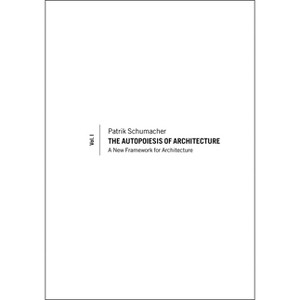
The Autopoiesis of Architecture, Volume I - by Patrik Schumacher (Paperback)
In Stock
Sponsored
About this item
Highlights
- Take a theoretical approach to architecture with The Autopoiesis of Architecture, which presents the topic as a discipline with its own unique logic.
- About the Author: Patrik Schumacher is partner at Zaha Hadid Architects and founding director of the Design Research Laboratory (DRL) at the Architectural Association (AA) in London.
- 480 Pages
- Architecture, General
Description
Book Synopsis
Take a theoretical approach to architecture with The Autopoiesis of Architecture, which presents the topic as a discipline with its own unique logic. Architecture's conception of itself is addressed as well as its development within wider contemporary society.
Author Patrik Schumacher offers innovative treatment that enriches architectural theory with a coordinated arsenal of concepts facilitating both detailed analysis and insightful comparisons with other domains, such as art, science and politics. He explores how the various modes of communication comprising architecture depend upon each other, combine, and form a unique subsystem of society that co-evolves with other important autopoietic subsystems like art, science, politics and the economy.
The first of two volumes that together present a comprehensive account of architecture's autopoiesis, this book elaborates the theory of architecture's autopoeisis in 8 parts, 50 sections and 200 chapters. Each of the 50 sections poses a thesis drawing a central message from the insights articulated within the respective section. The 200 chapters are gathering and sorting the accumulated intelligence of the discipline according to the new conceptual framework adopted, in order to catalyze and elaborate the new formulations and insights that are then encapsulated in the theses. However, while the theoretical work in the text of the chapters relies on the rigorous build up of a new theoretical language, the theses are written in ordinary language ? with the theoretical concepts placed in brackets. The full list of the 50 theses affords a convenient summary printed as appendix at the end of the book.
The second volume completes the analysis of the discourse and further proposes a new agenda for contemporary architecture in response to the challenges and opportunities that confront architectural design within the context of current societal and technological developments.
From the Back Cover
By presenting architecture as a discipline with its own unique logic, The Autopoiesis of Architecture provides a wholly new theoretical approach to architecture. The impact of this is far reaching. Architecture's conception of itself is addressed but also that of its development within wider contemporary society. Schumacher's innovative treatment of the subject enriches architectural theory with a coordinated arsenal of concepts that facilitates both detailed analysis and insightful comparisons with other domains, such as art, science and politics. The 'Autopoiesis' of the title refers to self-production: the term having first been introduced in biology to describe the essential characteristic of life as a circular organization that reproduces all its specific components out of its own life process. Once transposed into the theory of social systems, autopoiesis came to be understood as a system of communication capable of producing all its specific communication structures within their own internal process. It is this autopoietic system of communication that is being applied here to an architectural context. Architecture comprises various modes of communication, including drawings, texts and built works. These communications depend upon each other and combine to reproduce architecture as a specialized system of communication. The book explores how this system of communication forms a unique subsystem of society that co-evolves with other important autopoietic subsystems like art, science, politics and the economy.
The first of two volumes that together present a comprehensive account of architecture's autopoiesis, The Autopoiesis of Architecture: A New Framework for Architecture introduces the theoretical framework and traces the historical process of architecture's differentiation within its societal environment: its elevation above the craft of building, its emancipation from religion and politics, as well as its separation from art and science. On this basis Schumacher insists on the necessity of maintaining disciplinary autonomy and argues for its distinct demarcation in relation to art and engineering. Architecture's dependency on theory is emphasized and its internal separation into the avant-garde and the mainstream is explained. Styles are theorized as design research programmes that constitute architectural history as a progression of cycles of innovation that upgrade architecture to adapt to the ongoing evolution of society. This initial volume ends with the clarification of architecture's underlying societal function and raison d'être. The second volume completes the analysis of the discourse and further proposes a new agenda for contemporary architecture in response to the challenges and opportunities that confront architectural design within the context of current societal and technological developments.
Review Quotes
"... a wholly new theoretical approach to architecture... highly unusual." (Architecture Today, March 2011)
"... provides a wholly new approach and framework for thinking about architecture." (Dezeen.com, February 2011)
"... does well to relate new developments in architectural media to historical periods, with some fascinating passages on the design process." (Icon Magazine, February 2011)
About the Author
Patrik Schumacher is partner at Zaha Hadid Architects and founding director of the Design Research Laboratory (DRL) at the Architectural Association (AA) in London. He studied philosophy and architecture in Bonn, London and Stuttgart, where he received his architectural Diploma in 1990. In 1996 he founded the AADRL with Brett Steele, and continues to serve as one of its directors. In 1999 he completed his PhD at the Institute for Cultural Science, Klagenfurt University. Patrik Schumacher joined Zaha Hadid in 1988. Since then Zaha Hadid Architects has expanded from a small studio to a global firm employing over 300 architects. Patrik Schumacher's career continues to integrate practice and theory. His contribution to the discourse of contemporary architecture is also evident in his prior writings, such as Digital Hadid, 2004, as well as in his curatorial work for exhibitions, such as Latent Utopias, Graz, 2002. His essays are available on www.patrikschumacher.com.
Shipping details
Return details
Trending Non-Fiction






Discover more options