Sponsored
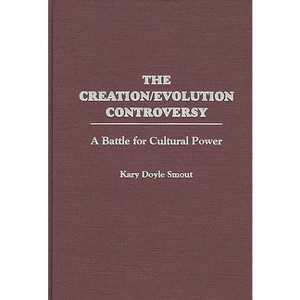
The Creation/Evolution Controversy - (384) by Kary D Smout (Hardcover)
In Stock
Sponsored
About this item
Highlights
- This rhetorical study of the various language strategies and competing worldviews involved in the 140-year argument between Biblical creationists and Darwinian evolutionists focuses on the 1860 Huxley/Wilberforce debate, the 1925 Scopes Monkey Trial, and the 1981 Arkansas Creation-Science Trial.
- About the Author: KARY DOYLE SMOUT is Associate Professor of English at Washington and Lee University.
- 224 Pages
- Science, Life Sciences
- Series Name: 384
Description
About the Book
This rhetorical study of the various language strategies and competing worldviews involved in the 140-year argument between Biblical creationists and Darwinian evolutionists focuses on the 1860 Huxley/Wilberforce debate, the 1925 Scopes Monkey Trial, and the 1981 Arkansas Creation-Science Trial.
When Darwin published his Origins of Species in 1859, he initiated a debate about the origin of human life and the role of God in human affairs scarcely equalled in world history. Smout traces the response of Biblical creationists to Darwinian evolutionists. Looking carefully at the stories told and the tactics used by both sides, he analyzes all available accounts of the original debate culminating in the 1860 Huxley/Wilberforce debate, the 1925 Scopes Monkey Trial, and the 1981 Arkansas Creation-Science Trial. Professor Smout argues that both sides in the controversy use various language strategies to persuade the culture as a whole to see the world that they see and to enact their position as public policy.
As Smout illustrates, the problem is that both sides rely on an inadequate conception of language as a namer of timeless realities rather than as an instrument used by human communities to achieve their goals. He attempts to articulate a better view of language and to show how it might help solve intractable arguments such as this. He argues that we should see language as a tool that shapes what we see, and definitions of terms as political acts rather than statements of fact made by disciplinary experts. An important analysis for students and scholars in rhetoric, history, religion, and sociology.
Book Synopsis
This rhetorical study of the various language strategies and competing worldviews involved in the 140-year argument between Biblical creationists and Darwinian evolutionists focuses on the 1860 Huxley/Wilberforce debate, the 1925 Scopes Monkey Trial, and the 1981 Arkansas Creation-Science Trial.
When Darwin published his Origins of Species in 1859, he initiated a debate about the origin of human life and the role of God in human affairs scarcely equalled in world history. Smout traces the response of Biblical creationists to Darwinian evolutionists. Looking carefully at the stories told and the tactics used by both sides, he analyzes all available accounts of the original debate culminating in the 1860 Huxley/Wilberforce debate, the 1925 Scopes Monkey Trial, and the 1981 Arkansas Creation-Science Trial. Professor Smout argues that both sides in the controversy use various language strategies to persuade the culture as a whole to see the world that they see and to enact their position as public policy. As Smout illustrates, the problem is that both sides rely on an inadequate conception of language as a namer of timeless realities rather than as an instrument used by human communities to achieve their goals. He attempts to articulate a better view of language and to show how it might help solve intractable arguments such as this. He argues that we should see language as a tool that shapes what we see, and definitions of terms as political acts rather than statements of fact made by disciplinary experts. An important analysis for students and scholars in rhetoric, history, religion, and sociology.Review Quotes
"A rigorous and incisive exploration of a significant debate in the cultural history of the United States....Smout skillfully traces the fascinating rhetorical dynamics of the highly-charged controversy over creationism and evolution during the last 150 years."-Steven Mailloux Professor of English University of California, Irvine
"In this skillful synthesis of historical reconstruction, cultural analysis, philosophical reflection and the parsing of legal argument, Kary Smout has given us a wonderfully full understanding of what is involved in the creation/evolution controversy."-Stanley Fish Professor of English and Law Executive Director, Duke University Press
?[C]ontributes to this debate by calling attention to the way language plays a critical but often undetected role. She points out that this is particularly true in the words "creation," "evolution," "science," religion" and "truth." By exploring the instabilities of these words, Smout has shown how the controversy between creation and evolution is actually a battle for language and culture itself.?-Science & Theology News
?[S]mout has produced an engaging and instructive study of the rhetoric employed for this purpose by those involved in this ongooing public debate.?-Perspectives on Science and Christian Faith
?[T]his book convincingly illustrates the utility of the postmodern linguistic approach. Smout offers ample insights on how creationists and evolutionists ground their rhetoric in two different worldviews that seldom meet.?-Journal of Church and State
"ÝC¨ontributes to this debate by calling attention to the way language plays a critical but often undetected role. She points out that this is particularly true in the words "creation," "evolution," "science," religion" and "truth." By exploring the instabilities of these words, Smout has shown how the controversy between creation and evolution is actually a battle for language and culture itself."-Science & Theology News
"ÝS¨mout has produced an engaging and instructive study of the rhetoric employed for this purpose by those involved in this ongooing public debate."-Perspectives on Science and Christian Faith
"ÝT¨his book convincingly illustrates the utility of the postmodern linguistic approach. Smout offers ample insights on how creationists and evolutionists ground their rhetoric in two different worldviews that seldom meet."-Journal of Church and State
"[S]mout has produced an engaging and instructive study of the rhetoric employed for this purpose by those involved in this ongooing public debate."-Perspectives on Science and Christian Faith
"[T]his book convincingly illustrates the utility of the postmodern linguistic approach. Smout offers ample insights on how creationists and evolutionists ground their rhetoric in two different worldviews that seldom meet."-Journal of Church and State
"[C]ontributes to this debate by calling attention to the way language plays a critical but often undetected role. She points out that this is particularly true in the words "creation," "evolution," "science," religion" and "truth." By exploring the instabilities of these words, Smout has shown how the controversy between creation and evolution is actually a battle for language and culture itself."-Science & Theology News
About the Author
KARY DOYLE SMOUT is Associate Professor of English at Washington and Lee University. Among his earlier publications are contributions to American Speech, Legal Writing, and Composition Studies.Shipping details
Return details
Trending Non-Fiction






Discover more options