Sponsored
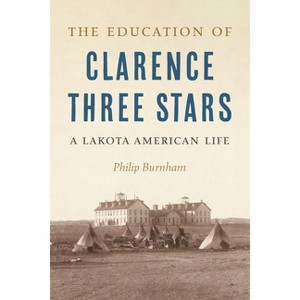
The Education of Clarence Three Stars - by Philip Burnham (Hardcover)
$21.59Save $13.36 (38% off)
In Stock
Eligible for registries and wish lists
Sponsored
About this item
Highlights
- In The Education of Clarence Three Stars Philip Burnham tells the life story of the remarkable Packs the Dog, a member of the Minneconjou Lakotas who was born in 1864 east of the Black Hills.
- About the Author: Philip Burnham is a retired associate professor of composition at George Mason University, a former reporter for Indian Country Today, and a freelance writer.
- 336 Pages
- Social Science, Ethnic Studies
Description
About the Book
Philip Burnham's threefold biography of Clarence Three Stars, the Pine Ridge Reservation, and the Oglala Lakota peoples during a half century of forced change and transformation reveals how Three Stars worked to undermine the settler-colonial system into which the Carlisle Indian Industrial School had tried to assimilate him.Book Synopsis
In The Education of Clarence Three Stars Philip Burnham tells the life story of the remarkable Packs the Dog, a member of the Minneconjou Lakotas who was born in 1864 east of the Black Hills. His father, Yellow Knife, died when the boy was five, and the family eventually enrolled at Pine Ridge Agency with the Oglalas under an uncle's name, Three Stars. In 1879 Packs the Dog joined the first class of Indian students to be admitted to the Carlisle Indian Industrial School. An enthusiastic student, Clarence Three Stars, as he would come to be known, was one of five Lakota children who volunteered to stay at Carlisle after the three-year plan of instruction was finished--though he eventually left the school in frustration. Three Stars returned to Pine Ridge and married Jennie Dubray, another Carlisle veteran, and they had seven children. The life of Lakota advocate Three Stars spanned a time of dramatic change for Native Americans, from the pre-reservation period through the Dawes Act of 1887 until just before the Indian Reorganization Act of 1934. Three Stars was a teacher, interpreter, catechist, lawyer, and politician who lived through the federal policy of American Indian assimilation in its many guises, including boarding school education, religious conversion, land allotment, and political reorganization. He used the fundamentals of his own boarding school education to advance the welfare of the Oglala Lakota people, even when his efforts were deemed threatening or subversive. His dedication to justice, learning, and self-governance informed a distinguished career of classroom excellence and political advocacy on his home reservation of Pine Ridge.Review Quotes
"This work is written and researched well enough to be popular to both general and academic audiences. . . . The narrative flows well and is fully supported by an impressive bibliography of primary and secondary sources. The Education of Clarence Three Stars belongs on the coffee table and in the classroom."--Jeffrey D. Means, Western Historical Quarterly
-- (5/19/2025 12:00:00 AM)"Burnham's work is a valuable addition to Native American biographies, shedding light on a figure who played a significant role in his community's history."--Rani-Henrik Andersson, American Historical Review
"I highly recommend this book and will be using it as a reference. Clarence Three Stars lived an important and effectual life."--Sandy Wounded Arrow, Nebraska History
"Clarence Three Stars left Pine Ridge and joined the first class to enter Carlisle Indian Industrial School and returned home to a strange and different place. Through the eyes of 'one of Pratt's boys' and with engaging prose, Philip Burnham traces Three Stars's pioneering journey in his own homeland as he readjusted and traversed the shifting reservation terrain that neither his cultural past nor Carlisle education fully prepared him for. In his search for his place in a new world, Three Stars became a government teacher, a store owner, a fee patent rancher, a Bennett County state's attorney, a family man, and a leader for a new generation. Burnham tells his important story in this engaging tribal biography that is truly an important American epic."--Richmond L. Clow, author of Spotted Tail: Warrior and Statesman
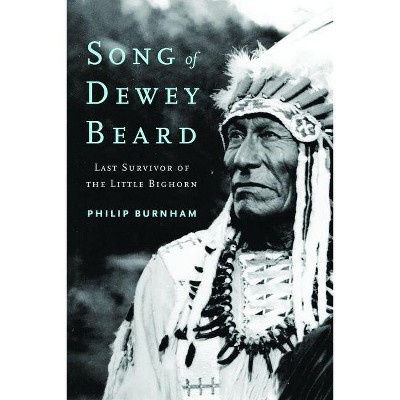
"As with his wonderful Song of Dewey Beard, Philip Burnham focuses on a single remarkable man, in this case Clarence Three Stars, boarding school graduate, educator, resolute advocate, and seat-of-the-pants lawyer, to trace the experience of the Lakota people as they grappled with the challenges faced after their confinement to reservations. Three Stars's life is a vivid revelation of their story, one of determination and cultural courage, an underappreciated chapter in the American experience."--Elliott West, author of Continental Reckoning: The American West in the Age of Expansion
About the Author
Philip Burnham is a retired associate professor of composition at George Mason University, a former reporter for Indian Country Today, and a freelance writer. He is the author of Indian Country, God's Country: Native Americans and the National Parks and Song of Dewey Beard: Last Survivor of the Little Bighorn (Bison Books, 2014), winner of the 2015 Spur Award for Best Western Biography, among other books.Dimensions (Overall): 9.07 Inches (H) x 6.35 Inches (W) x 1.33 Inches (D)
Weight: 1.36 Pounds
Suggested Age: 22 Years and Up
Number of Pages: 336
Genre: Social Science
Sub-Genre: Ethnic Studies
Publisher: Bison Books
Theme: Native American Studies
Format: Hardcover
Author: Philip Burnham
Language: English
Street Date: May 1, 2024
TCIN: 90350734
UPC: 9781496238047
Item Number (DPCI): 247-42-2225
Origin: Made in the USA or Imported
If the item details aren’t accurate or complete, we want to know about it.
Shipping details
Estimated ship dimensions: 1.33 inches length x 6.35 inches width x 9.07 inches height
Estimated ship weight: 1.36 pounds
We regret that this item cannot be shipped to PO Boxes.
This item cannot be shipped to the following locations: American Samoa (see also separate entry under AS), Guam (see also separate entry under GU), Northern Mariana Islands, Puerto Rico (see also separate entry under PR), United States Minor Outlying Islands, Virgin Islands, U.S., APO/FPO
Return details
This item can be returned to any Target store or Target.com.
This item must be returned within 90 days of the date it was purchased in store, shipped, delivered by a Shipt shopper, or made ready for pickup.
See the return policy for complete information.
Frequently bought together
$34.30
MSRP $35.00


$15.94
MSRP $28.95

Trending Non-Fiction

$19.31
was $20.98 New lower price
4 out of 5 stars with 62 ratings


$4.59
MSRP $7.99
Save $5 when you spend $20 on select books
4.8 out of 5 stars with 121 ratings

$6.20
MSRP $10.95
Save $5 when you spend $20 on select books
4.8 out of 5 stars with 33 ratings

$7.09
MSRP $9.99
Save $5 when you spend $20 on select books
4.9 out of 5 stars with 46 ratings
Discover more options
$11.00 - $17.97
MSRP $19.95 - $29.95

$11.29
MSRP $19.95
$11.07
MSRP $19.95