Sponsored
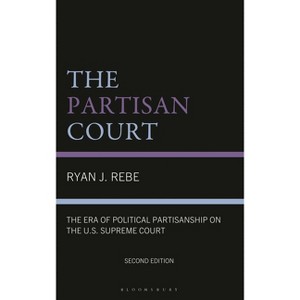
The Partisan Court - 2nd Edition by Ryan J Rebe (Hardcover)
In Stock
Sponsored
About this item
Highlights
- Drawing on new data and case analyses, Ryan J. Rebe provides substantial evidence that justices vote their partisan preferences on election law cases.By focusing specifically on election law, Rebe reveals a consistent pattern of partisanship on the Court.
- About the Author: Ryan J. Rebe, J.D., Ph.D., is chair and full professor of political science and director of legal studies at William Paterson University of New Jersey.
- 176 Pages
- Social Science, Sociology
Description
About the Book
This book provides a thorough analysis of the most important election law cases of the past twenty-five years. The findings reveal an undeniable pattern of partisanship on the U.S. Supreme Court that challenges conventional notions of consensus-building and neutral decision-making.Book Synopsis
Drawing on new data and case analyses, Ryan J. Rebe provides substantial evidence that justices vote their partisan preferences on election law cases.
By focusing specifically on election law, Rebe reveals a consistent pattern of partisanship on the Court. The findings controvert popular perceptions of non-biased decision-making and notions of fundamental fairness. The aggregate analysis shows that justices vote along party-lines in a majority of election law cases, and consensus-building is rare when there is a contentious electoral issue at stake. Exploring topics such as gerrymandering, campaign finance, voter ID laws, and presidential immunity, Rebe demonstrates that Supreme Court decisions often conflict with principles of stare decisis, originalism, and judicial restraint. Rebe also conducts a content analysis of the most controversial election law cases of the past twenty-five years, including Crawford v. Marion County, Citizens United v. FEC, Shelby County v. Holder, and Trump v. United States. In doing so, the book provides a thorough overview of over two decades of election law cases and sheds light on the ways these cases have reshaped America's electoral institutions.
Review Quotes
"Political scientists long ago established that judging is a political act. But are Supreme Court justices nakedly partisan? After reading Ryan J. Rebe's skillful account, there can be little doubt. And for the institutions of American democracy at the heart of this careful study, the situation is now perilous." --Patrick Schmidt, Macalester College
"This book delivers a powerful and systematic examination of how the Supreme Court's conservative majority has tilted election law in favor of Republican interests. Through rigorous statistical analysis and detailed case studies, the author exposes a troubling pattern of nakedly partisan decision-making that should alarm anyone who still believes in judicial independence from the political process. The new edition's addition of recent cases like Trump v. United States only strengthens the devastating case that America's highest court has become an overtly political institution, one currently captured by the Republican Party." --Nicholas B. Creel, Georgia College & State University "The Partisan Court offers a compelling case study of the modern U.S. Supreme Court and its far-reaching impact on the fundamental pillars of American democracy. From gerrymandering and campaign finance to voter suppression and presidential power, Rebe shows how the Court's decisions have reshaped democratic institutions and tilted the rules of representation. Provocative and accessible, this book challenges readers to see the Court not as an impartial guardian of the Constitution but as a central player in America's political battles." --Michael K. Romano, Shenandoah University "As partisanship continues to shape American politics, nuanced understandings of the legal expressions of this polarization are increasingly urgent. Ryan J. Rebe's The Partisan Court is exactly the type of work that deepens our understanding of polarization through an expert view. Rebe carefully demonstrates how this trend has marked recent Supreme Court jurisprudence that shapes democratic self-rule. His work will be of interest to scholars, students of law and politics, and in particular to those looking for a case-law oriented understanding of law as politics or who would benefit from a historical account of partisanship in lawmaking." --Jacob Eisler, Florida State University College of LawAbout the Author
Ryan J. Rebe, J.D., Ph.D., is chair and full professor of political science and director of legal studies at William Paterson University of New Jersey.Shipping details
Return details
Frequently bought together






Trending Non-Fiction