Sponsored
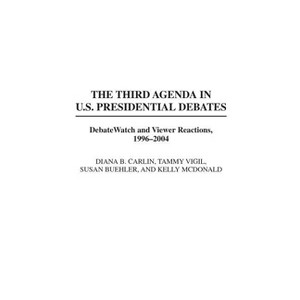
The Third Agenda in U.S. Presidential Debates - (Praeger Political Communication) by Susan Buehler & Diana Carlin & Kelly McDonald (Hardcover)
In Stock
Sponsored
About this item
Highlights
- Drawing on scholarly research and media critiques, The Third Agenda in Presidential Debates examines the most recent U.S. presidential debates from the perspective of television viewers who watched the encounters first hand.
- About the Author: Diana B. Carlin is a professor of Communication Studies at the University of Kansas.
- 296 Pages
- Political Science, American Government
- Series Name: Praeger Political Communication
Description
About the Book
Drawing on scholarly research and media critiques, The Third Agenda in Presidential Debates examines the most recent U.S. presidential debates from the perspective of television viewers who watched the encounters first hand. Through a national program--DebateWatch--tens of thousands of viewers had an opportunity to provide feedback to the debate sponsors, the campaigns, and the media following the 1996, 2000, and 2004 presidential debates. As a result, thousands of groups met after each debate to discuss what they liked and didn't like about a particular candidate, what they learned, and what they still needed to know about the issues presented before them. These focus groups, along with various surveys and emails, allowed viewers to lay out a concise third agenda for the debates: the public's, one in which comparisons could be drawn between their own interests and that of the media and the candidates themselves.
Besides clearly mapping out the important aspects the public looks for when watching a debate, the authors demonstrate how citizen participation challenges candidates and their issues. In addition, the authors offer predictions for future debates and how new generations will choose to participate.
Along with 14 analytical chapters, this work contains four detailed appendices, several tables, and an index.
Book Synopsis
Drawing on scholarly research and media critiques, The Third Agenda in Presidential Debates examines the most recent U.S. presidential debates from the perspective of television viewers who watched the encounters first hand. Through a national program--DebateWatch--tens of thousands of viewers had an opportunity to provide feedback to the debate sponsors, the campaigns, and the media following the 1996, 2000, and 2004 presidential debates. As a result, thousands of groups met after each debate to discuss what they liked and didn't like about a particular candidate, what they learned, and what they still needed to know about the issues presented before them. These focus groups, along with various surveys and emails, allowed viewers to lay out a concise third agenda for the debates: the public's, one in which comparisons could be drawn between their own interests and that of the media and the candidates themselves.
Besides clearly mapping out the important aspects the public looks for when watching a debate, the authors demonstrate how citizen participation challenges candidates and their issues. In addition, the authors offer predictions for future debates and how new generations will choose to participate.Review Quotes
"It offers new data and a perspective (qualitative) on presidential debates that differs from most work in this area. . . . There is no question that this book offers a unique and important contribution to the literature. It merits a place in libraries and on scholars' bookshelves." --Political Science Quarterly
About the Author
Diana B. Carlin is a professor of Communication Studies at the University of Kansas. She has conducted research on presidential debates since 1980 and created the DebateWatch project. She served on the advisory board for the Commission on Presidential Debates from 1987 until 2000. She is also the co-editor of and contributor to The 1992 Presidential Debates in Focus.
Kelly M. McDonald is an assistant professor at The Hugh Downs School of Human Communication where he served as Director of Forensics for five years. He is active in the Consortium for Strategic Communication, an initiative focused on national security and terrorism related questions from a message based perspective. He has published articles in Argumentation & Advocacy and in proceedings from the Conference on Argumentation. Tammy Vigil is an Assistant Professor at Boston University's College of Communication. Her research interests include political communication, rhetoric, and popular culture. Susan Buehler served as a graduate research assistant on the 1996 Ford Foundation grant project that started DebateWatch. She currently works as a part-time administrator for the University of Kansas.Shipping details
Return details
Trending Non-Fiction