Sponsored
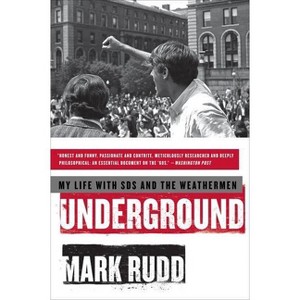
Underground - by Mark Rudd (Paperback)
In Stock
Sponsored
About this item
Highlights
- "Honest and funny, passionate and contrite, meticulously researched and deeply philosophical: an essential document on the '60s.
- Author(s): Mark Rudd
- 352 Pages
- Biography + Autobiography, Political
Description
About the Book
For the first time, the leader of the Columbia University student uprising of 1968 and fugitive member of the notorious Weather Underground tells his compelling and engrossing story.Book Synopsis
"Honest and funny, passionate and contrite, meticulously researched and deeply philosophical: an essential document on the '60s." --Washington Post
Mark Rudd, former '60s radical student leader and onetime fugitive member of the notorious Weather Underground, tells his compelling and engrossing story for the first time in Underground. The chairman of the SDS and leader of the 1968 student uprising at Columbia University, Rudd offers a gripping narrative of his political awakening and fugitive life during one of the most influential periods in modern U.S. history.
In 1968, Mark Rudd led the legendary occupation of five buildings at Columbia University, a dramatic act of protest against the university's support for the Vietnam War and its institutional racism. The charismatic chairman of the Columbia chapter of Students for a Democratic Society--the largest radical student organization in the United States--Rudd went on to become a national symbol of student revolt, and co-founded the Weathermen faction of SDS, which helped organize the notorious Days of Rage in Chicago in 1969.
But Mark Rudd wanted revolution, seeking to end war, racism, and injustice by any means necessary--even violence. By the end of 1970, he was one of the FBI's Most Wanted--and after a string of nonlethal bombings, he went into hiding for more than seven years before turning himself in to great media fanfare.
From the Back Cover
In 1968, Mark Rudd led the legendary occupation of five buildings at Columbia University, a dramatic act of protest against the university's support for the Vietnam War and its institutional racism. The charismatic chairman of the Columbia chapter of Students for a Democratic Society--the largest radical student organization in the United States--Rudd went on to become a national symbol of student revolt, and co-founded the Weathermen faction of SDS, which helped organize the notorious Days of Rage in Chicago in 1969.
But Mark Rudd wanted revolution, seeking to end war, racism, and injustice by any means necessary--even violence. By the end of 1970, he was one of the FBI's Most Wanted--and after a string of nonlethal bombings, he went into hiding for more than seven years before turning himself in to great media fanfare.
In this gripping narrative, Rudd speaks out about this tumultuous period, the role he played in its crucial events, and its aftermath.
Review Quotes
"Rudd is reflective and truthful . . . he shatters the romantic myth of the Weather Underground" - New York Post
"[An] absorbing narrative . . . Rudd's book has value." - New York Times Book Review
"Moral[ly] serious . . . the value of Underground is not to be measured by the depth of its self-criticism. Rather, it is worth reading as a travel guide into hell, a story-lesson and a warning about the risks of ideology inherent in all militant activism." - Clay Risen, New York Observer
"An important contribution to a growing collection of narratives from former participants in the revolutionary 1960s' underground....deeply disturbing, though illuminating, in its unemotional matter-of-factness." - truthdig
"Rudd is not on some flashback trip through Strawberry Fields Forever. Nor is his often-riveting new memoir an exercise in nostalgia, apologia, or retread rhetoric. It is a stark look back in candor. Rudd is searingly frank and self-critical, especially about the Weathermen's disastrous ventures into violent Days of Rage in Chicago and bombings galore later." - The Daily Beast
"Rudd conveys well the festival-like joy of the springtime campus uprisings of the late 1960s . . . Rudd's historical judgments are, to use a phrase from the era, right on." - Los Angeles Times
"A trailblazer . . . Rudd's essential contribution is his self-portrait as a youth who persuaded others to wreck rather than create--and his snapshots of like-minded contemporaries." - Wall Street Journal