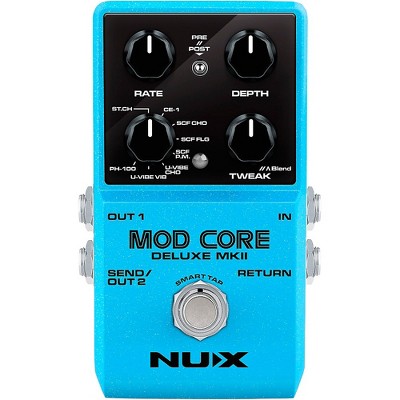
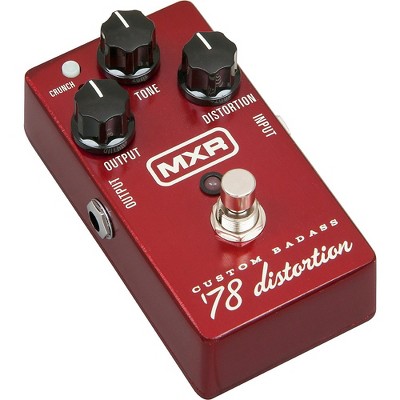
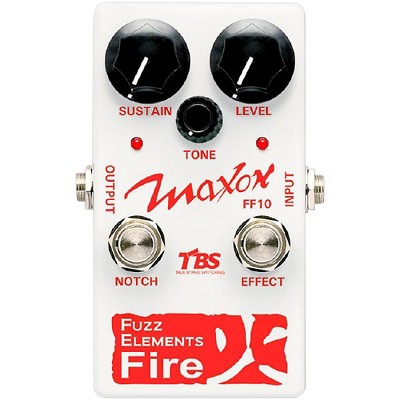
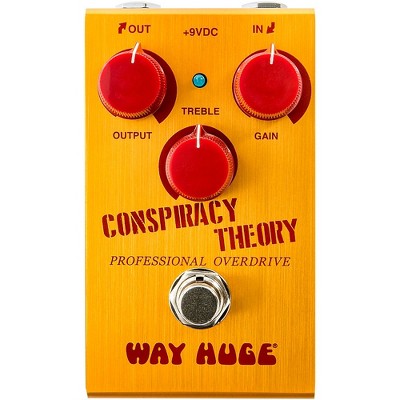
Many ambient reverb pedals support both mono and true stereo operation. Common I/O options include stereo in/out (often via TRS), separate left/right outputs, and flexible routing such as parallel (wet/dry) or serial signal paths to accommodate different effect chains.
Several pedals use buffered bypass, and some include analog or independent analog feedback paths. A few designs combine DSP with analog feedback (dual DSP/analog feedback architectures), letting users blend affected and unaffected signals for more natural or saturated repeats.
Typical creative controls include morphing between parameter sets, joystick-style blend controls, and momentary switches. Momentary functions can add sustain, trigger dive/rise clock shifts, or temporarily engage effects—useful for creating evolving swells, pitch shifts, and dynamic transitions.
Many pedals offer MIDI control and clock sync plus expression- and footswitch-inputs for real-time parameter control. Companion software or plugins and editors are common for deep editing and preset management, enabling DAW integration and external preset recall.
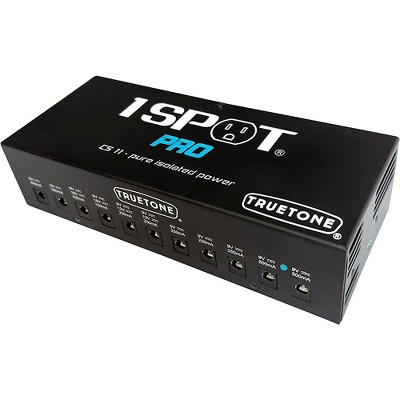
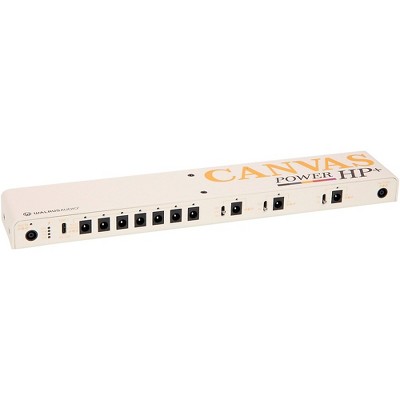
Most list 9V DC power with current draw in the ~100–300 mA range. Some specify center-negative polarity. A few models note optional battery support, while others do not use batteries.
Pedals often include classic studio programs—spring, hall, and plate—alongside ambient and experimental options such as washes, shimmer, latching pad trails, reverse modes, and octave-shifted reverb. These modes are designed to create lush, atmospheric textures.
On-board preset counts vary (examples include three, eight, and nine presets). Many pedals support expanded recall or storage via MIDI. Common external controls include MIDI, software editors, dual footswitches, tap tempo, and expression-pedal inputs.
Some pedals list studio-quality specs such as 48 kHz sampling and 24‑bit conversion with a 20 Hz–20 kHz frequency response. Others describe a high-fidelity digital reverb engine without publishing numeric sampling or conversion figures.
Common features include modulation controls with multiple wave-shape options (examples: SINE, WARP, SINK, SQUARE, RANDOM), modulation-rate controls, momentary clock-rate or Dive/Rise functions, octave up/down elements in reverb trails, and dedicated pitch-delay or dueling pitch-delay programs.