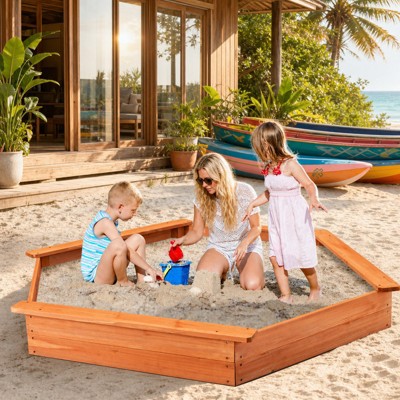
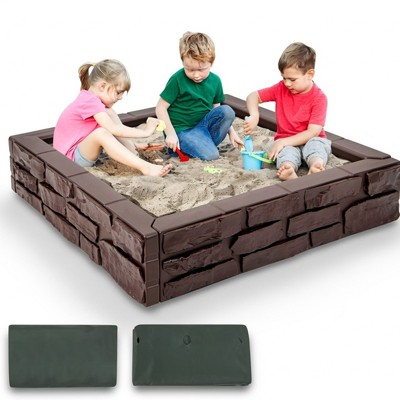
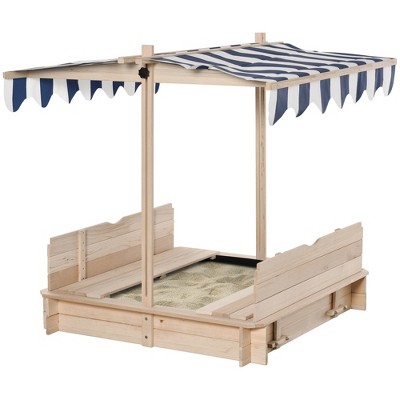
Covered children's sandpits are most often made from wood (examples cited include cedar, fir, and hemlock), high-density polyethylene (HDPE), and—less commonly—metal. Use these material names in product searches to compare durability, maintenance, and appearance.
Many covered sandpits use a bottomless frame combined with a fabric or holed liner. The liner allows water to drain and provides ventilation while the bottomless design makes it easy to change sand depth as needed. Listings frequently describe this bottomless + holed/fabric liner approach for drainage and sand-depth adjustment.
Most covered sandpits require adult assembly. Some products include tools, others do not, but many list easy or quick assembly and provide illustrated instructions. Expect basic hand tools and one or more adults for assembly unless the product states otherwise.
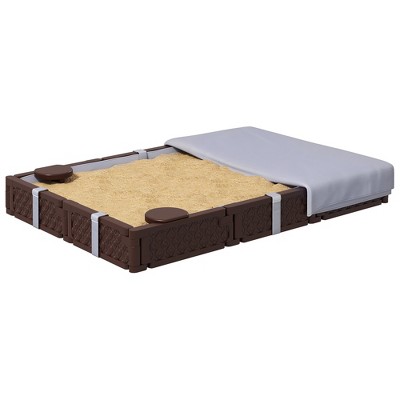
Top covers are commonly made from Oxford cloth or elastic fabric and are described as waterproof or water-resistant, dust‑resistant, tear‑resistant, and fade/UV‑resistant. Bottom liners are often fabric or holed liners designed to allow drainage and ventilation; together these elements protect the sand and help control moisture and sand depth.
Covered sandpits commonly include bench seating—corner benches, side benches, or multiple bench layouts (including octagon designs). Per-seat or per-bench weight capacities in listings range roughly from 132 lbs up to about 330 lbs. Typical backyard models provide seating for about 1–4 children, while larger multi‑bench or octagon designs can have more seats (examples list up to 8).
Most covered sandpits target young children, commonly listing ages from about 2 years up to around 12 years (many listings specify 3+ or ranges like 3–12 or 2–6). Typical backyard models have space for about 1–4 children; larger octagon or multi‑bench designs can seat more—examples list up to 8 seats.
Covers and canopies are often described as water‑resistant or waterproof, tear‑resistant, fade/UV‑resistant, and sun‑proof; common cover materials include Oxford cloth and polyester filament yarn. Wood frames from listings are frequently treated or finished (kiln‑dried, oil‑brushed, heat‑treated or coated) to improve weather resistance.
Sand capacity varies by model. Example listings include recommended amounts such as 250 lbs, a listed maximum of 352 lbs, and a range given as 200–500 lbs. Because capacities differ by size and design, check the specific product specifications for the recommended sand amount.