Target New ArrivalsGift Ideas for MomClothing, Shoes & AccessoriesHome & DecorKitchen & DiningOutdoor Living & GardenGroceryHousehold EssentialsBabyBeautyPersonal CareHealthWellnessLuggageSports & OutdoorsToysElectronicsVideo GamesMovies, Music & BooksSchool & Office SuppliesParty SuppliesGift IdeasGift CardsPetsUlta Beauty at TargetShop by CommunityTarget OpticalDealsClearanceNew ArrivalsSpring OutfitsGift Ideas for MomWomen’s Festival OutfitsTop DealsTarget Circle DealsWeekly AdShop Order PickupShop Same Day DeliveryRegistryRedCardTarget CircleFind Stores
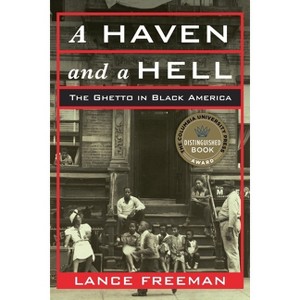
A Haven and a Hell - by  Lance Freeman (Paperback) - 1 of 1

A Haven and a Hell - by Lance Freeman (Paperback)

$30.00

In Stock

Free & easy returns

Free & easy returns

Return this item by mail or in store within 90 days for a full refund.
Eligible for registries and wish lists

About this item

Highlights

  • The black ghetto is thought of as a place of urban decay and social disarray.
  • About the Author: Lance Freeman is the Penn Integrates Knowledge Professor of City and Regional Planning and Sociology at the University of Pennsylvania.
  • 328 Pages
  • History, African American

Description


About the Book


Lance Freeman traces the evolving role of predominantly black neighborhoods in northern cities from the late nineteenth century through the present day. He reveals the forces that caused the ghetto's role as haven or hell to wax and wane.


Book Synopsis


The black ghetto is thought of as a place of urban decay and social disarray. Like the historical ghetto of Venice, it is perceived as a space of confinement, one imposed on black America by whites. It is the home of a marginalized underclass and a sign of the depth of American segregation. Yet while black urban neighborhoods have suffered from institutional racism and economic neglect, they have also been places of refuge and community.

In A Haven and a Hell, Lance Freeman examines how the ghetto shaped black America and how black America shaped the ghetto. Freeman traces the evolving role of predominantly black neighborhoods in northern cities from the late nineteenth century through the present day. At times, the ghetto promised the freedom to build black social institutions and political power. At others, it suppressed and further stigmatized African Americans. Freeman reveals the forces that caused the ghetto's role as haven or hell to wax and wane, spanning the Great Migration, mid-century opportunities, the eruptions of the sixties, the challenges of the seventies and eighties, and present-day issues of mass incarceration, the subprime crisis, and gentrification. Offering timely planning and policy recommendations based in this history, A Haven and a Hell provides a powerful new understanding of urban black communities at a time when the future of many inner-city neighborhoods appears uncertain.


Review Quotes


[An] informative sociohistorical analysis . . . For readers of urban history and black history, this is an excellent look at the ghetto's multifaceted place in American history.-- "Publishers Weekly"

A critical read at a time when gentrification is viewed as threatening the black identity of many urban neighborhoods, this book offers a rich and nuanced history of the ghetto's role in black American life from the late nineteenth century to the present. Resisting a simple characterization, Freeman shows that while the ghetto has sometimes served as an instrument of subjugation and institutional neglect, it has also offered a refuge that has helped to nurture black culture, institutions, and ideas.--Ingrid Gould Ellen, coeditor of The Dream Revisited: Contemporary Debates About Housing, Segregation, and Opportunity

An eloquently written and captivating book.-- "Journal of Planning Education and Research"

For those wholly unfamiliar with the history of the formation of the African-American ghetto, this book is an essential read. Its prosaic style makes it very reader friendly. As such, its biggest draw may be for undergraduate students and others who have little understanding of the historical and social conditions that gave rise to what appear today as blighted urban spaces.-- "American Journal of Sociology"

Freeman adds necessary perspective to our understanding of the role of the ghetto in American life.-- "Contemporary Sociology"

Freeman's rich historical account illustrates how pernicious processes of racial domination and exclusion created predominantly Black neighborhoods in Northern U.S. cities. Yet he also shows how these same processes created the conditions of possibility for autonomous Black social institutions and collective identities. Freeman seamlessly combines statistical and archival data with the voices of Black artists, activists, intellectuals, and business and political leaders across nearly 150 of U.S. history for an account that is at once soaring and surprisingly intimate.--Adam Reich, co-author of Working for Respect: Community and Conflict at Walmart

Immensely valuable.--Prentiss A. Dantzler, Georgia State University "Journal of Urban Affairs"

In A Haven and a Hell, Lance Freeman seeks to amplify the relationship between 'the ghetto' as a place, policy, and idea and as a black experience, source of resistance, and community. Using multiple places and narratives, this book renders 'the ghetto' as not only multifaceted but also critical to understanding the contemporary conditions of urban black America.--John Hipp, University of California, Irvine

Through rigorous sociohistorical analysis, Lance Freeman provides insight into how black ghettos developed and then changed over time, giving readers a good sense of the complicated trajectory of 'the ghetto' in America. A Haven and a Hell is a highly accessible and necessary book for a broader and richer understanding of urban black America.--Marcus Anthony Hunter, coauthor of Chocolate Cities: The Black Map of American Life

With diligent care, Lance Freeman weighs the hurts and capacities of ghetto life in the United States. In a field grown thick with pronouncement, his steadfast empirical commitment and reasoned analyses correct past misperceptions and open new vistas.--Harvey Molotch, coauthor of Urban Fortunes: The Political Economy of Place


About the Author


Lance Freeman is the Penn Integrates Knowledge Professor of City and Regional Planning and Sociology at the University of Pennsylvania. He was previously a professor in the Urban Planning Program in the Graduate School of Architecture, Planning, and Preservation at Columbia University. His books include There Goes the 'Hood: Views of Gentrification from the Ground Up (2005).
Dimensions (Overall): 8.9 Inches (H) x 5.91 Inches (W) x .87 Inches (D)
Weight: 1.0 Pounds
Suggested Age: 22 Years and Up
Number of Pages: 328
Genre: History
Sub-Genre: African American
Publisher: Columbia University Press
Format: Paperback
Author: Lance Freeman
Language: English
Street Date: July 19, 2022
TCIN: 1010854449
UPC: 9780231184618
Item Number (DPCI): 247-00-3355
Origin: Made in the USA or Imported
If the item details aren’t accurate or complete, we want to know about it.

Shipping details

Estimated ship dimensions: 0.87 inches length x 5.91 inches width x 8.9 inches height
Estimated ship weight: 1 pounds
We regret that this item cannot be shipped to PO Boxes.
This item cannot be shipped to the following locations: American Samoa (see also separate entry under AS), Guam (see also separate entry under GU), Northern Mariana Islands, Puerto Rico (see also separate entry under PR), United States Minor Outlying Islands, Virgin Islands, U.S., APO/FPO, Alaska, Hawaii

Return details

This item can be returned to any Target store or Target.com.
This item must be returned within 90 days of the date it was purchased in store, delivered to the guest, delivered by a Shipt shopper, or picked up by the guest.
See the return policy for complete information.

Q: Who is the intended audience for this book?

submitted by AI Shopping Assistant - 15 days ago
  • A: The book targets readers interested in urban history, African American studies, and those seeking insights into contemporary urban issues.

    submitted byAI Shopping Assistant - 15 days ago
    Ai generated

Q: How does the author view the ghetto's impact on black communities?

submitted by AI Shopping Assistant - 15 days ago
  • A: Freeman presents the ghetto as both a space of refuge and a site of oppression, illustrating its complex role in shaping black identity.

    submitted byAI Shopping Assistant - 15 days ago
    Ai generated

Q: What is the author's academic background?

submitted by AI Shopping Assistant - 15 days ago
  • A: Lance Freeman is a professor specializing in City and Regional Planning and Sociology at the University of Pennsylvania.

    submitted byAI Shopping Assistant - 15 days ago
    Ai generated

Q: What historic events does the book discuss?

submitted by AI Shopping Assistant - 15 days ago
  • A: The book covers events like the Great Migration, mid-century opportunities, and the socio-political challenges of the 1960s to the present.

    submitted byAI Shopping Assistant - 15 days ago
    Ai generated

Q: What themes are explored in this book?

submitted by AI Shopping Assistant - 15 days ago
  • A: Themes include urban decay, race relations, black community resilience, institutional racism, and the impact of gentrification.

    submitted byAI Shopping Assistant - 15 days ago
    Ai generated

Additional product information and recommendations

Discover more options

Trending History

Get top deals, latest trends, and more.

Privacy policy