Sponsored
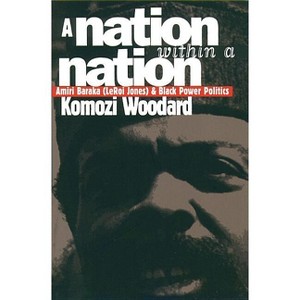
A Nation Within a Nation - by Komozi Woodard (Paperback)
In Stock
Sponsored
About this item
Highlights
- Poet and playwright Amiri Baraka is best known as one of the African American writers who helped ignite the Black Arts Movement.
- About the Author: Komozi Woodard is professor of American history at Sarah Lawrence College in Bronxville, New York.
- 400 Pages
- Biography + Autobiography, Cultural, Ethnic & Regional
Description
About the Book
Nation within a Nation: Amiri Baraka (LeRoi Jones) and Black Power PoliticsBook Synopsis
Poet and playwright Amiri Baraka is best known as one of the African American writers who helped ignite the Black Arts Movement. This book examines Baraka's cultural approach to Black Power politics and explores his role in the phenomenal spread of black nationalism in the urban centers of late-twentieth-century America, including his part in the election of black public officials, his leadership in the Modern Black Convention Movement, and his work in housing and community development.
Komozi Woodard traces Baraka's transformation from poet to political activist, as the rise of the Black Arts Movement pulled him from political obscurity in the Beat circles of Greenwich Village, swept him into the center of the Black Power Movement, and ultimately propelled him into the ranks of black national political leadership. Moving outward from Baraka's personal story, Woodard illuminates the dynamics and remarkable rise of black cultural nationalism with an eye toward the movement's broader context, including the impact of black migrations on urban ethos, the importance of increasing population concentrations of African Americans in the cities, and the effect of the 1965 Voting Rights Act on the nature of black political mobilization.
Review Quotes
"A Nation within a Nation will be one of the most important studies of black urban politics and culture in the postwar period." -- Robin D. G. Kelley, New York University
"A fascinating story on the life and work of writer and activist, Amiri Baraka. . . . A well researched book . . . the author does an excellent job of exploring the complexities of the modern black struggle for freedom in America." -- American Studies
"A well-researched, decidedly worthwhile study that enhances our understanding of Black Power stratagems." -- American Historical Review
"In giving us much to discuss and debate in its richly informative and insightful pages, [this book] deserves the widest possible audience." -- American Quarterly
"The best published work on the black power movement to date. . . . A seminal discussion of the black power movement based in both the ideological and the practical activities of a local organization led by one of the most important political and cultural figures in the post-World War II United States. Woodard's more local approach is a departure from most previous scholarship and opens a new and productive area of inquiry." -- Journal of American History
"The most important book to be written about the Black Power Movement. . . . More than a simple historical narrative, Woodard's work represents the partial recovery of discourses too often silenced within conventional African-American historiography." -- The Gaither Reporter
"Illuminates the dynamics and remarkable rise of black cultural nationalism with an eye toward the movement's broader context." -- [Charlottesville, VA]Tribune#
"Komozi Woodard's revisionist account of the evolution of Amiri Baraka into a sophisticated political activist is both balanced and moving." -- John Dittmer, DePauw University
"This book tells the fascinating story of a struggle that nearly succeeded in creating self-determination in the urban ghetto, a nation within the nation. . . . [It] is not about yesterday but the roots of today, for any readers who ask why ghettos and barrios persist as permanent features of liberal urban America, and what is to be done about them." -- Senator Tom Hayden
"This pathbreaking history of the transition from white to black political power in a northern city should be required reading for political scientists and urban planners, as well as for all citizens who care about the problems of race and class in urban America." -- John Dittmer, DePauw University
About the Author
Komozi Woodard is professor of American history at Sarah Lawrence College in Bronxville, New York. He has also worked extensively as an activist and journalist.Shipping details
Return details
Frequently bought together


Trending Non-Fiction





Discover more options