Sponsored
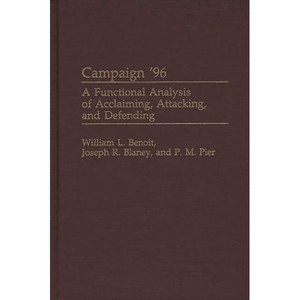
Campaign '96 - (Praeger Political Communication) by William L Benoit & Joseph R Blaney & P M Pier (Hardcover)
In Stock
Sponsored
About this item
Highlights
- Benoit, Blaney, and Pier apply the functional theory of political campaign discourse to the 1996 presidential campaign.
- About the Author: WILLIAM L. BENOIT is Professor of Communication at the University of Missouri.
- 288 Pages
- Political Science, American Government
- Series Name: Praeger Political Communication
Description
About the Book
Benoit, Blaney, and Pier apply the functional theory of political campaign discourse to the 1996 presidential campaign. When a citizen casts a vote, he or she makes a decision about which candidate is preferable. There are only three types of rhetorical strategies for persuading voters to believe a candidate is the better choice: acclaiming or self-praise, attacking or criticizing an opponent, and defending or responding to attacks. As they illustrate, acclaims, if accepted by the audience, make the candidate appear better. Attacks can make the opponent seem worse, improving the source's apparent preferability. If attacked, a candidate can attempt to restore--or prevent--lost credibility by defending against that attack.
As Benoit, Blaney, and Pier point out, the functional theory of political communication is relatively new, and their book illustrates it with a detailed analysis of the most recent presidential campaign. One of the major strengths of the study is the variety of message forms examined: television spots, debates, talk radio appearances, keynote speeches, acceptance speeches, speeches by spouses, radio addresses, and free television time remarks. It also examines all three parts of the campaign--primary, nominating conventions, and general campaign. This comprehensive analysis of the '96 presidential campaign will be of considerable use to students, scholars, and other researchers dealing with contemporary American electioneering.
Book Synopsis
Benoit, Blaney, and Pier apply the functional theory of political campaign discourse to the 1996 presidential campaign. When a citizen casts a vote, he or she makes a decision about which candidate is preferable. There are only three types of rhetorical strategies for persuading voters to believe a candidate is the better choice: acclaiming or self-praise, attacking or criticizing an opponent, and defending or responding to attacks. As they illustrate, acclaims, if accepted by the audience, make the candidate appear better. Attacks can make the opponent seem worse, improving the source's apparent preferability. If attacked, a candidate can attempt to restore--or prevent--lost credibility by defending against that attack.
As Benoit, Blaney, and Pier point out, the functional theory of political communication is relatively new, and their book illustrates it with a detailed analysis of the most recent presidential campaign. One of the major strengths of the study is the variety of message forms examined: television spots, debates, talk radio appearances, keynote speeches, acceptance speeches, speeches by spouses, radio addresses, and free television time remarks. It also examines all three parts of the campaign--primary, nominating conventions, and general campaign. This comprehensive analysis of the '96 presidential campaign will be of considerable use to students, scholars, and other researchers dealing with contemporary American electioneering.About the Author
WILLIAM L. BENOIT is Professor of Communication at the University of Missouri. He has published numerous articles and three books, including Candidates in Conflict: Persuasive Attack and Defense in the 1992 Presidential Debates (1996, with William T. Wells).
JOSEPH R. BLANEY is an Assistant Professor of Mass Communication at Northwest Missouri State University. He has published, with Benoit, in The Journal of Communication and Religion. P. M. PIER is a doctoral candidate in the Department of Communication at the University of Missouri. She has published, with Benoit and Blaney, in Communication Quarterly.Shipping details
Return details
Trending Non-Fiction