Return this item by mail or in store within 90 days for a full refund.
Eligible for registries and wish lists
About this item
Highlights
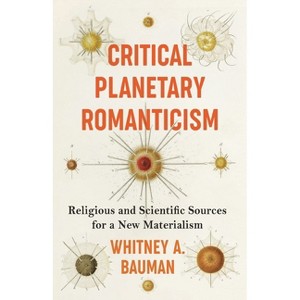
Facing planetary environmental crises, philosophers and theorists have critiqued the human exceptionalism of dominant forms of science.
About the Author: Whitney A. Bauman is professor of religious studies at Florida International University.
344 Pages
Religion, Philosophy
Description
About the Book
This book turns to the nineteenth-century German Romantic tradition to find resources for a new approach--critical planetary romanticism--that foregrounds the irreducible entanglement of all living and nonliving things.
Book Synopsis
Facing planetary environmental crises, philosophers and theorists have critiqued the human exceptionalism of dominant forms of science. Yet today is not the first moment in which technological and political change have spurred efforts to rethink humanity's place in the world. This book turns to the nineteenth-century German Romantic tradition to find resources for a new approach--critical planetary romanticism--that foregrounds the irreducible entanglement of all living and nonliving things.
Whitney A. Bauman argues that German Romantic figures such as Ernst Haeckel represent a vital alternative path for critical thought that strikingly anticipates contemporary new materialisms. Their thinking about evolution and ecology did not separate humans from the rest of the natural world but instead foregrounded an immanent understanding of the world from a position within it. Bauman traces the theological and religious influences on Romantic ecology, revealing how Christian as well as Indic and Islamic thought shaped scientific understandings of nature. Considering the history of scientific racism associated with Haeckel, he shows that critical planetary romanticism addresses the various embodied experiences of humanity and how they are shaped by power relations. At the same time, he challenges postmodern and critical theories to engage with the nonhuman world and the entirety of the planetary community. A bold intervention into environmental philosophy, Critical Planetary Romanticism reconceives new materialism and in so doing lays the groundwork for a new planetary politics.
Review Quotes
Bauman takes us on a lucid journey with nineteenth-century German Romantics and contemporary visionaries who view the natural world as emergent or evolving and eschew reductionist interpretations that have fueled technological extraction and damage. His clarion call for the adoption of a new materialism, blending science-based understandings with reverent eco-mindedness, is imbued with his deep philosophical wisdom and spiritual sensibilities.--Ursula Goodenough, author of The Sacred Depths of Nature: How Life Emerged and Evolved
Bauman's book is a tour de force, a remarkable synthesis of nineteenth-century German Romantic thinkers and twentieth-century critical theorists. It is a pathbreaking work in terms of highlighting a postmodern view of relationality and interdependence. The research is comprehensive and the conclusions are compelling. This book is original, creative, and potentially life-changing. It should be required reading for those seeking reattunements to the planetary community.--Mary Evelyn Tucker, Yale Forum on Religion and Ecology, coauthor of Journey of the Universe
In this eloquently argued and intellectually adventurous book, Bauman traces a line of thinking, knowing, and feeling about the natural world from J. G. Herder to Ernst Haeckel to articulate a contemporary religious naturalism, informed by emergent scientific understandings and attuned to current ecopolitical struggles. Written with creative verve, scholarly rigor, and ethical gravitas, Critical Planetary Romanticism proffers urgently needed insights for our ailing Earth and its diverse more-than-human denizens.--Kate Rigby, author of Reclaiming Romanticism: Towards an Ecopoetics of Decolonization
About the Author
Whitney A. Bauman is professor of religious studies at Florida International University. A cofounder of the interdisciplinary research platform Counterpoint: Navigating Knowledge, he is the author of Religion and Ecology: Developing a Planetary Ethic (Columbia, 2014) and coauthor of Environmental Ethics and Uncertainty: Wrestling with Wicked Problems (2019), among other books.
Dimensions (Overall): 8.5 Inches (H) x 5.5 Inches (W) x .77 Inches (D)
Weight: .88 Pounds
Suggested Age: 22 Years and Up
Number of Pages: 344
Genre: Religion
Sub-Genre: Philosophy
Publisher: Columbia University Press
Format: Paperback
Author: Whitney a Bauman
Language: English
Street Date: September 8, 2026
TCIN: 1010654848
UPC: 9780231211833
Item Number (DPCI): 247-12-3492
Origin: Made in the USA or Imported
If the item details aren’t accurate or complete, we want to know about it.
Shipping details
Estimated ship dimensions: 0.77 inches length x 5.5 inches width x 8.5 inches height
Estimated ship weight: 0.88 pounds
We regret that this item cannot be shipped to PO Boxes.
This item cannot be shipped to the following locations: American Samoa (see also separate entry under AS), Guam (see also separate entry under GU), Northern Mariana Islands, Puerto Rico (see also separate entry under PR), United States Minor Outlying Islands, Virgin Islands, U.S., APO/FPO, Alaska, Hawaii
Return details
This item can be returned to any Target store or Target.com.
This item must be returned within 90 days of the date it was purchased in store, delivered to the guest, delivered by a Shipt shopper, or picked up by the guest.