Target New ArrivalsGift Ideas for DadClothing, Shoes & AccessoriesHome & DecorKitchen & DiningOutdoor Living & GardenGroceryHousehold EssentialsBabyBeautyPersonal CareSports & OutdoorsHealthWellnessLuggageSchool & Office SuppliesToysElectronicsVideo GamesMovies, Music & BooksParty SuppliesGift IdeasGift CardsPetsUlta Beauty at TargetShop by CommunityTarget OpticalDealsClearanceNew ArrivalsGift Ideas for DadBack to SchoolCollegeTop DealsTarget Circle DealsWeekly AdShop Order PickupShop Same Day DeliveryRegistryRedCardTarget CircleFind Stores
Discourse on the Method - by  René Descartes (Paperback) - 1 of 1

Discourse on the Method - by René Descartes (Paperback)

$19.99

In Stock

Free & easy returns

Free & easy returns

Return this item by mail or in store within 90 days for a full refund.
Eligible for registries and wish lists

About this item

Highlights

  • Discourse on the Method of Rightly Conducting One's Reason and of Seeking Truth in the Sciences (French: Discours de la Méthode Pour bien conduire sa raison, et chercher la vérité dans les sciences) is a philosophical and autobiographical treatise published by René Descartes in 1637.
  • Author(s): René Descartes
  • 58 Pages
  • Social Science, General

Description


Book Synopsis


  • Discourse on the Method of Rightly Conducting One's Reason and of Seeking Truth in the Sciences (French: Discours de la Méthode Pour bien conduire sa raison, et chercher la vérité dans les sciences) is a philosophical and autobiographical treatise published by René Descartes in 1637. It is best known as the source of the famous quotation 'Je pense, donc je suis' (English: 'I think, therefore I am', or 'I am thinking, therefore I exist'), which occurs in Part IV of the work. The similar Latin statement, Cogito, ergo sum, is found in Meditations on First Philosophy (1641) and Principles of Philosophy (1644). Discourse on the Method is one of the most influential works in the history of modern philosophy, and important to the development of natural sciences. In this work, Descartes tackles the problem of skepticism, which had previously been studied by Sextus Empiricus, Al-Ghazali and Michel de Montaigne. Descartes modified it to account for a truth he found to be incontrovertible. Descartes started his line of reasoning by doubting everything, so as to assess the world from a fresh perspective, clear of any preconceived notions.The book was originally published in Leiden, in the Netherlands. Later, it was translated into Latin and published in 1656 in Amsterdam. The book was intended as an introduction to three works: Dioptrique, Météores and Géométrie. La Géométrie contains Descartes's initial concepts that later developed into the Cartesian coordinate system.
  • The text was written and published in French rather than the language in which philosophical and scientific texts were most frequently written and published in at the time, namely, Latin. Most of Descartes' other works were written in Latin.Together with Meditations on First Philosophy, Principles of Philosophy and Rules for the Direction of the Mind, it forms the base of the epistemology known as Cartesianism. The long chains of simple and easy reasonings by means of which geometers are accustomed to reach the conclusions of their most difficult demonstrations, had led me to imagine that all things, the knowledge of which is competent to man, are mutually connected in the same way, and that there is nothing so far removed from us as to be beyond our reach, or so hidden that we cannot discover it, provided only we abstain from accepting the false for the true, and always preserve in our thoughts the order necessary for the deduction of one truth from another. This treatise on the value of doubt and skepticism when studying the natural world laid the foundation for the modern scientific method as we still employ it today, as well as the basis for modern philosophy.
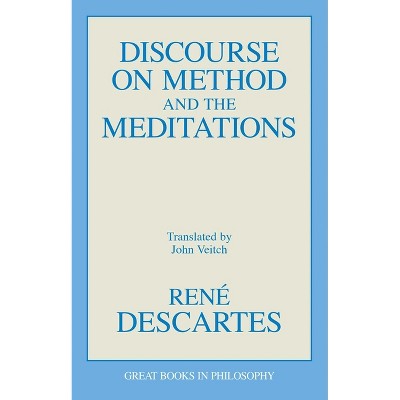
  • Written in French and first published in 1637 under the full title Discourse on the Method of Rightly Conducting the Reason, and Seeking Truth in the Sciences, it is here presented in the 1901 edition of the 1850 English translation by Scottish poet, philosopher, and historian JOHN VEITCH (1829-1894).
Dimensions (Overall): 8.27 Inches (H) x 5.83 Inches (W) x .14 Inches (D)
Weight: .19 Pounds
Suggested Age: 22 Years and Up
Number of Pages: 58
Genre: Social Science
Sub-Genre: General
Publisher: Les Prairies Numeriques
Format: Paperback
Author: René Descartes
Language: English
Street Date: October 28, 2020
TCIN: 1010991786
UPC: 9782382742303
Item Number (DPCI): 247-20-5532
Origin: Made in the USA or Imported
If the item details aren’t accurate or complete, we want to know about it.

Shipping details

Estimated ship dimensions: 0.14 inches length x 5.83 inches width x 8.27 inches height
Estimated ship weight: 0.19 pounds
We regret that this item cannot be shipped to PO Boxes.
This item cannot be shipped to the following locations: American Samoa (see also separate entry under AS), Guam (see also separate entry under GU), Northern Mariana Islands, Puerto Rico (see also separate entry under PR), United States Minor Outlying Islands, Virgin Islands, U.S., APO/FPO, Alaska, Hawaii

Return details

This item can be returned to any Target store or Target.com.
This item must be returned within 90 days of the date it was purchased in store, delivered to the guest, delivered by a Shipt shopper, or picked up by the guest.
See the return policy for complete information.

Q: How does this book relate to modern scientific methods?

submitted by AI Shopping Assistant - 22 days ago
  • A: It laid the foundation for the modern scientific method by promoting doubt and careful reasoning in studies of the natural world.

    submitted byAI Shopping Assistant - 22 days ago
    Ai generated

Q: What is the main focus of Descartes' work?

submitted by AI Shopping Assistant - 22 days ago
  • A: The work emphasizes the importance of reasoning and skepticism in understanding truth and the natural sciences.

    submitted byAI Shopping Assistant - 22 days ago
    Ai generated

Q: What famous quote is derived from this book?

submitted by AI Shopping Assistant - 22 days ago
  • A: The well-known quote is 'Je pense, donc je suis', meaning 'I think, therefore I am'.

    submitted byAI Shopping Assistant - 22 days ago
    Ai generated

Q: How did Descartes approach the problem of skepticism?

submitted by AI Shopping Assistant - 22 days ago
  • A: He began by doubting everything to evaluate the world from a fresh perspective, free from preconceived notions.

    submitted byAI Shopping Assistant - 22 days ago
    Ai generated

Q: In what language was the original work published?

submitted by AI Shopping Assistant - 22 days ago
  • A: The original work was published in French, a departure from the usual Latin of philosophical texts at that time.

    submitted byAI Shopping Assistant - 22 days ago
    Ai generated

Additional product information and recommendations

Discover more options

Get top deals, latest trends, and more.

Privacy policy