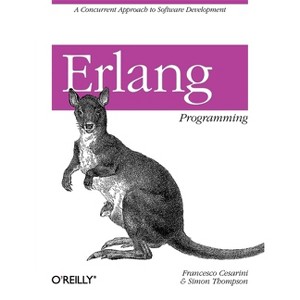
This book is an in-depth introduction to Erlang, a programming language ideal for any situation where concurrency, fault tolerance, and fast response is essential.
About the Author: Francesco Cesarini is the founder and CTO of Erlang Training and Consulting http: //www.erlang-consulting.com/.
494 Pages
Computers + Internet, Programming
Description
About the Book
This work provides an in-depth explanation of the basics and essentials of the functional programming language Erlang.
Book Synopsis
This book is an in-depth introduction to Erlang, a programming language ideal for any situation where concurrency, fault tolerance, and fast response is essential. Erlang is gaining widespread adoption with the advent of multi-core processors and their new scalable approach to concurrency. With this guide you'll learn how to write complex concurrent programs in Erlang, regardless of your programming background or experience.
Written by leaders of the international Erlang community -- and based on their training material -- Erlang Programming focuses on the language's syntax and semantics, and explains pattern matching, proper lists, recursion, debugging, networking, and concurrency.
This book helps you:
Understand the strengths of Erlang and why its designers included specific features
Learn the concepts behind concurrency and Erlang's way of handling it
Write efficient Erlang programs while keeping code neat and readable
Discover how Erlang fills the requirements for distributed systems
Add simple graphical user interfaces with little effort
Learn Erlang's tracing mechanisms for debugging concurrent and distributed systems
Use the built-in Mnesia database and other table storage features
Erlang Programming provides exercises at the end of each chapter and simple examples throughout the book.
About the Author
Francesco Cesarini is the founder and CTO of Erlang Training and Consulting http: //www.erlang-consulting.com/. Having used Erlang on a daily basis since 1995, he started his career as an intern at Ericsson's computer science lab, the birth place of Erlang. He spent four years at Ericsson working with flagship Erlang projects, including the R1 release of the OTP middleware. He has taught Erlang/OTP to all parties involved in the software cycle, including developers, support engineers, testers as well as project and technical managers. In 2003, he also started teaching undergraduate students at the IT University of Gothenburg.
Soon after Erlang was released as Open Source, he founded Erlang Training and Consulting. With offices in the UK, Sweden, Poland (and soon the US), they have become the world leaders an Erlang based consulting, contracting, support, training and systems development. Their client base is spread on five continents and ranges from small start-ups to blue chip companies. In his role as CTO, is currently leading the research, development and consulting teams.
He is active in the Erlang community not only through regularly talks, seminars and tutorials at conferences worldwide, but also through his involvement in international research projects. He organises local Erlang user groups and with the help of his colleagues, runs the trapexit.org http: //www.trapexit.org/ Erlang community website.
Simon Thompson is Professor of Logic and Computation in the Computing Laboratory of the University of Kent, where he has taught computing at undergraduate and postgraduate levels for the past twenty five years, and where he has been department head for the last six.
His research work has centered on functional programming: program verification, type systems, and most recently development of software tools for functional programming languages. His team has built the HaRe tool for refactoring Haskell programs, and is currently developing Wrangler to do the same for Erlang. His research has been funded by various agencies including EPSRC and the European Framework programme. His training is as a mathematician: he has an MA in Mathematics from Cambridge and a D.Phil. in mathematical logic from Oxford.
He has written three books in his field of interest; Type Theory and Functional Programming published in 1991; Miranda: The Craft of Functional Programming (1995) and Haskell: The Craft of Functional Programming (2nd ed. 1999). These are all published by Addison Wesley.
Dimensions (Overall): 9.2 Inches (H) x 7.0 Inches (W) x 1.1 Inches (D)
Weight: 1.75 Pounds
Suggested Age: 22 Years and Up
Number of Pages: 494
Genre: Computers + Internet
Sub-Genre: Programming
Publisher: O'Reilly Media
Theme: General
Format: Paperback
Author: Francesco Cesarini & Simon Thompson
Language: English
Street Date: July 28, 2009
TCIN: 1007907212
UPC: 9780596518189
Item Number (DPCI): 247-13-3420
Origin: Made in the USA or Imported
If the item details aren’t accurate or complete, we want to know about it.
Shipping details
Estimated ship dimensions: 1.1 inches length x 7 inches width x 9.2 inches height
Estimated ship weight: 1.75 pounds
We regret that this item cannot be shipped to PO Boxes.
This item cannot be shipped to the following locations: American Samoa (see also separate entry under AS), Guam (see also separate entry under GU), Northern Mariana Islands, Puerto Rico (see also separate entry under PR), United States Minor Outlying Islands, Virgin Islands, U.S., APO/FPO
Return details
This item can be returned to any Target store or Target.com.
This item must be returned within 90 days of the date it was purchased in store, delivered to the guest, delivered by a Shipt shopper, or picked up by the guest.