Target New ArrivalsBack to SchoolCollegeHalloweenClothing, Shoes & AccessoriesHome & DecorKitchen & DiningOutdoor Living & GardenGroceryHousehold EssentialsBabyBeautyPersonal CareSports & OutdoorsPetsHealthWellnessSchool & Office SuppliesToys & GamesElectronics & TechVideo GamesMovies, Music & BooksParty SuppliesGift IdeasGift CardsShop by CommunityTarget OpticalDealsClearanceNew ArrivalsBack to SchoolCollegeTop DealsTarget Circle DealsWeekly AdShop Order PickupShop Same Day DeliveryRegistryRedCardTarget CircleFind Stores
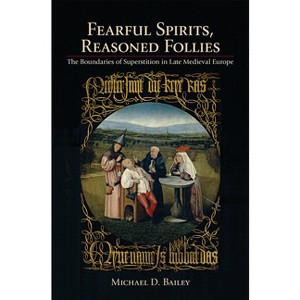
Fearful Spirits, Reasoned Follies - by  Michael D Bailey (Paperback) - 1 of 1

Fearful Spirits, Reasoned Follies - by Michael D Bailey (Paperback)

$41.95

In Stock

Free & easy returns
Free & easy returns
Return this item by mail or in store within 90 days for a full refund.
Eligible for registries and wish lists
Save 5% every day
With Target Circle™ Card (restrictions apply)

About this item

Highlights

  • Superstitions are commonplace in the modern world.
  • About the Author: Michael D. Bailey is Associate Professor of History at Iowa State University.
  • 312 Pages
  • History, Europe

Description


About the Book


Explores the thorny concept of superstition as it was understood and debated in the Middle Ages.


Book Synopsis


Superstitions are commonplace in the modern world. Mostly, however, they evoke innocuous images of people reading their horoscopes or avoiding black cats. Certain religious practices might also come to mind--praying to St. Christopher or lighting candles for the dead. Benign as they might seem today, such practices were not always perceived that way. In medieval Europe superstitions were considered serious offenses, violations of essential precepts of Christian doctrine or immutable natural laws. But how and why did this come to be? In Fearful Spirits, Reasoned Follies, Michael D. Bailey explores the thorny concept of superstition as it was understood and debated in the Middle Ages.

Bailey begins by tracing Christian thinking about superstition from the patristic period through the early and high Middle Ages. He then turns to the later Middle Ages, a period that witnessed an outpouring of writings devoted to superstition--tracts and treatises with titles such as De superstitionibus and Contra vitia superstitionum. Most were written by theologians and other academics based in Europe's universities and courts, men who were increasingly anxious about the proliferation of suspect beliefs and practices, from elite ritual magic to common healing charms, from astrological divination to the observance of signs and omens. As Bailey shows, however, authorities were far more sophisticated in their reasoning than one might suspect, using accusations of superstition in a calculated way to control the boundaries of legitimate religion and acceptable science. This in turn would lay the conceptual groundwork for future discussions of religion, science, and magic in the early modern world. Indeed, by revealing the extent to which early modern thinkers took up old questions about the operation of natural properties and forces using the vocabulary of science rather than of belief, Bailey exposes the powerful but in many ways false dichotomy between the "superstitious" Middle Ages and "rational" European modernity.


Review Quotes


Fearful Spirits, Unreasoned Follies is a groundbreaking work, suitable for graduate seminars and advanced undergraduate courses on premodern magic and witchcraft. It exemplifies why Bailey is one of the best scholars writing about the Middle Ages today.

-- "The Catholic Historical Review"

As many scholars have pointed out, the differences between religion and superstition are in the eye of the beholder. Focusing largely on the works of French--and German--speaking theologians, Mark Bailey's detailed and readable new book argues that debates about this boundary were also important to medieval thinking.

-- "the english historical review"

As Bailey elegantly points out, church authorities used superstition to promote proper religious devotion, and understanding these actions and beliefs is vital to understanding medieval culture and society. Basing his book upon a close reading of the primary sources, Bailey clearly explains the importance of superstition among the elite and in common practice during the late Middle Ages and explains how authorities sought to create a coherent theory of superstition to better control society. Summing Up: Highly recommended.

-- "Choice"

Bailey draws on a range of theorists and specialists to contribute meaningfully to the deconstruction of that great scholarly irony: modernity.... It amused this reader greatly that through a study of medieval understandings of superstition, Bailey helps to show that modernity itself is every bit as shadowy a thing as are those werewolves of the forest.

-- "Journal of Religious History"

Bailey provides his reader with a broad overview of Christian thinking about superstition from the patristic period through to the fourteenth century. The complexity of the multiple meanings that inhered in the term is immediately apparent, but Bailey writes with an eye to the future, and particularly the emergence of what he sees as a new impetus in this long-standing discussion.

-- "Renaissance Quarterly"

Bailey writes clearly, without jargon and is excellent at noting changes in emphasis over time and differences between his sources without overplaying them. Yet he is far from being unreflective and concludes with a chapter explicitly pondering the trope of "modernity" and the role the concept of superstition has played in its construction.

-- "Speculum"

Bailey's approach to late medieval superstition highlights the challenges of determining what constitutes acceptable spiritual practice. He emphasizes that an exact definition of superstition may not exist: superstition itself is slippery and protean.... Bailey enriches his subject while expanding its relevance.

-- "Fortean Times"

Elegantly written and cogently argued, Bailey's book should be required reading for undergraduate and graduate students in a variety of fields, from European History and Religion to the History of Science. For scholars, Bailey has generously provided a wealth of material for further study in an Appendix of Late Medieval Sources Addressing Superstition.

-- "magic, ritual, and witchcraft"

The book's structure is clear, logical, and useful.... Bailey has addressed a very complicated topic with impressive skill, facing multiple difficulties with the subject matter head-on. His convincing argument regarding the changes in the meaning of "superstition" lead to one of the first statements of the conclusion, that "there is the abiding modern prejudice to view both the 'medieval' and the 'superstitious' as indicative of fundamentally immutable premodern irrationality.... This, then, is a much welcome book, useful to historians of both religion and magic alike.

-- "The Journal of religion"

This stimulating book traces a neglected thread in the Western intellectualtradition and challenges those modern prejudices and tropes of medievalsuperstition that are so irritating and offensive to historians of the period. Although the main focus of Michael Bailey's investigations is predominantly German writers of the fourteenth and fifteenth centuries, he placesthem within a discourse stretching back to the Romans and forward intoour own time.... Bailey is to be commended for approaching these complex issues from a fresh and provocative angle. Students of both science and witchcraft have much to ponder here.

-- "Parergon - Journal of the Australian and New Zealand Association for Medieval and Early Modern Studies"


About the Author


Michael D. Bailey is Associate Professor of History at Iowa State University. He is the author of Battling Demons: Witchcraft, Heresy, and Reform in the Late Middle Ages; Historical Dictionary of Witchcraft; and Magic and Superstition in Europe: A Concise History from Antiquity to the Present.

Dimensions (Overall): 9.21 Inches (H) x 6.14 Inches (W) x .7 Inches (D)
Weight: 1.06 Pounds
Suggested Age: 22 Years and Up
Number of Pages: 312
Genre: History
Sub-Genre: Europe
Publisher: Cornell University Press
Theme: Medieval
Format: Paperback
Author: Michael D Bailey
Language: English
Street Date: November 15, 2017
TCIN: 1013192143
UPC: 9781501714733
Item Number (DPCI): 247-60-7683
Origin: Made in the USA or Imported
If the item details aren’t accurate or complete, we want to know about it.

Shipping details

Estimated ship dimensions: 0.7 inches length x 6.14 inches width x 9.21 inches height
Estimated ship weight: 1.06 pounds
We regret that this item cannot be shipped to PO Boxes.
This item cannot be shipped to the following locations: American Samoa (see also separate entry under AS), Guam (see also separate entry under GU), Northern Mariana Islands, Puerto Rico (see also separate entry under PR), United States Minor Outlying Islands, Virgin Islands, U.S., APO/FPO, Alaska, Hawaii

Return details

This item can be returned to any Target store or Target.com.
This item must be returned within 90 days of the date it was purchased in store, delivered to the guest, delivered by a Shipt shopper, or picked up by the guest.
See the return policy for complete information.

Additional product information and recommendations

Discover more options

Skip to next section

Best-selling All Book Genres

Skip to next section

Get top deals, latest trends, and more.