Target New ArrivalsGift Ideas for DadClothing, Shoes & AccessoriesHome & DecorKitchen & DiningOutdoor Living & GardenGroceryHousehold EssentialsBabyBeautyPersonal CareSports & OutdoorsHealthWellnessLuggageSchool & Office SuppliesToysElectronicsVideo GamesMovies, Music & BooksParty SuppliesGift IdeasGift CardsPetsUlta Beauty at TargetShop by CommunityTarget OpticalDealsClearanceNew ArrivalsGift Ideas for DadBack to SchoolCollegeTop DealsTarget Circle DealsWeekly AdShop Order PickupShop Same Day DeliveryRegistryRedCardTarget CircleFind Stores
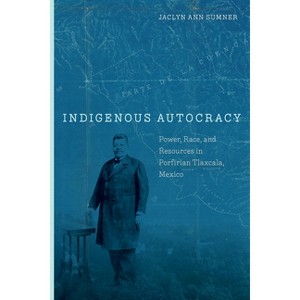
Indigenous Autocracy - by  Jaclyn Sumner (Paperback) - 1 of 1

Indigenous Autocracy - by Jaclyn Sumner (Paperback)

$30.00

In Stock

Free & easy returns

Free & easy returns

Return this item by mail or in store within 90 days for a full refund.
Eligible for registries and wish lists

About this item

Highlights

  • When General Porfirio Díaz assumed power in 1876, he ushered in Mexico's first prolonged period of political stability and national economic growth--though "progress" came at the cost of democracy.
  • About the Author: Jaclyn Ann Sumner is Associate Professor of History at Presbyterian College.
  • 244 Pages
  • History, Latin America

Description


About the Book


"When General Porfirio Dâiaz assumed power in 1876, he ushered in Mexico's first prolonged period of political stability and national economic growth - though "progress" came at the cost of democracy. Indigenous Autocracy presents a new story about how regional actors negotiated between national authoritarian rule and local circumstances by explaining how an Indigenous person held state level power in Mexico during the thirty-five year dictatorship that preceded the Mexican Revolution (the Porfiriato), and the apogee of scientific racism across Latin America. Although he was one of few recognizably Indigenous persons in office, Prâospero Cahuantzi of Tlaxcala kept his position (1885-1911) longer than any other gubernatorial appointee under Porfirio Dâiaz's transformative but highly oppressive dictatorship (1876-1911). Cahuantzi leveraged his identity and his region's Indigenous heritage to ingratiate himself to Dâiaz and other nation-building elites. Locally, Cahuantzi navigated between national directives aimed at modernizing Mexico, often at the expense of the impoverished rural majority, and strategic management of Tlaxcala's natural resources - in particular, balancing growing industrial demand for water with the needs of the local population. Jaclyn Ann Sumner shows how this intermediary actor brokered national expectations and local conditions to maintain state power, challenging the idea that governors during the Porfirian dictatorship were little more than provincial stewards who repressed dissent. Drawing upon documentation from over a dozen Mexican archives, the book brings Porfirian-era Mexico into critical conversations about race and environmental politics in Latin America"--


Book Synopsis


When General Porfirio Díaz assumed power in 1876, he ushered in Mexico's first prolonged period of political stability and national economic growth--though "progress" came at the cost of democracy. Indigenous Autocracy presents a new story about how regional actors negotiated between national authoritarian rule and local circumstances by explaining how an Indigenous person held state-level power in Mexico during the thirty-five-year dictatorship that preceded the Mexican Revolution (the Porfiriato), and the apogee of scientific racism across Latin America.

Although he was one of few recognizably Indigenous persons in office, Próspero Cahuantzi of Tlaxcala kept his position (1885-1911) longer than any other gubernatorial appointee under Porfirio Díaz's transformative but highly oppressive dictatorship (1876-1911). Cahuantzi leveraged his identity and his region's Indigenous heritage to ingratiate himself to Díaz and other nation-building elites. Locally, Cahuantzi navigated between national directives aimed at modernizing Mexico, often at the expense of the impoverished rural majority, and strategic management of Tlaxcala's natural resources--in particular, balancing growing industrial demand for water with the needs of the local population. Jaclyn Ann Sumner shows how this intermediary actor brokered national expectations and local conditions to maintain state power, challenging the idea that governors during the Porfirian dictatorship were little more than provincial stewards who repressed dissent. Drawing upon documentation from more than a dozen Mexican archives, the book brings Porfirian-era Mexico into critical conversations about race and environmental politics in Latin America.


Review Quotes


"Indigenous Autocracy reveals how Tlaxcala's Próspero Cahuantzi managed to stay in power for twenty-six years as one of Mexico's few 'full-blooded' Indigenous governors. Compellingly arguing that the secret to Cahuantzi's political longevity was a deft and selective use of his indigeneity and its signifiers, the book effectively integrates cultural, political, and environmental history to revise our understanding of Porfirian Mexico." --Mikael Wolfe, Stanford University

"Jaclyn Ann Sumner's well-written and well-documented research represents the current state of Porfiriato historiography: one that broadens its gaze while blending the cultural and postmodern approach with interpretations on the right of the ideological spectrum. Indigenous Autocracy is a useful work for specialists familiar with the extensive historiographical production on Tlaxcala and the Porfirian years." --Jose Alfredo Rangel Silva, Hispanic American Historical Review

"Reconstructing in painstaking detail the life and times of a powerful Indigenous governor, Jaclyn Ann Sumner gives us a heady combination of predictable elite thuggery and development with far less predictable racial politics, regional autonomy, development, environmental consideration, and even populism. The result is credible, readable, and professionally unmissable." --Paul Gillingham Northwestern University

"Sumner's Indigenous Autocracy masterfully demonstrates how bringing together research on race, the environment, technology, and local history can illuminate broader changes in identity politics, nation-state construction, development, and power." --Justin Castro, H-Environment

"This book brings new perspectives to state-level politics in Porfirian Mexico, the stable interlude between the political wars of the 1850s and 1860s, and the revolutionary conflicts that began in 1910." --John Tutino, Pacific Historical Review

"This is a well-researched lens into Mexican politics, society, and culture during a critical period in Mexico's history. Recommended." --E. C. Rothera, CHOICE

"While historians often highlight the elite's double standard toward the Indigenous past and present, much less attention has been given to how those who self-identified as Indigenous sought to connect past and present, how they challenged elite criteria to neatly separate Indigenous from non-Indigenous artifacts and practices, or how they contested definitions of indigeneity. Sumner interestingly shows how Cahuantzi produced alternative understandings of indigeneity, like when he himself joined the ranks of those seeking to preserve and exhibit Indigenous antiques, or when he delivered a speech in Nahuatl at the International Congress of Americanists in Mexico City." --Ariadna Acevedo-Rodrigo, American Historical Review


About the Author


Jaclyn Ann Sumner is Associate Professor of History at Presbyterian College.
Dimensions (Overall): 8.9 Inches (H) x 5.9 Inches (W) x .6 Inches (D)
Weight: .75 Pounds
Suggested Age: 22 Years and Up
Number of Pages: 244
Genre: History
Sub-Genre: Latin America
Publisher: Stanford University Press
Theme: Mexico
Format: Paperback
Author: Jaclyn Sumner
Language: English
Street Date: November 14, 2023
TCIN: 1006999778
UPC: 9781503637399
Item Number (DPCI): 247-48-2100
Origin: Made in the USA or Imported
If the item details aren’t accurate or complete, we want to know about it.

Shipping details

Estimated ship dimensions: 0.6 inches length x 5.9 inches width x 8.9 inches height
Estimated ship weight: 0.75 pounds
We regret that this item cannot be shipped to PO Boxes.
This item cannot be shipped to the following locations: American Samoa (see also separate entry under AS), Guam (see also separate entry under GU), Northern Mariana Islands, Puerto Rico (see also separate entry under PR), United States Minor Outlying Islands, Virgin Islands, U.S., APO/FPO, Alaska, Hawaii

Return details

This item can be returned to any Target store or Target.com.
This item must be returned within 90 days of the date it was purchased in store, delivered to the guest, delivered by a Shipt shopper, or picked up by the guest.
See the return policy for complete information.

Q: Who is the author of Indigenous Autocracy?

submitted by AI Shopping Assistant - 2 days ago
  • A: Jaclyn Ann Sumner is the author and an Associate Professor of History at Presbyterian College.

    submitted byAI Shopping Assistant - 2 days ago
    Ai generated

Q: How did Cahuantzi maintain his political power?

submitted by AI Shopping Assistant - 2 days ago
  • A: Cahuantzi leveraged his Indigenous identity and regional heritage to align with national elites while managing local needs.

    submitted byAI Shopping Assistant - 2 days ago
    Ai generated

Q: What is the main focus of Indigenous Autocracy?

submitted by AI Shopping Assistant - 2 days ago
  • A: The book explores how regional actors navigated national authoritarian rule in Mexico, particularly through the governance of Indigenous leader Prospero Cahuantzi.

    submitted byAI Shopping Assistant - 2 days ago
    Ai generated

Q: What historical period does the book cover?

submitted by AI Shopping Assistant - 2 days ago
  • A: It covers the Porfirio Diaz dictatorship in Mexico from 1876 to 1911, focusing on political stability and economic growth.

    submitted byAI Shopping Assistant - 2 days ago
    Ai generated

Q: What themes are explored in the book?

submitted by AI Shopping Assistant - 2 days ago
  • A: The book discusses race, environmental politics, and the complexities of governance during the Porfirian era in Mexico.

    submitted byAI Shopping Assistant - 2 days ago
    Ai generated

Additional product information and recommendations

Discover more options

Get top deals, latest trends, and more.

Privacy policy