Sponsored
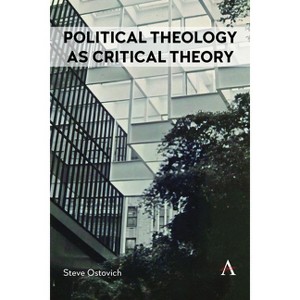
Political Theology as Critical Theory - by Steve Ostovich (Paperback)
Pre-order
Sponsored
About this item
Highlights
- Reimagines political theory through a critical political theology that challenges liberal individualism and proposes a historically grounded, action-oriented vision of political reason and subjectivity informed by eschatological time.
- About the Author: Steve Ostovich is Professor Emeritus of Philosophy at the College of St. Scholastica and resides in Minnesota, USA.
- 100 Pages
- Philosophy, Political
Description
About the Book
This book maps a new path to understanding subjectivity and history in response to the challenges faced by modern political thinking, including the shortcomings of liberal individualism in accounting for our lives together. It describes a critical theory derived from political theology and focused on temporal existence without recourse to atemporal principles.
Book Synopsis
Reimagines political theory through a critical political theology that challenges liberal individualism and proposes a historically grounded, action-oriented vision of political reason and subjectivity informed by eschatological time.
Political theology classically and traditionally was about legitimizing state power by grounding it in a metaphysical order revealed in nature. Thomas Hobbes's Leviathan interrupted this tradition and set political theory on a new, culturally modern course. Hobbes secularized biblical myth to describe how a political order based on a social contract among naturally free and independent individuals works. Hobbes was a natural scientist, and the development of the modern sciences in which Hobbes participated undermined confidence in any natural order based on metaphysical principles. He defined liberty in terms derived from physics as simply the absence of impediments and defended the freedom of individuals to think for themselves. Hobbes also was an early modern biblical critic subjecting biblical texts to historical criticism, and he might be said to have demythologized the Leviathan: his mythological beast turns out to be a big machine. But Hobbes also recognized the usefulness of religion for understanding and encouraging obedience to state power. He stipulated that the Sovereign has the power to establish the religion to be espoused publicly in the worship and opinions of the subjects of the state but at the same time (and in line with his modern principles) allowed for individuals to maintain a private reserve regarding their personal beliefs, thereby opening the door to conflicts that bedevil political life today. The new political theology of Johann Baptist Metz offers a way to work through the tensions and conflicts of contemporary political life. Classical political theology and modern social contract theory are both concerned with establishing and legitimizing order and (at least for modern political theory) security. Metz's political theology shifts attention to the meaning of political action and the perpetually unfulfilled hope for justice in history. Metz participated in Marxist-Christian dialogue in the 1960s leading him to a "theology of the world" which reads the world as eschatological history (in the manner of Walter Benjamin's messianic history) rather than as nature and understands historical action as informed by hope in the promise of political justice, a promise defined negatively (in the manner of Theodor Adorno's critical negativity) as the "eschatological proviso" that all political systems are provisional in light of the unrealized promise of justice. Metz understands reason anamnestically as based on "dangerous memories" (another Benjamin category) of past suffering or anamnestic solidarity with the dead whose suffering precludes closure of meaning. Metz offers an image for this work expressed in terms of the cultural history of the West: he is proposing a return to "Jerusalem" as understood in Tertullian's distinction "Jerusalem versus Athens." Christian theology turned to "Athens" and categories derived from Greek philosophy to explain itself. Both Tertullian and Metz called for a return to "Jerusalem" and the categories of (Jewish) biblical thinking. For Tertullian, this was preserving faith from rational criticism; for Metz, "Jerusalem" is still about reason. But Metz also recognizes the threats to this history-integrated reason like the Holocaust. This requires confronting the challenge of Auschwitz as a paradigm of meaningless suffering that cannot be explained; neither can it be denied, and we are left with unanswerable questions that nevertheless must direct our thinking. A new political theology makes possible new ways of thinking through the challenges of modern political culture. A primary case is political subjectivity. Modern political culture begins with liberal individualism: the question becomes why rational individuals live together in organized groups. For Hobbes, our natural freedom and equality result in the war of each against all, making life "nasty, brutish, and short." Our response is to enter a social contract in which we hand over some of our liberty to a state we create to protect our lives (and property). At base, politics is about survival (biopolitics), about bare life and not the good human life. An alternative is the political subjectivity found in the Israelite prophet Amos whose understanding of repentance locates the meaning of individual lives in their maintenance of the covenant vitality of the people. Individual existence derives from community life without being incorporated into collective identity. Hannah Arendt and Judith Butler offer parallel insights into political subjectivity: Arendt by finding a related political subjectivity in Socrates and by describing freedom as the human capacity to do something new that depends on being witnessed by others to become real, and Butler by describing subjectivity as developing in responsibility to and with others. Rather than conflict and contradiction between the individual and community, politics is where we exist as free subjects. (Other cases also are examined.)
About the Author
Steve Ostovich is Professor Emeritus of Philosophy at the College of St. Scholastica and resides in Minnesota, USA.
Shipping details
Return details
Frequently bought together



Trending Book Pre-Orders