Target New ArrivalsGift Ideas for MomClothing, Shoes & AccessoriesHome & DécorKitchen & DiningOutdoor Living & GardenFurnitureGroceryHousehold EssentialsBabyBeautyPersonal CareHealthWellnessLuggageSports & OutdoorsToysElectronicsVideo GamesMovies, Music & BooksSchool & Office SuppliesParty SuppliesGift IdeasGift CardsPetsUlta Beauty at TargetShop by CommunityTarget OpticalDealsClearanceTarget New ArrivalsSpring OutfitsGift Ideas for MomWomen’s Festival OutfitsTop DealsTarget Circle DealsWeekly AdShop Order PickupShop Same Day DeliveryRegistryRedCardTarget CircleFind Stores
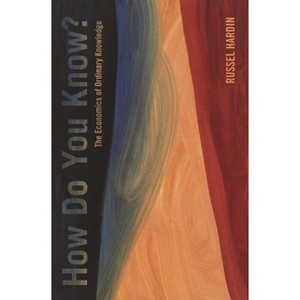
How Do You Know? - by  Russell Hardin (Paperback) - 1 of 1

How Do You Know? - by Russell Hardin (Paperback)

$24.95Save $2.00 (7% off)

In Stock

Eligible for registries and wish lists

About this item

Highlights

  • How do ordinary people come to know or believe what they do?
  • About the Author: Russell Hardin is professor of politics at New York University and the author of many books, including "David Hume: Moral and Political Theorist, Indeterminacy and Society" (Princeton), "Liberalism, Constitutionalism, and Democracy," and "One for All: The Logic of Group Conflict" (Princeton).
  • 240 Pages
  • Philosophy, Epistemology

Description


Book Synopsis


How do ordinary people come to know or believe what they do? We need an account of this process to help explain why people act as they do. You might think I am acting irrationally--against my interest or my purpose--until you realize that what you know and what I know differ significantly. My actions, given my knowledge, might make eminently good sense. Of course, this pushes our problem back one stage to assess why someone knows or believes what they do. That is the focus of this book. Russell Hardin supposes that people are not usually going to act knowingly against their interests or other purposes. To try to understand how they have come to their knowledge or beliefs is therefore to be charitable in assessing their rationality. Hardin insists on such a charitable stance in the effort to understand others and their sometimes objectively perverse actions.

Hardin presents an essentially economic account of what an individual can come to know and then applies this account to many areas of ordinary life: political participation, religious beliefs, popular knowledge of science, liberalism, culture, extremism, moral beliefs, and institutional knowledge. All of these can be enlightened by the supposition that people are attempting reasonable actions under the severe constraints of acquiring better knowledge when they face demands that far outstretch their possibilities.


From the Back Cover


"This book develops a general, economic theory of ordinary knowledge and applies it to many different kinds of knowledge and belief, providing a clear and convincing view of many of the world's problems, such as fanaticism and nationalism. A significant contribution that will be useful to readers in many different fields, How Do You Know? is also beautifully written and a pleasure to read."--Jonathan Baron, University of Pennsylvania

"Russell Hardin's How Do You Know? is original, thought provoking, and important. It raises questions of both practical and intellectual significance and it is very well written--indeed, it is an engrossing read."--Geoffrey Brennan, Duke University and University of North Carolina, Chapel Hill


Review Quotes


"[Hardin] he offers an insightful lens on popular knowledge in society and politics."---Mark B. Brown, Perspectives on Politics

"Overall, this book is a good choice for anybody with broad interests, as Hardin is highly knowledgeable on an impressive broad scale of issues. It is well-written, and the many international examples give this book a rare global perspective. . . . [I]t is an essential reference that serves as an excellent guide to a fast, multidisciplinary theme."---Hans Dubois, CEU Political Science Journal

"This book is an exceptionally clear statement of why individuals believe and act as they do and should be especially useful to policy makers."-- "Choice"


About the Author


Russell Hardin is professor of politics at New York University and the author of many books, including "David Hume: Moral and Political Theorist, Indeterminacy and Society" (Princeton), "Liberalism, Constitutionalism, and Democracy," and "One for All: The Logic of Group Conflict" (Princeton).
Dimensions (Overall): 9.21 Inches (H) x 6.14 Inches (W) x .55 Inches (D)
Weight: .83 Pounds
Suggested Age: 22 Years and Up
Number of Pages: 240
Genre: Philosophy
Sub-Genre: Epistemology
Publisher: Princeton University Press
Format: Paperback
Author: Russell Hardin
Language: English
Street Date: January 5, 2014
TCIN: 1001922081
UPC: 9780691162225
Item Number (DPCI): 247-18-3993
Origin: Made in the USA or Imported
If the item details aren’t accurate or complete, we want to know about it.

Shipping details

Estimated ship dimensions: 0.55 inches length x 6.14 inches width x 9.21 inches height
Estimated ship weight: 0.83 pounds
We regret that this item cannot be shipped to PO Boxes.
This item cannot be shipped to the following locations: American Samoa (see also separate entry under AS), Guam (see also separate entry under GU), Northern Mariana Islands, Puerto Rico (see also separate entry under PR), United States Minor Outlying Islands, Virgin Islands, U.S., APO/FPO, Alaska, Hawaii

Return details

This item can be returned to any Target store or Target.com.
This item must be returned within 90 days of the date it was purchased in store, delivered to the guest, delivered by a Shipt shopper, or picked up by the guest.
See the return policy for complete information.

Q: What genres does this book belong to?

submitted by AI Shopping Assistant - 27 days ago
  • A: This book belongs to the genres of philosophy and epistemology.

    submitted byAI Shopping Assistant - 27 days ago
    Ai generated

Q: How does Hardin approach the study of knowledge?

submitted by AI Shopping Assistant - 27 days ago
  • A: Hardin uses an economic theory to explain how individuals acquire knowledge and the factors influencing their beliefs.

    submitted byAI Shopping Assistant - 27 days ago
    Ai generated

Q: What type of readership is this book intended for?

submitted by AI Shopping Assistant - 27 days ago
  • A: The book is suggested for readers aged 22 years and up, with broad interests in knowledge and belief.

    submitted byAI Shopping Assistant - 27 days ago
    Ai generated

Q: What is the main focus of this book?

submitted by AI Shopping Assistant - 27 days ago
  • A: The book focuses on understanding how ordinary people form their beliefs and knowledge, and why they act based on these.

    submitted byAI Shopping Assistant - 27 days ago
    Ai generated

Q: Who is the author of the book?

submitted by AI Shopping Assistant - 27 days ago
  • A: The author is Russell Hardin, a professor of politics at New York University.

    submitted byAI Shopping Assistant - 27 days ago
    Ai generated

Additional product information and recommendations

Get top deals, latest trends, and more.

Privacy policy

Footer

About Us

About TargetCareersNews & BlogTarget BrandsBullseye ShopSustainability & GovernancePress CenterAdvertise with UsInvestorsAffiliates & PartnersSuppliersTargetPlus

Help

Target HelpReturnsTrack OrdersRecallsContact UsFeedbackAccessibilitySecurity & FraudTeam Member ServicesLegal & Privacy

Stores

Find a StoreClinicPharmacyTarget OpticalMore In-Store Services

Services

Target Circle™Target Circle™ CardTarget Circle 360™Target AppRegistrySame Day DeliveryOrder PickupDrive UpFree 2-Day ShippingShipping & DeliveryMore Services
PinterestFacebookInstagramXYoutubeTiktokTermsCA Supply ChainPrivacy PolicyCA Privacy RightsYour Privacy ChoicesInterest Based AdsHealth Privacy Policy