Target New ArrivalsGift Ideas for DadClothing, Shoes & AccessoriesHome & DecorKitchen & DiningOutdoor Living & GardenGroceryHousehold EssentialsBabyBeautyPersonal CareSports & OutdoorsHealthWellnessLuggageSchool & Office SuppliesToysElectronicsVideo GamesMovies, Music & BooksParty SuppliesGift IdeasGift CardsPetsUlta Beauty at TargetShop by CommunityTarget OpticalDealsClearanceNew ArrivalsGift Ideas for DadBack to SchoolCollegeTop DealsTarget Circle DealsWeekly AdShop Order PickupShop Same Day DeliveryRegistryRedCardTarget CircleFind Stores
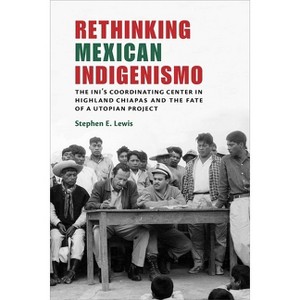
Rethinking Mexican Indigenismo - by  Stephen E Lewis (Paperback) - 1 of 1

Rethinking Mexican Indigenismo - by Stephen E Lewis (Paperback)

$34.99

In Stock

Free & easy returns

Free & easy returns

Return this item by mail or in store within 90 days for a full refund.
Eligible for registries and wish lists

About this item

Highlights

  • Honorable Mention for the 2019 Thomas McGann Book Prize from the Rocky Mountain Council for Latin American Studies Mexico's National Indigenist Institute (INI) was at the vanguard of hemispheric indigenismo from 1951 through the mid-1970s, thanks to the innovative development projects that were first introduced at its pilot Tseltal-Tsotsil Coordinating Center in highland Chiapas.
  • About the Author: Stephen E. Lewis is a professor of history at California State University, Chico.
  • 360 Pages
  • History, Latin America

Description


About the Book


This book traces how indigenista innovation gave way to stagnation as local opposition, shifting national priorities, and waning financial support took their toll.


Book Synopsis


Honorable Mention for the 2019 Thomas McGann Book Prize from the Rocky Mountain Council for Latin American Studies

Mexico's National Indigenist Institute (INI) was at the vanguard of hemispheric indigenismo from 1951 through the mid-1970s, thanks to the innovative development projects that were first introduced at its pilot Tseltal-Tsotsil Coordinating Center in highland Chiapas. This book traces how indigenista innovation gave way to stagnation as local opposition, shifting national priorities, and waning financial support took their toll. After 1970 indigenismo may have served the populist aims of President Luis Echeverría, but Mexican anthropologists, indigenistas, and indigenous people themselves increasingly challenged INI theory and practice and rendered them obsolete.


Review Quotes


Rethinking Mexican Indigenismo is one of but a few archive-based studies--and the first in English to focus on Chiapas--that treats indigenismo as a historical subject. Overall, Lewis's book is a fascinating portrait of how, in the author's words, 'an indigenista project that initially contemplated major structural reforms [. . .] ended up a widely criticized, largely ineffective bureaucracy that lost the support of the very people it purported to serve.'--Tribal College Journal of American Indian Higher Education

[Lewis's] approach, grounded in painstaking archival work and the author's deep knowledge of the region, yields a superb analysis of the fraught relationship among revolutionary indigenism, Mexican anthropology, and Tzeltal and Tzotzil communities.--Ben Fallaw, American Historical Review

A welcomed addition to the growing scholarship that attempts to make sense of Mexico's rapid decline as a continental leader on indigenous policies.--IK: Other Ways of Knowing

Overall, Lewis has provided a rich, exhaustive account of indigenismo from the 1940s through the 1970s that will become required reading for anyone trying to understand Mexican rural politics during this time period.--Hispanic American Historical Review

Steve Lewis expertly provides us with a magnificent tour-de-force of indigenista policy initiatives designed to improve the life of the Maya in Chiapas, Mexico's most backward state. This book is required reading to understand the potential and contradictions of government-centered development programs, as well as the personalities of those who design such policies.--Marc Becker, author of Pachakutik: Indigenous Movements and Electoral Politics in Ecuador

Well written and clearly argued, this book analyzes the outcomes of a generation of government policy vis-à-vis indigenous peoples in Chiapas. . . . It is a superior contribution to the field in part because of its scope and in part because of its detail.--Alexander S. Dawson, author of Indian and Nation in Revolutionary Mexico


About the Author


Stephen E. Lewis is a professor of history at California State University, Chico. He is the author of The Ambivalent Revolution: Forging State and Nation in Chiapas, 1910-1945 and the coeditor of The Eagle and the Virgin: Nation and Cultural Revolution in Mexico, 1920-1940.
Dimensions (Overall): 9.0 Inches (H) x 6.0 Inches (W) x .8 Inches (D)
Weight: 1.16 Pounds
Suggested Age: 22 Years and Up
Number of Pages: 360
Genre: History
Sub-Genre: Latin America
Publisher: University of New Mexico Press
Theme: Mexico
Format: Paperback
Author: Stephen E Lewis
Language: English
Street Date: May 1, 2020
TCIN: 1010464651
UPC: 9780826361516
Item Number (DPCI): 247-25-5679
Origin: Made in the USA or Imported
If the item details aren’t accurate or complete, we want to know about it.

Shipping details

Estimated ship dimensions: 0.8 inches length x 6 inches width x 9 inches height
Estimated ship weight: 1.16 pounds
We regret that this item cannot be shipped to PO Boxes.
This item cannot be shipped to the following locations: American Samoa (see also separate entry under AS), Guam (see also separate entry under GU), Northern Mariana Islands, Puerto Rico (see also separate entry under PR), United States Minor Outlying Islands, Virgin Islands, U.S., APO/FPO, Alaska, Hawaii

Return details

This item can be returned to any Target store or Target.com.
This item must be returned within 90 days of the date it was purchased in store, delivered to the guest, delivered by a Shipt shopper, or picked up by the guest.
See the return policy for complete information.

Additional product information and recommendations
Discover more options

Best-selling History

Get top deals, latest trends, and more.

Privacy policy