Sponsored
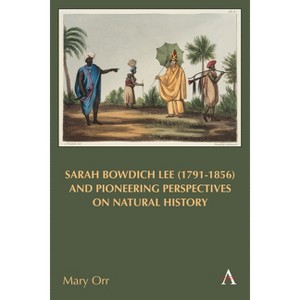
Sarah Bowdich Lee (1791-1856) and Pioneering Perspectives on Natural History - by Mary Orr (Hardcover)
In Stock
Sponsored
About this item
Highlights
- History from below has particular advantages.
- About the Author: Mary Orr is the Buchanan Chair of French at the University of St Andrews.
- 310 Pages
- Science, Natural History
Description
About the Book
This first book-length appraisal of the pioneering perspectives of Sarah Bowdich Lee (1791-1856) on natural history in the first half of the nineteenth century pivotally highlights the intercultural, interdisciplinary and multi-genre reach of her work. The fact that she undertook it independently and transnationally over three decadeschallenges approaches to women, gender and national nineteenth-century scientific endeavour that have defined women at work in the period by their secondary roles (to more famous men in science) that also delimit their contributions and discoveries(as domestic). By focusing on how Sarah undertook her science despite the many bars to women in its fields, this study also promotes one woman's blueprint for non-conformist independent work and, in consequence, an alternative paradigm for the 'leaky pipeline' model still informing women's careers in STEM(M) today.
Book Synopsis
History from below has particular advantages. It uncovers overlooked protagonists in (inter)national endeavour for their importance and wider significance, and plots triumphs of discovery and contribution to knowledge where they are supposed not to occur. One such figure is (British-born) Sarah née Wallace, Mrs T. Edward Bowdich then Mrs R. Lee (1791-1856). Despite her multiple contributions to new natural history and its publication in both France and Britain in the first half of the nineteenth century, no monograph study has attended to her life's workin independent natural history-making for its interdisciplinary range and perspectives, or explored its intercultural significance through the double contexts of expert French and British natural history and publication.
- In making good these omissions, this book does much more than provide a first concerted recuperation and examination of Sarah's unbrokenproduction of science publications from 1825 until her death in 1856 that intermediated 'French' and 'British' natural history in several new fields and in multiple genres. More importantly, the focus is on how Sarah's expert productivity was also achieved, when she had to overcome significant scientific losses - of new specimens from the field, of major international mentors - severally in her 'career'. If these lynch-pin moments frame the three main sections of the book, and the chapters each contain, the larger story of Sarah's overcoming and successes form a case study that can better draw attention to the circumstances and conditions in which Sarah's largely unheralded contributions and triumphs were achieved. Since at least one 'small' achievement in scientific endeavour merges in each chapter, the record can be set straight concerning Sarah's importance at the forefront of new sub-disciplines in French as well as British science from the 1820s to the 1850s, for example, ichthyology (in Part One), ethnography (in Part Two) and science dissemination and education (in Part Three).
- The lynch-pin moments and framing conditions of production informing them add significant creative and pragmatic twists to an alternative story for expert science and natural history-makingthat overcomes seemingly impossible personal and sociocultural odds irrespective of gender. Sarah's multiple non-conformism then makes for a fascinating case study and historical precedent for re-examining women's independent contributions in the history of nineteenth-century science as precedent-setting by comparison with 'leaky pipeline' modelling for women's careers and work in STEM(M) today. The book's closing inquiry thus calls for new perspectives following Sarah's example, to challenge the understanding of 'serious' natural history-making as inclusive of inter medial forms. The possibility, creativity and distinction of Sarah's story is the distinguishing feature of this book.
Review Quotes
"Mary Orr's book is a magnificent study of the fascinating author and natural historian Sarah Bowditch Lee. Pursuing her in the archives and through her extensive travels in West Africa, Bowditch Lee is returned to her rightful place in history and science. Extensive appendices demonstrate the number and range and significance of her publications. This book is an impressive undertaking, accomplished with elegance and spirit." -- Sharon Ruston, Professor, Department of English Literature and Creative Writing, Lancaster University.
"Mary Orr's meticulously-researched book recovers Sarah Bowdich Lee's pioneering contributions to science over three decades, across continents and despite the challenges and barriers Bowdich faced as a woman, a mother and a widow. This book will become the standard reference on Bowdich Lee and, equally importantly, prompt readers to re-evaluate women's scientific work in this period. -- Patience Schell, University of Aberdeen.
"This is a nuanced and original account of a neglected figure, and a highly stimulating exploration of the communication and wider understanding of the natural sciences in the nineteenth century and afterwards. By means of careful scholarly detection, Orr's rich, multi-layered interpretation of Bowdich's work and significance places this woman of science in her rightful place and makes, thereby, a substantial contribution to our understanding of nineteenth century science, history and culture." -- David Brown, Professor of Modern History, University of Southampton.
"This study of the British natural historian Sarah Bowdich Lee is a formidable scholarly achievement. It pays significant critical attention to the multifaceted contribution she made to nineteenth-century explorative science and it responds to an urgent need in various intersecting fields - history of science, literary studies and women's studies - to investigate how women looked beyond national frameworks to advance scientific endeavour." -- Alison E. Martin, Professor of British Studies, JGU Mainz/Germersheim, Germany.
"What will she do now?" Sarah Bowdich Lee's wonderfully non-conformist life as a traveller, naturalist, author, and illustrator subverts many of our expectations. In a ground-breaking biography, Mary Orr offers a rousing story that will interest all who care about inclusivity in STEMM while also causing historians to re-examine their understanding of the people and practices of nineteenth century science. -- Jonathan R. Topham, Professor of History of Science, University of Leeds.
Miranda
Orr's insightful approach to Sarah Bowdich Lee's numerous productions illuminates the role many nineteenth-century women played in the field of natural history, recalling the many stories which still need to be uncovered through inter- and pluri-disciplinary methodologies. Her fascinating inquiry into one woman's scientific endeavour appears, therefore, as a call for renewed study of others, and will be of much interest to all scholars interested in nineteenth-century history of science, art history and gender studies. --Miranda
The extraordinary achievements of Bowdich Lee and the significance of her work emerge through Orr's contextual understanding of several disciplines; the traditional barriers between science and the humanities in history are dismantled in this rich biography. --French Studies
The book is likely to become a important resource and reference-work, that can be mined productively both by researchers looking specifically at women's participation in early nineteenth-century science and also by scholars concerned more broadly with the development of, and connections between, French and British science in this period. -- The British Society for Literature and Science
The British Society for Literature and Science
About the Author
Mary Orr is the Buchanan Chair of French at the University of St Andrews. Her specialist research in nineteenth-century French studies connects its literatures, histories and cultures, and includesthe natural and earth sciences in their ambit.
Shipping details
Return details
Frequently bought together

Trending Non-Fiction




Discover more options