Sponsored
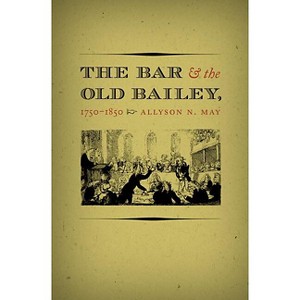
The Bar and the Old Bailey, 1750-1850 - (Studies in Legal History) by Allyson N May (Paperback)
In Stock
Sponsored
About this item
Highlights
- Allyson May chronicles the history of the English criminal trial and the development of a criminal bar in London between 1750 and 1850.
- Author(s): Allyson N May
- 376 Pages
- Freedom + Security / Law Enforcement, Legal History
- Series Name: Studies in Legal History
Description
About the Book
Allyson May chronicles the history of the English criminal trial and the development of a criminal bar in London between 1750 and 1850. She charts the transformation of the legal process and the evolution of professional standards for the criminal bar through an examination of the working lives of the Old Bailey barristers of the period. Includes a comprehensive biographical appendix.Book Synopsis
Allyson May chronicles the history of the English criminal trial and the development of a criminal bar in London between 1750 and 1850. She charts the transformation of the legal process and the evolution of professional standards of conduct for the criminal bar through an examination of the working lives of the Old Bailey barristers of the period. In describing the rise of adversarialism, May uncovers the motivations and interests of prosecutors, defendants, the bench, and the state, as well as the often-maligned "Old Bailey hacks" themselves.
Traditionally, the English criminal trial consisted of a relatively unstructured altercation between the victim-prosecutor and the accused, who generally appeared without a lawyer. A criminal bar had emerged in London by the 1780s, and in 1836 the Prisoners' Counsel Act recognized the defendant's right to legal counsel in felony trials and lifted many restrictions on the activities of defense lawyers. May explores the role of barristers before and after the Prisoners' Counsel Act. She also details the careers of individual members of the bar -- describing their civil practice in local, customary courts as well as their criminal practice -- and the promotion of Old Bailey counsel to the bench of that court. A comprehensive biographical appendix augments this discussion.
Review Quotes
"A notable contribution to legal history and to the history of the professions, unusually well-written and the product of prodigious research." -- Economic History Review
"A well-researched and important addition to our growing understanding of the evolution of the criminal trial in England." -- American Historical Review
"Among the most thoroughly-researched explorations of the relationship between the upper branch of the legal profession and the reforms of the criminal trial to date. . . . Rooted in meticulous research into the diverse working lives of the individuals who made up the London bar, [it gives] readers a sense of the day to day practice at the Old Bailey. . . . A significant contribution." -- Journal of Social History
"An important book. . . . [May's] analysis of the barristers who practiced at the Old Bailey, London's principal criminal court, puts human flesh on the story of 'lawyerization'. . . . A substantial contribution to the scholarly literature on the history of the bar." -- Albion
"May has written a thoughtful, detailed, and painstakingly researched study that focuses on criminal lawyers who practiced in London's central criminal court, the Old Bailey, during this era of fundamental legal change." -- Journal of Interdisciplinary History
"May's thorough account of the formation of the Old Bailey bar is necessary reading for anyone interested in the development of the criminal trial or the legal profession in England." -- American Journal of Legal History
"May's volume adds a vital dimension to this earlier scholarship. She fills in the flesh and bones of the story by giving us a greater sense of the identity of the men who were largely responsible for bringing about this change. . . . It is a sobering tale, one that highlights the place of unintended consequences in the history of a profession that often claims to be in control of its own development." -- Reviews in History (the Institute of Historical Research, London)
"Provides invaluable groundwork for future research into the development of legal ethics and professional discipline." -- Law and History Review
"Represents a significant addition to our understanding of the history of the Old Bailey and its advocates in a crucial formative period for English criminal justice." -- Journal of Legal History
Shipping details
Return details
Frequently bought together

Trending Non-Fiction