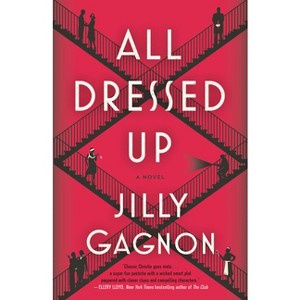
All Dressed Up - by Jilly Gagnon (Paperback)
$17.00
Out of Stock

Free & easy returns
Return this item by mail or in store within 30 days for a full refund.
Find alternative
- $7.79MSRP $10.99
- $17.00was $20.00 New lower price
- $5.69 - $17.68MSRP $5.99 - $18.99
- $9.39MSRP $12.99
- $17.36MSRP $19.95
- $11.14MSRP $17.99
- $16.86MSRP $30.00
- $37.22MSRP $55.00
- $15.91MSRP $19.99
- $18.68MSRP $24.95
- $36.48MSRP $50.00
- $21.47MSRP $23.00
- $8.10MSRP $9.99
- $11.05MSRP $17.99
Eligible for registries and wish lists
About this item
Additional product information and recommendations
Discover more options
- $7.79MSRP $10.99
- $17.00was $20.00 New lower price
- $5.69 - $17.68MSRP $5.99 - $18.99
- $9.39MSRP $12.99
- $17.36MSRP $19.95
- $11.14MSRP $17.99
- $16.86MSRP $30.00
- $37.22MSRP $55.00
- $15.91MSRP $19.99
- $18.68MSRP $24.95
- $36.48MSRP $50.00
- $21.47MSRP $23.00
- $8.10MSRP $9.99
- $11.05MSRP $17.99
Frequently bought together
- $10.99 - $14.90MSRP $19.99 - $27.994.8 out of 5 stars with 5 ratings
- $7.21MSRP $12.99
- $8.52 - $11.89MSRP $9.99 - $17.995 out of 5 stars with 2 ratings
- $15.39MSRP $24.00


Best-selling Adult Fiction Books
- $14.24was $18.99 New lower price5 out of 5 stars with 2 ratings
- $14.24 - $17.59MSRP $18.00 - $30.004.7 out of 5 stars with 568 ratings
- $9.63 - $19.26MSRP $17.99 - $32.994.6 out of 5 stars with 102 ratings
3.5 out of 5 stars with 2 reviews
100% would recommend
2 recommendations
3 out of 5 stars
Thumbs up graphic, would recommend
4 October, 2022
Murder mystery weekend with a real murder
Thanks to Random House & NetGalley for a digital advance reader copy. All comments and opinions are my own. “Becca loves mysteries. I’ll give her a mystery weekend, she’ll know I love her.” Becca guesses this is what her husband Blake decided as they drove to a remote yet stunning estate for a three-day getaway. And she also thinks it’s an attempt at an apology, as Becca has recently discovered Blake’s affair, which came out of the blue after nearly 10 years of marriage. So we have a 1920’s murder mystery game hosted at a remote mansion with a few other couples, one of which Becca and Blake already know. Even with the marital issues, Becca decides to make the best of it and go along with the costumes, characters, atmosphere, red herrings, and the “murder” of their host. The clues come fast and furious, and everyone must team up to solve the crime, while remembering that any one of them could be the murderer. This sounded like an intriguing premise, especially when one of the actresses playing the part of the maid disappears. Now we (Becca and I) have more than one mystery to solve. Are characters acting suspiciously because they have connections to the missing maid, or because they’re just acting the part they’ve been given in the game? Since the book is told from Becca’s point of view, I was as confused as she was: “I couldn’t even tell when they were acting, whether their dropped hints and sidelong glances meant anything or whether they were all just part of the game we were playing.” But to make things more complicated, Becca is an unreliable narrator. Blake’s betrayal has left Becca nearly unhinged, or at least that’s how it seems. She is over-the-top jealous, unable to read normal body language clues, and is often bordering on hysterics. This leads to poor decision making, putting herself in danger as she continues to look for the missing maid (the real mystery of the weekend). I liked the way Becca justifies her immersion in murder mysteries after learning of her husband’s affair, with “every book or episode ending with a neat resolution, the chaos safely hidden away, order restored…The setting might change, but underneath they were all the same. Something terrible threatened, but every single time there was a solution. Closure. The good were exonerated and the evil was safely tucked away, episode after episode, the unchanging cadence of it pure mental balm.” That’s why I like murder mysteries, too. We are inside Becca’s head the entire book, which wasn’t a comfortable place to be. She seemed emotionally overwrought and more frantic than necessary, while her husband was so patient and loving and tried to placate her when he could tell she was losing her grip. I liked the premise a lot, and the climax was satisfyingly nail-biting, but I didn’t like Becca or her angst. So I’m giving this one a 3 out of 5. Still worth reading.
4 out of 5 stars
Thumbs up graphic, would recommend
6 September, 2022
Fun, exciting
I love a mystery within a mystery and All Dressed Up had my mind spinning a time or two. The feel I found while diving into the story of a murder in an old manor home set during the roaring twenties had me anxious and excited. Becca and her husband, Blake, are going through a difficult time in their marriage and this mystery weekend is Blake’s surprise to his wife in an effort to mend the breach between them. As the story unfolds, I found myself side eyeing every character that was introduced. I love twisted suspense filled mysteries and hoped this one was going to deliver it all. While it could have gone in a direction that would have made this all the more mind shattering, I still enjoyed the story. My suspect ended up being the villain which is how I measure the quality of the mystery. Keep me from guessing who it is while laying everything out in front of me and I’m a complete goner. Unfortunately, that did not happen but I liked the atmosphere the author created as she shined a light on all the sins of the guest at this murder mystery party.