Target New ArrivalsGift Ideas for MomClothing, Shoes & AccessoriesHome & DecorKitchen & DiningOutdoor Living & GardenGroceryHousehold EssentialsBabyBeautyPersonal CareHealthWellnessLuggageSports & OutdoorsToysElectronicsVideo GamesMovies, Music & BooksSchool & Office SuppliesParty SuppliesGift IdeasGift CardsPetsUlta Beauty at TargetShop by CommunityTarget OpticalDealsClearanceTarget New ArrivalsSpring OutfitsGift Ideas for MomWomen’s Festival OutfitsTop DealsTarget Circle DealsWeekly AdShop Order PickupShop Same Day DeliveryRegistryRedCardTarget CircleFind Stores
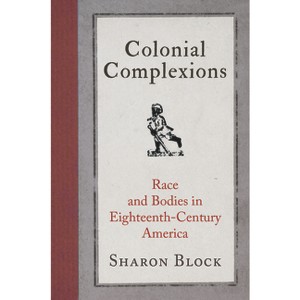
Colonial Complexions - (Early American Studies) by  Sharon Block (Paperback) - 1 of 1

Colonial Complexions - (Early American Studies) by Sharon Block (Paperback)

$24.99
In Stock

Free & easy returns

Free & easy returns

Return this item by mail or in store within 90 days for a full refund.
Eligible for registries and wish lists

About this item

Highlights

  • In Colonial Complexions, historian Sharon Block examines how Anglo-Americans built racial ideologies out of descriptions of physical appearance.
  • About the Author: Sharon Block is Professor of History at the University of California, Irvine.
  • 232 Pages
  • History, United States
  • Series Name: Early American Studies

Description


About the Book


How did descriptions of individuals' appearance reinforce emergent categories of race? In Colonial Complexions, more than 4000 advertisements for runaway slaves and servants reveal how colonists transformed seemingly observable characteristics into racist reality.


Book Synopsis


In Colonial Complexions, historian Sharon Block examines how Anglo-Americans built racial ideologies out of descriptions of physical appearance. By analyzing more than 4,000 advertisements for fugitive servants and slaves in colonial newspapers alongside scores of transatlantic sources, she reveals how colonists transformed observable characteristics into racist reality. Building on her expertise in digital humanities, Block repurposes these well-known historical sources to newly highlight how daily language called race and identity into being before the rise of scientific racism.

In the eighteenth century, a multitude of characteristics beyond skin color factored into racial assumptions, and complexion did not have a stable or singular meaning. Colonists justified a race-based slave labor system not by opposing black and white but by accumulating differences in the bodies they described: racism was made real by marking variation from a norm on some bodies, and variation as the norm on others. Such subtle systemizations of racism naturalized enslavement into bodily description, erased Native American heritage, and privileged life history as a crucial marker of free status only for people of European-based identities.

Colonial Complexions suggests alternative possibilities to modern formulations of racial identities and offers a precise historical analysis of the beliefs behind evolving notions of race-based differences in North American history.


Review Quotes


""Colonial Complexions has done important work to hone our understanding of the role of colonial advertisements in western-Atlantic racial formations, and Block has assembled a valuable archive that remains ripe for future inquiry into the interlinked processes of human monetization and racialization during the period just before the founding of a republic still in their thrall."-- "Eighteenth-Century Studies"

"Colonial Complexions is a crucial contribution to the history of race and a noteworthy model for digital age historical methodology."-- "Black Perspectives"

"Colonial Complexions is remarkable. Through an astonishing amount of research and the analysis of thousands of advertisements for missing persons in colonial newspapers, Sharon Block determines when and how 'race' acquired its meaning and basic equation with slavery. In this innovative way, she argues that race and slavery came to be intertwined through seemingly innocuous descriptions."-- "Elizabeth Reis, Macaulay Honors College, City University of New York"

"Colonial Complexions offers an important new angle on the processes through which racial categories became entrenched in American and Western thought and culture . . . [and] a badly needed and deeply insightful analysis of a level of race-making that falls between high scientific discourse and social life . . . Sharon Block reveals a too-often hidden and absolutely crucial current of racial thought and practice in early America."-- "Journal of Early American History"

"[T]his is an admirable work of scholarship that provides thoughtful and thorough statistical analysis of a telling but previously neglected archive. The result is to buttress the recent scholarly understanding of the inchoate nature of racial ideology (and even bodily perception) in the third quarter of the eighteenth century in British North America. As much of the scholarly work toward redefining our understandings of race in this key period has been done by literary and theoretically oriented scholars, the support of Block's careful statistical analysis, and her compelling presentation of it, should prove invaluable to the ongoing debate on this always contentious issue.""-- "Early American Literature"

"A powerful history of complexion and how it mobilized across race, labor, and hierarchy in colonial slavery. Colonial Complexions asks us to think carefully about the processes of race-making. Sharon Block's engagement with the history of the body and the meanings ascribed to color represents foundational work in the history of racial formation and power in early America."-- "Jennifer L. Morgan, New York University"

"By employing digital methods to interrogate the process of race-making in the eighteenth-century, Colonial Complexions makes visible the cultural worldview underlying racial formations and pushes scholarship in exciting new directions."-- "Journal of Southern History"

"In Colonial Complexions, historian Sharon Block offers a subtle and profound reading of the processes of race-making in colonial North America. Drawing on thousands of advertisements for the return of servant and enslaved laborers of African, European, and Native American descent, Block offers a careful and critical reading of how colonial slave and contract owners consolidated racial meaning on bodies through specific language, evaluation, and the naturalization of status over the eighteenth century. After reading this book, scholars will be compelled to deconstruct colonial terms of racial designation that have been uncritically reproduced and to change the way we think and write about race and racial meaning in the past and the effects of these terms in our present."-- "Marisa Fuentes, Rutgers University"

"Part of Block's purpose in Colonial Complexions is to prompt historians to think more carefully about echoing without question the descriptions and classifications we find in our sources . . . .Colonial Complexions contributes mightily to the literature on the social construction of race by illuminating the very real effects of those constructions."-- "Reviews in American History"


About the Author


Sharon Block is Professor of History at the University of California, Irvine.
Dimensions (Overall): 9.0 Inches (H) x 6.0 Inches (W) x .53 Inches (D)
Weight: .76 Pounds
Suggested Age: 22 Years and Up
Number of Pages: 232
Genre: History
Sub-Genre: United States
Series Title: Early American Studies
Publisher: University of Pennsylvania Press
Format: Paperback
Author: Sharon Block
Language: English
Street Date: May 7, 2021
TCIN: 1010467443
UPC: 9780812224924
Item Number (DPCI): 247-26-4054
Origin: Made in the USA or Imported
If the item details aren’t accurate or complete, we want to know about it.

Shipping details

Estimated ship dimensions: 0.53 inches length x 6 inches width x 9 inches height
Estimated ship weight: 0.76 pounds
We regret that this item cannot be shipped to PO Boxes.
This item cannot be shipped to the following locations: American Samoa (see also separate entry under AS), Guam (see also separate entry under GU), Northern Mariana Islands, Puerto Rico (see also separate entry under PR), United States Minor Outlying Islands, Virgin Islands, U.S., APO/FPO, Alaska, Hawaii

Return details

This item can be returned to any Target store or Target.com.
This item must be returned within 90 days of the date it was purchased in store, delivered to the guest, delivered by a Shipt shopper, or picked up by the guest.
See the return policy for complete information.

Q: What does the book suggest about modern racial identities?

submitted by AI Shopping Assistant - 6 days ago
  • A: It proposes alternative perspectives on racial identities, challenging contemporary notions rooted in historical contexts.

    submitted byAI Shopping Assistant - 6 days ago
    Ai generated

Q: Which academic methods does Sharon Block utilize in this book?

submitted by AI Shopping Assistant - 6 days ago
  • A: Block employs digital humanities to analyze historical sources, providing new insights into race and identity formation.

    submitted byAI Shopping Assistant - 6 days ago
    Ai generated

Q: How does the book relate to advertisements for runaway slaves?

submitted by AI Shopping Assistant - 6 days ago
  • A: The book analyzes over 4,000 advertisements, revealing how colonists linked physical descriptions to emergent racial categories.

    submitted byAI Shopping Assistant - 6 days ago
    Ai generated

Q: What is the significance of complexion in early American racial ideologies?

submitted by AI Shopping Assistant - 6 days ago
  • A: Complexion played a critical role in shaping racial assumptions, illustrating a complicated understanding beyond skin color.

    submitted byAI Shopping Assistant - 6 days ago
    Ai generated

Q: What topics does Sharon Block explore in this book?

submitted by AI Shopping Assistant - 6 days ago
  • A: Sharon Block explores how Anglo-Americans constructed racial ideologies through physical appearance, emphasizing cultural and historical contexts.

    submitted byAI Shopping Assistant - 6 days ago
    Ai generated

Additional product information and recommendations

Discover more options

Trending History

Get top deals, latest trends, and more.

Privacy policy