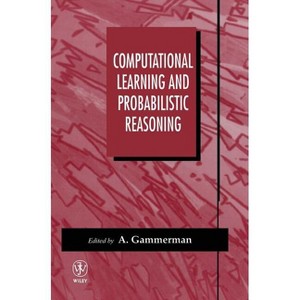
This book is devoted to two interrelated techniques in solving some important problems in machine intelligence and pattern recognition, namely probabilistic reasoning and computational learning.
About the Author: A. Gammerman is the editor of Computational Learning and Probabilistic Reasoning, published by Wiley.
338 Pages
Mathematics, Discrete Mathematics
Description
Book Synopsis
This book is devoted to two interrelated techniques in solving some important problems in machine intelligence and pattern recognition, namely probabilistic reasoning and computational learning. It is divided into four parts, the first of which describes several new inductive principles and techniques used in computational learning. The second part contains papers on Bayesian and Causal Belief networks. Part three includes chapters on case studies and descriptions of several hybrid systems and the final part describes some related theoretical work in the field of probabilistic reasoning.
From the Back Cover
Providing a unified coverage of the latest research and applications methods and techniques, this book is devoted to two interrelated techniques for solving some important problems in machine intelligence and pattern recognition, namely probabilistic reasoning and computational learning. The contributions in this volume describe and explore the current developments in computer science and theoretical statistics which provide computational probabilistic models for manipulating knowledge found in industrial and business data. These methods are very efficient for handling complex problems in medicine, commerce and finance. Part I covers Generalisation Principles and Learning and describes several new inductive principles and techniques used in computational learning. Part II describes Causation and Model Selection including the graphical probabilistic models that exploit the independence relationships presented in the graphs, and applications of Bayesian networks to multivariate statistical analysis. Part III includes case studies and descriptions of Bayesian Belief Networks and Hybrid Systems. Finally, Part IV on Decision-Making, Optimization and Classification describes some related theoretical work in the field of probabilistic reasoning. Statisticians, IT strategy planners, professionals and researchers with interests in learning, intelligent databases and pattern recognition and data processing for expert systems will find this book to be an invaluable resource. Real-life problems are used to demonstrate the practical and effective implementation of the relevant algorithms and techniques.
About the Author
A. Gammerman is the editor of Computational Learning and Probabilistic Reasoning, published by Wiley.
Dimensions (Overall): 9.91 Inches (H) x 6.91 Inches (W) x 1.04 Inches (D)
Weight: 1.73 Pounds
Suggested Age: 22 Years and Up
Number of Pages: 338
Genre: Mathematics
Sub-Genre: Discrete Mathematics
Publisher: Wiley
Format: Hardcover
Author: A Gammerman
Language: English
Street Date: August 6, 1996
TCIN: 1009801164
UPC: 9780471962793
Item Number (DPCI): 247-26-7932
Origin: Made in the USA or Imported
If the item details aren’t accurate or complete, we want to know about it.
Shipping details
Estimated ship dimensions: 1.04 inches length x 6.91 inches width x 9.91 inches height
Estimated ship weight: 1.73 pounds
We regret that this item cannot be shipped to PO Boxes.
This item cannot be shipped to the following locations: American Samoa (see also separate entry under AS), Guam (see also separate entry under GU), Northern Mariana Islands, Puerto Rico (see also separate entry under PR), United States Minor Outlying Islands, Virgin Islands, U.S., APO/FPO, Alaska, Hawaii
Return details
This item can be returned to any Target store or Target.com.
This item must be returned within 90 days of the date it was purchased in store, delivered to the guest, delivered by a Shipt shopper, or picked up by the guest.
Q: What type of readers would benefit from this book?
submitted by AI Shopping Assistant - 1 month ago
A: Statisticians, IT strategy planners, and researchers interested in learning and pattern recognition will find this book valuable.
submitted byAI Shopping Assistant - 1 month ago
Ai generated
Q: Who is the author of this book?
submitted by AI Shopping Assistant - 1 month ago
A: The book is edited by A. Gammerman, who specializes in computational learning.
submitted byAI Shopping Assistant - 1 month ago
Ai generated
Q: How is the book structured?
submitted by AI Shopping Assistant - 1 month ago
A: The book is divided into four parts covering inductive principles, Bayesian networks, case studies, and theoretical work in probabilistic reasoning.
submitted byAI Shopping Assistant - 1 month ago
Ai generated
Q: What practical applications does the book discuss?
submitted by AI Shopping Assistant - 1 month ago
A: It explores applications of computational models for solving problems in medicine, commerce, and finance.
submitted byAI Shopping Assistant - 1 month ago
Ai generated
Q: What are the main topics covered in the book?
submitted by AI Shopping Assistant - 1 month ago
A: The book focuses on probabilistic reasoning and computational learning in machine intelligence and pattern recognition.