Target New ArrivalsBack to SchoolCollegeHalloweenClothing, Shoes & AccessoriesHome & DecorKitchen & DiningOutdoor Living & GardenGroceryHousehold EssentialsBabyBeautyPersonal CareSports & OutdoorsPetsHealthWellnessSchool & Office SuppliesToys & GamesElectronics & TechVideo GamesMovies, Music & BooksParty SuppliesGift IdeasGift CardsShop by CommunityTarget OpticalDealsClearanceNew ArrivalsBack to SchoolCollegeTop DealsTarget Circle DealsWeekly AdShop Order PickupShop Same Day DeliveryRegistryRedCardTarget CircleFind Stores
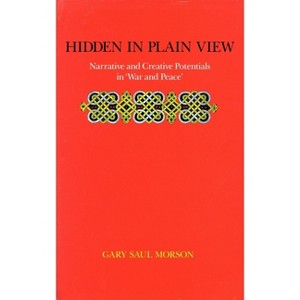
Hidden in Plain View - by  Gary Saul Morson (Paperback) - 1 of 1

Hidden in Plain View - by Gary Saul Morson (Paperback)

$35.00

In Stock

Free & easy returns
Free & easy returns
Return this item by mail or in store within 90 days for a full refund.
Eligible for registries and wish lists
Save 5% every day
With Target Circle™ Card (restrictions apply)

About this item

Highlights

  • For decades, the formal peculiarities of War and Peace disturbed Russian and Western critics, who attributed both the anomalous structure and the literary power of the book to Tolstoy's "primitive," unruly genius.
  • About the Author: Gary Saul Morson is Professor of Slavic Languages and Comparative Literature at Northwestern University, and the author of The Boundaries of Genre: Dostoevsky's 'Diary of a Writer' and the Traditions of Literary Utopia, and the editor of Literature and History: Theoretical Problems and Russian Case Studies.
  • 336 Pages
  • Literary Criticism, Russian & Soviet

Description


Book Synopsis


For decades, the formal peculiarities of War and Peace disturbed Russian and Western critics, who attributed both the anomalous structure and the literary power of the book to Tolstoy's "primitive," unruly genius. Using that critical history as a starting point, this volume recaptures the overwhelming sense of strangeness felt by the work's first readers and thereby illuminates Tolstoy's theoretical and narratological concerns.

The author demonstrates that the formal peculiarities of War and Peace were deliberate, designed to elude what Tolstoy regarded as the falsifying constraints of all narratives, both novelistic and historical. Developing and challenging the ideas of Mikhail Bakhtin, Morson explores Tolstoy's account of the work's composition in light of various myths of the creative process. He proposes a theory of "creation by potential" that incorporates Tolstoy's main concerns: the "openness" of each historical moment; the role of chance in history and within narrative patterns; and the efficacy of ordinary events, "hidden in plain view," in shaping history and individual psychology. In his reading of Tolstoy, he demonstrates how we read literary works within the "penumbral text" of associated theories of creativity.


From the Back Cover


For decades, the formal peculiarities of War and Peace disturbed Russian and Western critics, who attributed both the anomalous structure and the literary power of the book to Tolstoy's "primitive," unruly genius. Using that critical history as a starting point, this volume recaptures the overwhelming sense of strangeness felt by the work's first readers and thereby illuminates Tolstoy's theoretical and narratological concerns.
The author demonstrates that the formal peculiarities of War and Peace were deliberate, designed to elude what Tolstoy regarded as the falsifying constraints of all narratives, both novelistic and historical. Developing and challenging the ideas of Mikhail Bakhtin, Morson explores Tolstoy's account of the work's composition in light of various myths of the creative process. He proposes a theory of "creation by potential" that incorporates Tolstoy's main concerns: the "openness" of each historical moment; the role of chance in history and within narrative patterns; and the efficacy of ordinary events, "hidden in plain view," in shaping history and individual psychology. In his reading of Tolstoy, he demonstrates how we read literary works within the "penumbral text" of associated theories of creativity.


Review Quotes


"Perhaps the single most intelligent reading of War and Peace we have in English." --William Mills Todd III, Stanford University


About the Author


Gary Saul Morson is Professor of Slavic Languages and Comparative Literature at Northwestern University, and the author of The Boundaries of Genre: Dostoevsky's 'Diary of a Writer' and the Traditions of Literary Utopia, and the editor of Literature and History: Theoretical Problems and Russian Case Studies.
Dimensions (Overall): 8.4 Inches (H) x 5.4 Inches (W) x .9 Inches (D)
Weight: .9 Pounds
Suggested Age: 22 Years and Up
Number of Pages: 336
Genre: Literary Criticism
Sub-Genre: Russian & Soviet
Publisher: Stanford University Press
Format: Paperback
Author: Gary Saul Morson
Language: English
Street Date: December 1, 1988
TCIN: 1013083169
UPC: 9780804717182
Item Number (DPCI): 247-59-4499
Origin: Made in the USA or Imported
If the item details aren’t accurate or complete, we want to know about it.

Shipping details

Estimated ship dimensions: 0.9 inches length x 5.4 inches width x 8.4 inches height
Estimated ship weight: 0.9 pounds
We regret that this item cannot be shipped to PO Boxes.
This item cannot be shipped to the following locations: American Samoa (see also separate entry under AS), Guam (see also separate entry under GU), Northern Mariana Islands, Puerto Rico (see also separate entry under PR), United States Minor Outlying Islands, Virgin Islands, U.S., APO/FPO, Alaska, Hawaii

Return details

This item can be returned to any Target store or Target.com.
This item must be returned within 90 days of the date it was purchased in store, delivered to the guest, delivered by a Shipt shopper, or picked up by the guest.
See the return policy for complete information.

Additional product information and recommendations

Discover more options

Skip to next section

Best-selling Books

Skip to next section

Get top deals, latest trends, and more.