Target New ArrivalsGift Ideas for MomClothing, Shoes & AccessoriesHome & DecorKitchen & DiningOutdoor Living & GardenGroceryHousehold EssentialsBabyBeautyPersonal CareHealthWellnessLuggageSports & OutdoorsToysElectronicsVideo GamesMovies, Music & BooksSchool & Office SuppliesParty SuppliesGift IdeasGift CardsPetsUlta Beauty at TargetShop by CommunityTarget OpticalDealsClearanceTarget New ArrivalsSpring OutfitsGift Ideas for MomWomen’s Festival OutfitsTop DealsTarget Circle DealsWeekly AdShop Order PickupShop Same Day DeliveryRegistryRedCardTarget CircleFind Stores
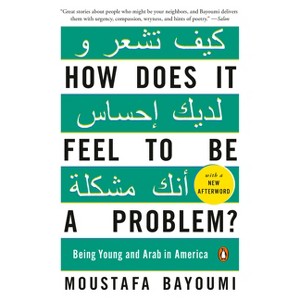
How Does It Feel to Be a Problem? - by  Moustafa Bayoumi (Paperback) - 1 of 1

How Does It Feel to Be a Problem? - by Moustafa Bayoumi (Paperback)

$10.95Save $7.05 (39% off)

Out of Stock

Free & easy returns

Free & easy returns

Return this item by mail or in store within 90 days for a full refund.
Eligible for registries and wish lists

About this item

Highlights

  • "Bayoumi offers a revealing portrait of life for people who are often scrutinized but seldom heard from.
  • About the Author: Moustafa Bayoumi was born in Zürich, Switzerland, and raised in Canada.
  • 336 Pages
  • Social Science, Islamic Studies

Description


About the Book


In prose that is at once blunt and lyrical, Bayoumi presents the story of howyoung Arab and Muslim Americans are forging lives for themselves in a countrythat often mistakes them for the enemy.


Book Synopsis


"Bayoumi offers a revealing portrait of life for people who are often scrutinized but seldom heard from." --Booklist (starred review)

"Wholly intelligent and sensitively-drawn, How Does It Feel to Be a Problem? is an important investigation into the hearts and minds of young Arab-Americans. This significant and eminently readable work breaks through preconceptions and delivers a fresh take on a unique and vital community. Moustafa Bayoumi's voice is refreshingly frank, personable, and true." --Diana Abu-Jaber, author of Origin, Crescent, and The Language of Baklava

An eye-opening look at how young Arab- and Muslim-Americans are forging lives for themselves in a country that often mistakes them for the enemy

Just over a century ago, W.E.B. Du Bois posed a probing question in his classic The Souls of Black Folk How does it feel to be a problem? Now, Moustafa Bayoumi asks the same about America's new "problem"-Arab- and Muslim-Americans. Bayoumi takes readers into the lives of seven twenty-somethings living in Brooklyn, home to the largest Arab-American population in the United States. He moves beyond stereotypes and clichés to reveal their often unseen struggles, from being subjected to government surveillance to the indignities of workplace discrimination. Through it all, these young men and women persevere through triumphs and setbacks as they help weave the tapestry of a new society that is, at its heart, purely American.


Review Quotes


"As Moustafa Bayoumi argues in his provocative investigation, young Arab-Americans are still struggling to define their identities in a hostile environment and to cope with the governments distrust . . . despite what they have suffered and continue to endure, Bayoumi and his interview subjects still hope that America is a place where they can live in peace--and find justice, fairness, and freedom." --Francine Prose, O Magazine

"In How Does It Feel to Be a Problem? Bayoumi . . . gives twenty-something Arab-Americans the chance to talk about their victories and defeats." --The Wall Street Journal

"These are great stories about people who might be your neighbors, and Bayoumi delivers them with urgency, compassion, wryness and hints of poetry. You may walk away from the book with a much greater understanding of Arab-American life, but you'll feel that's simply because you've hung out with Bayoumi and friends, snarfing down Dunkin' Donuts or puffing on hookahs, talking about vital issues." --Salon.com

"Bayoumi's book fascinates." --Deborah Douglas, Chicago Sun-Times

"Moustafa Bayoumi's How Does It Feel to Be a Problem? has an intimate feel, as the author listens closely to the dreams and realities of seven young Arabs living in post-9/11 America." --Dallas Morning News

"An indispensable guide . . . a well-written book on a subject that is often overlooked or treated as a side note to bigger problems, like the occupation of Iraq, Israeli aggression and civil liberties." --The Arab American News

"Bayoumi succeeds in presenting the reader with more than just a glimpse into these lives. One is right there with Rasha, a Palestinian-American teenager, who was detained along with the rest of her family without reason following 9/11. This first story is the most chilling as one can sense the frustration and dread emanating from Rasha's story. I have heard about things like this happening but to actually read about 19-year-old Rasha and what she and her entire family had to endure is something else. Bayoumi's decision to talk to Arabs from Brooklyn was a wise one as these stories are reflections from a group of people that not only have bared the brunt of discrimination, but call New York City their home and therefore, 9/11 affected them as it did most New Yorkers. By providing a book accessible to the masses, Bayoumi gives the Arab problem a very human face that other Americans can empathize with." --MediaandIslam.com

"Bayoumi offers a revealing portrait of life for people who are often scrutinized but seldom heard from." --Booklist (starred review)

"In many ways, [Bayoumi's] absorbing and affectionate book is a quintessentially American picture of 21st century citizens 'absorbing and refracting all the ethnicities and histories surrounding [them].' However, the testimonies from these young adults--summary seizures from their homes, harassment from strangers, being fired for having an Arab or Muslim name--have a weight and a sorrow that is 'often invisible to the general public.'" --Publishers Weekly (starred review)

"The book's title derives from a question posed by W.E.B. Du Bois in The Souls of Black Folk, and given the burgeoning of anti-Arab, anti-Muslim sentiments since 9/11, the author's appropriation of it seems apt. [Bayoumi] poignantly portrays young people coming of age at a time when 'informants and spies are regular topics of conversation . . . friendships are tested, trust disappears.'" --Kirkus Reviews

"Wholly intelligent and sensitively-drawn, How Does It Feel to Be a Problem? is an important investigation into the hearts and minds of young Arab-Americans. This significant and eminently readable work breaks through preconceptions and delivers a fresh take on a unique and vital community. Moustafa Bayoumi's voice is refreshingly frank, personable, and true." --Diana Abu-Jaber, author of Origin, Crescent, and The Language of Baklava

"In relating the gripping personal stories of seven young Arab and Muslim Americans from Brooklyn in How Does it Feel to be a Problem?, Moustafa Bayoumi reveals the feelings and frustrations of the current era's scapegoats, who can be demonized, profiled, and reviled without fear of sanction. His book shows both the dimensions of this new problem for American society, and the hopeful signs that this problem too can be overcome." --Rashid Khalidi, Edward Said Professor of Arab Studies, Columbia University and author of The Iron Cage

"Suspenseful storytelling and rich detail make How Does It Feel to Be a Problem? required reading for Americans yearning for knowledge about Islam and their Muslim neighbors in the United States. In a series of fascinating narratives about the horrors and conflicts young Muslim-Americans faced after 9/11, Moustafa Bayoumi has written a work that is passionate, yet measured, humorous, and above all enlightening." --Geneive Abdo, author of Mecca and Main Street: Muslim Life in America After 9/11

"With deft prose, acute insight and extensive reporting, Moustafa Bayoumi has produced truly engrossing portraits of young Muslim Americans about whom we usually hear only empty polemics. With a light touch, he gives voice to people who are referred to often and heard from rarely. The result is a sense of the tentative resistance of a besieged generation, as well as their determination to force America to be true to its promise even if it means confronting prejudice in its practice."
--Gary Younge, author of Stranger in a Strange Land: Encounters in the Disunited States and No Place Like Home


About the Author


Moustafa Bayoumi was born in Zürich, Switzerland, and raised in Canada. He earned his Ph.D. at Columbia University and is Professor of English at Brooklyn College, the City University of New York. He is the author of This Muslim American Life: Dispatches from the War on Terror, which was chosen as a Best Book of 2015 by The Progressive magazine and awarded the Arab American Book Award for Non-Fiction. He edited Midnight on the Mavi Marmara: the Attack on the Gaza Freedom Flotilla and How It Changed the Course of the Israel/Palestine Conflict and is co-editor of The Edward Said Reader. How Does It Feel To Be a Problem? won an American Book Award and the Arab American Book Award for Non-Fiction. Bayoumi is also a frequent contributor to The Guardian, and his writing has appeared in The Nation, The New York Times Magazine, New York Magazine, The National, CNN.com, The London Review of Books, The Chronicle of Higher Education, and many other publications. He is the recipient of two excellence in teaching awards, a 2011 Culture and Achievement Award from the Network of Arab American Professionals, and a 2016 Pathmaker to Peace Award from the organization Brooklyn for Peace. In 2015, he was awarded the honorary degree of Doctor of Humane Letters by Southern Vermont College. He lives in Brooklyn, New York.
Dimensions (Overall): 8.06 Inches (H) x 5.38 Inches (W) x .68 Inches (D)
Weight: .55 Pounds
Suggested Age: 22 Years and Up
Number of Pages: 336
Genre: Social Science
Sub-Genre: Islamic Studies
Publisher: Penguin Books
Format: Paperback
Author: Moustafa Bayoumi
Language: English
Street Date: July 1, 2009
TCIN: 76922708
UPC: 9780143115410
Item Number (DPCI): 247-01-2119
Origin: Made in the USA or Imported
If the item details aren’t accurate or complete, we want to know about it.

Shipping details

Estimated ship dimensions: 0.68 inches length x 5.38 inches width x 8.06 inches height
Estimated ship weight: 0.55 pounds
We regret that this item cannot be shipped to PO Boxes.
This item cannot be shipped to the following locations: American Samoa (see also separate entry under AS), Guam (see also separate entry under GU), Northern Mariana Islands, Puerto Rico (see also separate entry under PR), United States Minor Outlying Islands, Virgin Islands, U.S., APO/FPO, Alaska, Hawaii

Return details

This item can be returned to any Target store or Target.com.
This item must be returned within 90 days of the date it was purchased in store, delivered to the guest, delivered by a Shipt shopper, or picked up by the guest.
See the return policy for complete information.

Q: What themes are explored in Bayoumi's book?

submitted by AI Shopping Assistant - 1 month ago
  • A: The book delves into identity, discrimination, and the lives of young Arab and Muslim Americans.

    submitted byAI Shopping Assistant - 1 month ago
    Ai generated

Q: What significance does the book's title hold?

submitted by AI Shopping Assistant - 1 month ago
  • A: The title references W.E.B. Du Bois's question about being perceived as a problem, applied to Arab and Muslim Americans.

    submitted byAI Shopping Assistant - 1 month ago
    Ai generated

Q: What is the author's background?

submitted by AI Shopping Assistant - 1 month ago
  • A: Moustafa Bayoumi is a professor, author, and journalist with a focus on Arab-American issues and experiences.

    submitted byAI Shopping Assistant - 1 month ago
    Ai generated

Q: How does the author approach the subject matter?

submitted by AI Shopping Assistant - 1 month ago
  • A: Bayoumi uses a blend of blunt and lyrical prose to present intimate and revealing portraits of his subjects.

    submitted byAI Shopping Assistant - 1 month ago
    Ai generated

Q: What type of narratives does the author present?

submitted by AI Shopping Assistant - 1 month ago
  • A: Bayoumi shares compelling personal stories that highlight the experiences and challenges faced by young Arab-Americans.

    submitted byAI Shopping Assistant - 1 month ago
    Ai generated

Additional product information and recommendations

Discover more options

Trending Social Science Books

Get top deals, latest trends, and more.

Privacy policy