Target New ArrivalsGift Ideas for MomClothing, Shoes & AccessoriesHome & DecorKitchen & DiningOutdoor Living & GardenGroceryHousehold EssentialsBabyBeautyPersonal CareHealthWellnessLuggageSports & OutdoorsToysElectronicsVideo GamesMovies, Music & BooksSchool & Office SuppliesParty SuppliesGift IdeasGift CardsPetsUlta Beauty at TargetShop by CommunityTarget OpticalDealsClearanceTarget New ArrivalsSpring OutfitsGift Ideas for MomWomen’s Festival OutfitsTop DealsTarget Circle DealsWeekly AdShop Order PickupShop Same Day DeliveryRegistryRedCardTarget CircleFind Stores
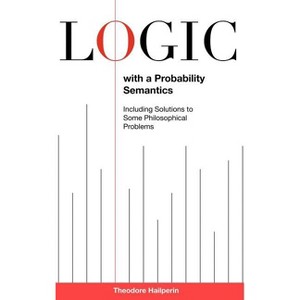
Logic with a Probability Semantics - by  Theodore Hailperin (Hardcover) - 1 of 1

Logic with a Probability Semantics - by Theodore Hailperin (Hardcover)

$95.00

In Stock

Free & easy returns

Free & easy returns

Return this item by mail or in store within 90 days for a full refund.
Eligible for registries and wish lists

About this item

Highlights

  • The present study is an extension of the topic introduced in Dr. Hailperin's Sentential Probability Logic, where the usual true-false semantics for logic is replaced with one based more on probability, and where values ranging from 0 to 1 are subject to probability axioms.
  • About the Author: Theodore Hailperin is emeritus professor of mathematics at Lehigh University.
  • 126 Pages
  • Mathematics, Logic

Description


About the Book


The book extends the development of probability logic-a logic using probability, not verity (true, false) as the basic semantic notion. The basic connectives "not," "and," and "or" are described in depth to include quantified formulas. Also discussed is the notion of the suppo...


Book Synopsis


The present study is an extension of the topic introduced in Dr. Hailperin's Sentential Probability Logic, where the usual true-false semantics for logic is replaced with one based more on probability, and where values ranging from 0 to 1 are subject to probability axioms. Moreover, as the word "sentential" in the title of that work indicates, the language there under consideration was limited to sentences constructed from atomic (not inner logical components) sentences, by use of sentential connectives ("no," "and," "or," etc.) but not including quantifiers ("for all," "there is").

An initial introduction presents an overview of the book. In chapter one, Halperin presents a summary of results from his earlier book, some of which extends into this work. It also contains a novel treatment of the problem of combining evidence: how does one combine two items of interest for a conclusion-each of which separately impart a probability for the conclusion-so as to have a probability for the conclusion based on taking both of the two items of interest as evidence?

Chapter two enlarges the Probability Logic from the first chapter in two respects: the language now includes quantifiers ("for all," and "there is") whose variables range over atomic sentences, not entities as with standard quantifier logic. (Hence its designation: ontological neutral logic.) A set of axioms for this logic is presented. A new sentential notion--the suppositional--in essence due to Thomas Bayes, is adjoined to this logic that later becomes the basis for creating a conditional probability logic.

Chapter three opens with a set of four postulates for probability on ontologically neutral quantifier language. Many properties are derived and a fundamental theorem is proved, namely, for any probability model (assignment of probability values to all atomic sentences of the language) there will be a unique extension of the probability values to all closed sentences of the language.


Review Quotes


"There are some original features in the treatment given to the subject by the author, which make it an interesting reading also for people well acquainted with other work on probabilistic logics." --Mathematical Reviews

"Anyone interested in the history and philosophy of logic will find this work intriguing. Amateur logicians will find it challenging but will appreciate the progression toward expressing quantified probability logic in a richer formal structure, thus broadening the book's range of possible applications." --Mathematics Teacher


About the Author


Theodore Hailperin is emeritus professor of mathematics at Lehigh University. He has also worked as an aerodynamic ballistician at the Ballistics Research Laboratory in Aberdeen, MD.
Dimensions (Overall): 9.1 Inches (H) x 6.1 Inches (W) x .6 Inches (D)
Weight: .75 Pounds
Suggested Age: 22 Years and Up
Number of Pages: 126
Genre: Mathematics
Sub-Genre: Logic
Publisher: Lehigh University Press
Format: Hardcover
Author: Theodore Hailperin
Language: English
Street Date: December 16, 2010
TCIN: 1010936865
UPC: 9781611460100
Item Number (DPCI): 247-42-4884
Origin: Made in the USA or Imported
If the item details aren’t accurate or complete, we want to know about it.

Shipping details

Estimated ship dimensions: 0.6 inches length x 6.1 inches width x 9.1 inches height
Estimated ship weight: 0.75 pounds
We regret that this item cannot be shipped to PO Boxes.
This item cannot be shipped to the following locations: American Samoa (see also separate entry under AS), Guam (see also separate entry under GU), Northern Mariana Islands, Puerto Rico (see also separate entry under PR), United States Minor Outlying Islands, Virgin Islands, U.S., APO/FPO, Alaska, Hawaii

Return details

This item can be returned to any Target store or Target.com.
This item must be returned within 90 days of the date it was purchased in store, delivered to the guest, delivered by a Shipt shopper, or picked up by the guest.
See the return policy for complete information.

Q: What is the unique aspect of probability logic discussed?

submitted by AI Shopping Assistant - today
  • A: The book presents a new notion called the suppositional, which forms the basis for a conditional probability logic.

    submitted byAI Shopping Assistant - today
    Ai generated

Q: What is the primary focus of the book?

submitted by AI Shopping Assistant - today
  • A: The book focuses on extending probability logic, replacing traditional true-false semantics with probability-based semantics.

    submitted byAI Shopping Assistant - today
    Ai generated

Q: Who is the author of this book?

submitted by AI Shopping Assistant - today
  • A: The author, Theodore Hailperin, is an emeritus professor of mathematics at Lehigh University.

    submitted byAI Shopping Assistant - today
    Ai generated

Q: What concepts are explored in the first chapter?

submitted by AI Shopping Assistant - today
  • A: Chapter one summarizes results from the author's previous work and addresses combining evidence in probability logic.

    submitted byAI Shopping Assistant - today
    Ai generated

Q: How does the book handle quantifiers in logic?

submitted by AI Shopping Assistant - today
  • A: The book introduces ontologically neutral quantifiers within probability logic, extending the language beyond atomic sentences.

    submitted byAI Shopping Assistant - today
    Ai generated

Additional product information and recommendations

Discover more options

Trending Education Books

Get top deals, latest trends, and more.

Privacy policy