Target New ArrivalsGift Ideas for MomClothing, Shoes & AccessoriesHome & DecorKitchen & DiningOutdoor Living & GardenGroceryHousehold EssentialsBabyBeautyPersonal CareHealthWellnessLuggageSports & OutdoorsToysElectronicsVideo GamesMovies, Music & BooksSchool & Office SuppliesParty SuppliesGift IdeasGift CardsPetsUlta Beauty at TargetShop by CommunityTarget OpticalDealsClearanceNew ArrivalsSpring OutfitsGift Ideas for MomWomen’s Festival OutfitsTop DealsTarget Circle DealsWeekly AdShop Order PickupShop Same Day DeliveryRegistryRedCardTarget CircleFind Stores
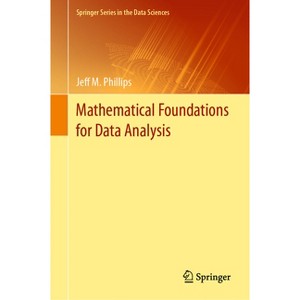
Mathematical Foundations for Data Analysis - (Springer the Data Sciences) by  Jeff M Phillips (Hardcover) - 1 of 1

Mathematical Foundations for Data Analysis - (Springer the Data Sciences) by Jeff M Phillips (Hardcover)

$64.99

In Stock

Free & easy returns

Free & easy returns

Return this item by mail or in store within 90 days for a full refund.
Eligible for registries and wish lists

About this item

Highlights

  • This textbook, suitable for an early undergraduate up to a graduate course, provides an overview of many basic principles and techniques needed for modern data analysis.
  • About the Author: Jeff M. Phillips is an Associate Professor in the School of Computing within the University of Utah.
  • 287 Pages
  • Mathematics, Counting & Numeration
  • Series Name: Springer the Data Sciences

Description


Book Synopsis


This textbook, suitable for an early undergraduate up to a graduate course, provides an overview of many basic principles and techniques needed for modern data analysis. In particular, this book was designed and written as preparation for students planning to take rigorous Machine Learning and Data Mining courses. It introduces key conceptual tools necessary for data analysis, including concentration of measure and PAC bounds, cross validation, gradient descent, and principal component analysis. It also surveys basic techniques in supervised (regression and classification) and unsupervised learning (dimensionality reduction and clustering) through an accessible, simplified presentation. Students are recommended to have some background in calculus, probability, and linear algebra. Some familiarity with programming and algorithms is useful to understand advanced topics on computational techniques.


From the Back Cover


This textbook, suitable for an early undergraduate up to a graduate course, provides an overview of many basic principles and techniques needed for modern data analysis. In particular, this book was designed and written as preparation for students planning to take rigorous Machine Learning and Data Mining courses. It introduces key conceptual tools necessary for data analysis, including concentration of measure and PAC bounds, cross validation, gradient descent, and principal component analysis. It also surveys basic techniques in supervised (regression and classification) and unsupervised learning (dimensionality reduction and clustering) through an accessible, simplified presentation. Students are recommended to have some background in calculus, probability, and linear algebra. Some familiarity with programming and algorithms is useful to understand advanced topics on computational techniques.


Review Quotes


"This is certainly a timely book with large potential impact and appeal. ... the book is therewith accessible to a broad scientific audience including undergraduate students. ... Mathematical Foundations for Data Analysis provides a comprehensive exploration of the mathematics relevant to modern data science topics, with a target audience that is looking for an intuitive and accessible presentation rather than a deep dive into mathematical intricacies." (Aretha L. Teckentrup, SIAM Review, Vol. 65 (1), March, 2023)
"The book is fairly compact, but a lot of information is presented in those pages. ... the book is pretty much self-contained, but prior knowledge of linear algebra and python programming would benefit anyone. The clear writing is backed in many instances by helpful illustrations. Color is used judiciously throughout the text to help differentiate between objects and highlight items of interest. ... Phillips' book is much more concise, but still discusses many different mathematical aspects of data science." (David R. Gurney, MAA Reviews, September 5, 2021)


About the Author


Jeff M. Phillips is an Associate Professor in the School of Computing within the University of Utah. He directs the Utah Center for Data Science as well as the Data Science curriculum within the School of Computing. His research is on algorithms for big data analytics, a domain with spans machine learning, computational geometry, data mining, algorithms, and databases, and his work regularly appears in top venues in each of these fields. He focuses on a geometric interpretation of problems, striving for simple, geometric, and intuitive techniques with provable guarantees and solve important challenges in data science. His research is supported by numerous NSF awards including an NSF Career Award.


Dimensions (Overall): 9.4 Inches (H) x 7.8 Inches (W) x .8 Inches (D)
Weight: 1.4 Pounds
Suggested Age: 22 Years and Up
Number of Pages: 287
Genre: Mathematics
Sub-Genre: Counting & Numeration
Series Title: Springer the Data Sciences
Publisher: Springer
Format: Hardcover
Author: Jeff M Phillips
Language: English
Street Date: March 30, 2021
TCIN: 1011338693
UPC: 9783030623401
Item Number (DPCI): 247-22-3603
Origin: Made in the USA or Imported
If the item details aren’t accurate or complete, we want to know about it.

Shipping details

Estimated ship dimensions: 0.8 inches length x 7.8 inches width x 9.4 inches height
Estimated ship weight: 1.4 pounds
We regret that this item cannot be shipped to PO Boxes.
This item cannot be shipped to the following locations: American Samoa (see also separate entry under AS), Guam (see also separate entry under GU), Northern Mariana Islands, Puerto Rico (see also separate entry under PR), United States Minor Outlying Islands, Virgin Islands, U.S., APO/FPO, Alaska, Hawaii

Return details

This item can be returned to any Target store or Target.com.
This item must be returned within 90 days of the date it was purchased in store, delivered to the guest, delivered by a Shipt shopper, or picked up by the guest.
See the return policy for complete information.

Q: Who is the author of this textbook?

submitted by AI Shopping Assistant - 1 day ago
  • A: The author is Jeff M. Phillips, an Associate Professor at the University of Utah's School of Computing.

    submitted byAI Shopping Assistant - 1 day ago
    Ai generated

Q: What prior knowledge is recommended for readers?

submitted by AI Shopping Assistant - 1 day ago
  • A: Readers should have a background in calculus, probability, and linear algebra, along with some familiarity with programming.

    submitted byAI Shopping Assistant - 1 day ago
    Ai generated

Q: What topics are covered in this textbook?

submitted by AI Shopping Assistant - 1 day ago
  • A: The textbook covers principles like concentration of measure, PAC bounds, cross validation, and techniques in supervised and unsupervised learning.

    submitted byAI Shopping Assistant - 1 day ago
    Ai generated

Q: How is the content presented in the book?

submitted by AI Shopping Assistant - 1 day ago
  • A: The content is presented in an accessible and simplified manner, making complex concepts easier to understand for students.

    submitted byAI Shopping Assistant - 1 day ago
    Ai generated

Q: What is the target audience for this book?

submitted by AI Shopping Assistant - 1 day ago
  • A: The book is aimed at early undergraduate to graduate students preparing for Machine Learning and Data Mining courses.

    submitted byAI Shopping Assistant - 1 day ago
    Ai generated

Additional product information and recommendations

Discover more options

Trending Education Books

Get top deals, latest trends, and more.

Privacy policy