Target New ArrivalsFourth of JulyGift Ideas for DadClothing, Shoes & AccessoriesHome & DecorKitchen & DiningOutdoor Living & GardenGroceryHousehold EssentialsBabyBeautyPersonal CareSports & OutdoorsHealthWellnessLuggageSchool & Office SuppliesToys & GamesElectronicsVideo GamesMovies, Music & BooksParty SuppliesGift IdeasGift CardsPetsUlta Beauty at TargetShop by CommunityTarget OpticalDealsClearanceNew ArrivalsGift Ideas for DadBack to SchoolCollegeTop DealsTarget Circle DealsWeekly AdShop Order PickupShop Same Day DeliveryRegistryRedCardTarget CircleFind Stores
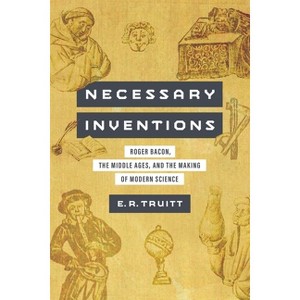
Necessary Inventions - by  Elly Rachel Truitt (Hardcover) - 1 of 1

Necessary Inventions - by Elly Rachel Truitt (Hardcover)

$55.00

Pre-order

Free & easy returns

Free & easy returns

Return this item by mail or in store within 90 days for a full refund.
Eligible for registries and wish lists

About this item

Highlights

  • A study of thirteenth-century philosopher Roger Bacon that reveals the medieval thinking that erased non-Christian texts, actors, and cultures from the history of science In his works, thirteenth-century English scholastic philosopher and Franciscan Roger Bacon depicted an enticing future that included, among other technological marvels, vehicles of unimaginable speed without animal power, diving bells for exploring the ocean floor, and mirrors and lenses that could incinerate whole armies.
  • About the Author: E. R. Truitt is Associate Professor in the Department of the History and Sociology of Science at the University of Pennsylvania.
  • 232 Pages
  • History, Europe

Description


Book Synopsis


A study of thirteenth-century philosopher Roger Bacon that reveals the medieval thinking that erased non-Christian texts, actors, and cultures from the history of science

In his works, thirteenth-century English scholastic philosopher and Franciscan Roger Bacon depicted an enticing future that included, among other technological marvels, vehicles of unimaginable speed without animal power, diving bells for exploring the ocean floor, and mirrors and lenses that could incinerate whole armies. These speculative technologies exemplify the promise of scientia experimentalis, Bacon's term for his theory of scientific knowledge production, and which relied on both theory and experiential knowledge to get accurate knowledge of the natural world. In the centuries after his death, others constructed Bacon's inventiveness and anticipation through partial readings, creative mistranslations, and purposeful distortions of his work, especially relating to scientia experimentalis.

In Necessary Inventions, E. R. Truitt uses Roger Bacon and his afterlives to establish and critique the role of periodization in the historiography of science, specifically the divide between "medieval" and "modern." Truitt shows how, in his lifetime, Bacon was part of an intellectual current of men at Oxford and in Paris, and he consulted texts written in Arabic, newly available in Latin, from which he borrowed, synthesized, and Christianized knowledge about optics, experimentation, and other topics. By the nineteenth century, however, Bacon was understood within the history of scientific development as a brilliant visionary who foretold (or, according to some, invented) later technologies and whose theory of scientia experimentalis anticipated the scientific method by five hundred years. This framing implies that Bacon's own time--the Middle Ages-- was one of intellectual immaturity, and that Bacon's ideas were precocious because the period in which he lived was an era of intellectual stagnation, hostile to rational thought. Truitt exposes the history of this characterization of the medieval period, showing how it organizes both the historiography of science and the narrative of scientific progress.

Uncovering the logic of replacement theology that undergirds the characterization of Bacon as a prophetic figure of scientific modernity, Necessary Inventions reveals the medieval thinking that enabled modern science to tell a story of scientific development that erased non-Christian texts, actors, and cultures from the history of science.


About the Author


E. R. Truitt is Associate Professor in the Department of the History and Sociology of Science at the University of Pennsylvania. She is author of Medieval Robots: Mechanism, Magic, Nature, and Art, also available from the University of Pennsylvania Press.
Dimensions (Overall): 9.0 Inches (H) x 6.0 Inches (W)
Suggested Age: 22 Years and Up
Number of Pages: 232
Genre: History
Sub-Genre: Europe
Publisher: University of Pennsylvania Press
Theme: Medieval
Format: Hardcover
Author: Elly Rachel Truitt
Language: English
Street Date: September 8, 2026
TCIN: 1006061305
UPC: 9781512829884
Item Number (DPCI): 247-34-3498
Origin: Made in the USA or Imported
If the item details aren’t accurate or complete, we want to know about it.

Shipping details

Estimated ship dimensions: 1 inches length x 6 inches width x 9 inches height
Estimated ship weight: 1 pounds
We regret that this item cannot be shipped to PO Boxes.
This item cannot be shipped to the following locations: American Samoa (see also separate entry under AS), Guam (see also separate entry under GU), Northern Mariana Islands, Puerto Rico (see also separate entry under PR), United States Minor Outlying Islands, Virgin Islands, U.S., APO/FPO, Alaska, Hawaii

Return details

This item can be returned to any Target store or Target.com.
This item must be returned within 90 days of the date it was purchased in store, delivered to the guest, delivered by a Shipt shopper, or picked up by the guest.
See the return policy for complete information.

Q: Who is the author of Necessary Inventions?

submitted by AI Shopping Assistant - 5 days ago
  • A: The author is E. R. Truitt, an Associate Professor at the University of Pennsylvania.

    submitted byAI Shopping Assistant - 5 days ago
    Ai generated

Q: How does the book address the concept of scientia experimentalis?

submitted by AI Shopping Assistant - 5 days ago
  • A: It explores Bacon's theory of scientia experimentalis, emphasizing the blend of theory and experiential knowledge in science.

    submitted byAI Shopping Assistant - 5 days ago
    Ai generated

Q: What unique technologies does Roger Bacon envision?

submitted by AI Shopping Assistant - 5 days ago
  • A: Bacon envisions technologies like fast vehicles without animal power and diving bells for ocean exploration.

    submitted byAI Shopping Assistant - 5 days ago
    Ai generated

Q: What is the main focus of the book?

submitted by AI Shopping Assistant - 5 days ago
  • A: The book studies Roger Bacon's philosophy and critiques the historical narrative of science that excludes non-Christian contributions.

    submitted byAI Shopping Assistant - 5 days ago
    Ai generated

Q: What era does the book primarily discuss?

submitted by AI Shopping Assistant - 5 days ago
  • A: The book primarily discusses the thirteenth century and the medieval period's influence on scientific thought.

    submitted byAI Shopping Assistant - 5 days ago
    Ai generated

Additional product information and recommendations

Discover more options

Best-selling History

Get top deals, latest trends, and more.

Privacy policy