Target New ArrivalsFourth of JulyBack to SchoolCollegeClothing, Shoes & AccessoriesHome & DecorKitchen & DiningOutdoor Living & GardenGroceryHousehold EssentialsBabyBeautyPersonal CareSports & OutdoorsHealthWellnessSchool & Office SuppliesToys & GamesElectronicsVideo GamesMovies, Music & BooksParty SuppliesGift IdeasGift CardsPetsUlta Beauty at TargetShop by CommunityTarget OpticalDealsClearanceNew ArrivalsBack to SchoolCollegeTop DealsTarget Circle DealsWeekly AdShop Order PickupShop Same Day DeliveryRegistryRedCardTarget CircleFind Stores
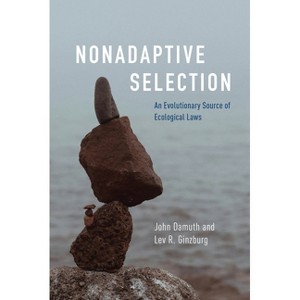
Nonadaptive Selection - by John Damuth & Lev R Ginzburg - 1 of 1

Nonadaptive Selection - by John Damuth & Lev R Ginzburg (Paperback)

$35.00

FormatPaperback

In Stock

Free & easy returns
Free & easy returns
Return this item by mail or in store within 90 days for a full refund.
Eligible for registries and wish lists

About this item

Highlights

  • The first comprehensive explanation of a widely applicable but underappreciated mechanism of evolution operating at higher levels of organization than the individual.
  • About the Author: John Damuth (1952-2024) was a senior research scientist in the Department of Ecology, Evolution, and Marine Biology at the University of California, Santa Barbara.
  • 240 Pages
  • Science, Life Sciences

Description


About the Book


"Ecologists John Damuth and Lev Ginzburg identify a specific evolutionary process in biology, which they call non-adaptive selection. The idea is simple, but the implications are profound. Non-adaptive selection, as they use the term, is selection among biological entities (as is natural selection) but is based on the fitness effects of logical or mathematical properties intrinsic to the entities under selection rather than on interactions of traits with a local shared environment. In other words, features of systems that evolve by non-adaptive selection do not adapt to local environmental conditions; rather, this selective process increases the long-term stability of the focal systems independent of local conditions. Consequently, the process tends to maintain stability and stable equilibria. Non-adaptive selection may be of most particular value in explaining broad, persistent patterns in multi-species biological units where adaptive evolution may be weak or poorly defined. Examples include: Damuth's Law, the equivalence of energy use among animals species across a wide range of body sizes; the consistency of allometric scaling powers; the shortness of trophic chains; and the prevalence of certain types of three-species trophic structures across ecosystems. Damuth and Ginzburg see non-adaptive selection underlying patterns of ecological allometries, community structure, and species interactions with some implications for macroevolution. Moreover, they find a surprising relationship between these non-adaptive processes and biological laws. They do not advocate the reorientation of any existing research programs but present non-adaptive selection as an additional conceptual framework that may be useful to add to ecology and evolution"--


Book Synopsis


The first comprehensive explanation of a widely applicable but underappreciated mechanism of evolution operating at higher levels of organization than the individual.

In this important treatise, ecologists and evolutionary biologists John Damuth and Lev R. Ginzburg identify a specific evolutionary process in biology, which they call nonadaptive selection. The idea is simple, but the implications are profound. Nonadaptive selection, as they use the term, is selection among biological entities (as is natural selection) but is based on the fitness effects of structural properties intrinsic to the entities under selection rather than on interactions between traits and a local shared environment. In other words, features of systems that evolve by nonadaptive selection do not adapt to local environmental conditions; rather, this selective process increases the long-term stability of the focal systems independent of local conditions.

Nonadaptive selection may be of particular value in explaining broad, persistent patterns in multispecies biological units where adaptive evolution may be weak or poorly defined. Examples include Damuth's Law, the equivalence of energy use among animal species across a wide range of body sizes; the ratio-dependent, or Arditi-Ginzburg, predation conjecture; the consistency of allometric scaling powers; the shortness of trophic chains; and the prevalence of certain types of three-species trophic structures across ecosystems. Damuth and Ginzburg see nonadaptive selection underlying patterns of ecological allometries, community structure, and species interactions, with some implications for macroevolution. Moreover, they find a surprising relationship between these nonadaptive processes and biological laws. They do not advocate the reorientation of any existing research programs but present nonadaptive selection as an additional conceptual framework that may be useful to add to ecology and evolution.


Review Quotes


"Nonadaptive Selection . . . will have served a useful purpose if it encourages evolutionary biologists to clarify what they mean by selection and more clearly distinguish questions of stability from questions of adaptation."

--David Haig "Evolution"

"A dense and complex argument is required to fully explore this idea. Accordingly, Damuth and Ginzburg provide 621 supporting literature citations across a wide range of topics in macroecology, community ecology, and evolutionary theory. It is a good starting point for future thought. Recommended."

--G. C. Stevens "Choice"

"Damuth and Ginzburg have put their finger on an important class of phenomena generating broadscale patterns in ecology and evolution. Ecological and evolutionary theory searches for the stable equilibria of models depicting the dynamical flows and interaction mechanisms among entities in communities, ecosystems, and clades, because systems should be continually pushed toward or be at these values. Their great contribution is in recognizing that seeking stability in these mechanisms should reveal inherent patterning across systems that is independent of specific differences in environmental conditions."

--Michael R. Dietrich and Mark A. McPeek "BioScience"

"A total intellectual and scientific pleasure. Damuth and Ginzburg have made a case for connection among a diverse set of phenomena that have resisted our understanding. More importantly, they've made new phenomena make more sense just by naming a process. Nonadaptive Selection is one of the most original and important books on evolution and ecology to come out in the last twenty years."--Carl Simpson, University of Colorado Boulder


About the Author


John Damuth (1952-2024) was a senior research scientist in the Department of Ecology, Evolution, and Marine Biology at the University of California, Santa Barbara. Lev R. Ginzburg is professor emeritus in the Department of Ecology and Evolution at Stony Brook University. Among his books are the coauthored How Species Interact: Altering the Standard View on Trophic Ecology and Ecological Orbits: How Planets Move and Populations Grow.
Dimensions (Overall): 8.9 Inches (H) x 6.0 Inches (W) x .7 Inches (D)
Weight: 1.05 Pounds
Suggested Age: 22 Years and Up
Number of Pages: 240
Genre: Science
Sub-Genre: Life Sciences
Publisher: University of Chicago Press
Theme: Ecology
Format: Paperback
Author: John Damuth & Lev R Ginzburg
Language: English
Street Date: July 10, 2025
TCIN: 1008661975
UPC: 9780226838571
Item Number (DPCI): 247-19-7534
Origin: Made in the USA or Imported
If the item details aren’t accurate or complete, we want to know about it.

Shipping details

Estimated ship dimensions: 0.7 inches length x 6 inches width x 8.9 inches height
Estimated ship weight: 1.05 pounds
We regret that this item cannot be shipped to PO Boxes.
This item cannot be shipped to the following locations: American Samoa (see also separate entry under AS), Guam (see also separate entry under GU), Northern Mariana Islands, Puerto Rico (see also separate entry under PR), United States Minor Outlying Islands, Virgin Islands, U.S., APO/FPO, Alaska, Hawaii

Return details

This item can be returned to any Target store or Target.com.
This item must be returned within 90 days of the date it was purchased in store, delivered to the guest, delivered by a Shipt shopper, or picked up by the guest.
See the return policy for complete information.

Additional product information and recommendations

Discover more options

Best-selling Education Books

Get top deals, latest trends, and more.