Target New ArrivalsGift Ideas for MomClothing, Shoes & AccessoriesHome & DecorKitchen & DiningOutdoor Living & GardenGroceryHousehold EssentialsBabyBeautyPersonal CareHealthWellnessLuggageSports & OutdoorsToysElectronicsVideo GamesMovies, Music & BooksSchool & Office SuppliesParty SuppliesGift IdeasGift CardsPetsUlta Beauty at TargetShop by CommunityTarget OpticalDealsClearanceTarget New ArrivalsSpring OutfitsGift Ideas for MomWomen’s Festival OutfitsTop DealsTarget Circle DealsWeekly AdShop Order PickupShop Same Day DeliveryRegistryRedCardTarget CircleFind Stores
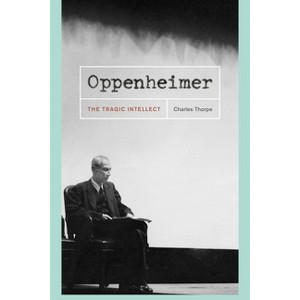
Oppenheimer - by  Charles Thorpe (Paperback) - 1 of 1

Oppenheimer - by Charles Thorpe (Paperback)

$34.00

In Stock

Free & easy returns

Free & easy returns

Return this item by mail or in store within 90 days for a full refund.
Eligible for registries and wish lists

About this item

Highlights

  • At a time when the Manhattan Project was synonymous with large-scale science, physicist J. Robert Oppenheimer (1904-67) represented the new sociocultural power of the American intellectual.
  • About the Author: Charles Thorpe is an associate professor in the Department of Sociology at the University of California, San Diego.
  • 448 Pages
  • Science, Physics

Description


Book Synopsis


At a time when the Manhattan Project was synonymous with large-scale science, physicist J. Robert Oppenheimer (1904-67) represented the new sociocultural power of the American intellectual. Catapulted to fame as director of the Los Alamos atomic weapons laboratory, Oppenheimer occupied a key position in the compact between science and the state that developed out of World War II. By tracing the making--and unmaking--of Oppenheimer's wartime and postwar scientific identity, Charles Thorpe illustrates the struggles over the role of the scientist in relation to nuclear weapons, the state, and culture.
A stylish intellectual biography, Oppenheimer maps out changes in the roles of scientists and intellectuals in twentieth-century America, ultimately revealing transformations in Oppenheimer's persona that coincided with changing attitudes toward science in society.
"This is an outstandingly well-researched book, a pleasure to read and distinguished by the high quality of its observations and judgments. It will be of special interest to scholars of modern history, but non-specialist readers will enjoy the clarity that Thorpe brings to common misunderstandings about his subject."--Graham Farmelo, Times Higher Education Supplement "A fascinating new perspective. . . . Thorpe's book provides the best perspective yet for understanding Oppenheimer's Los Alamos years, which were critical, after all, not only to his life but, for better or worse, the history of mankind."--Catherine Westfall, Nature


Review Quotes


"An original and compelling analysis of Oppenheimer's life and role as a scientific leader." -- Mary Jo Nye "Chemical Heritage"

""Oppenheimer: The Tragic Intellect" is not a conventional, cradle-to-grave biography like Kai Bird and Martin Sherwin''s "American Prometheus," winner of a Pulitzer Prize in 2006. Rather, Thorpe concentrates mainly on Oppenheimer''s transition from academia to his post as scientific director of the Manhattan Project, and subsequently his security hearing and the period in Oppenheimer''s life--as Thorpe puts it--after he was "excommunicated from the inner circle of the nuclear state.'' This is an outstandingly well-researched book, a pleasure to read and distinguished by the high quality of its observations and judgments. It will be of special interest to scholars of modern history, but non-specialist readers will enjoy the clarity that Thorpe brings to common misunderstandings about his subject." -- Graham Farmelo "Times Higher Education Supplement" (04/20/2007)

"[Thorpe''s] book is magnificently well researched, elegantly written, and analytically profound. It is packed with new and original insights. "Oppenheimer: The Tragic Intellect" is one of the finest books I have ever read." -- Richard Polenberg "Journal of American History"

"A fascinating new perspective....Thorpe''s book provides the best perspective yet for understanding Oppenheimer''s Los Alamos years, which were critical, after all, not only to his life but, for better or worse, the history of mankind." -- Catherine Westfall "Nature" (05/24/2007)

"He is known as the father of the atomic bomb, but J. Robert Oppenheimer was much more than that. As scientific director of the Los Alamos atomic weapons laboratory during the second world war, Oppenheimer was a social symbol, a ''nodal point'' where scientific, political and military interests clashed. It is this sociological aspect of his life that Thorpe focuses on here." -- Sam Kean "New Scientist" (11/11/2006)

"A masterful contribution to Oppenheimer studies. Charles Thorpe skillfully weaves together sociology, history, and biography to create a rich tapestry of Oppenheimer's complex life and times. Thorpe provides new perspectives on Oppenheimer's evolution as a scientific intellectual and cultural icon, as well as new insights into the changing constellation of science, state power, and the moral responsibility of the scientist, of which Oppenheimer was both a driving force and a tragic victim."--David C. Cassidy, author of "J. Robert Oppenheimer and the American Century"

"Because he directed the U.S. effort to develop the atomic bomb, physicist J. Robert Oppenheimer at the height of World War II became a new kind of icon among select scientists. Perhaps never before in history had a scientist held so much power. Oppenheimer''s development and oversight of the Los Alamos National Laboratory changed the dynamics of physics research and scientific ethics. Thorpe paints an illuminating picture of this charismatic teacher and researcher and documents his downfall in the aftermath of his work at Los Alamos. Thorpe notes that Oppenheimer''s and his fellow scientists'' concerns about the morality of developing the bomb were eclipsed by their focus on technical issues. Later, Oppenheimer became a staunch critic of the continuing development of nuclear weapons and thus made himself a target of government scrutiny. The FBI eventually accused him of being an enemy agent."--"Science News"

"Charles Thorpe's analytically brilliant addition to the expanding Oppenheimer library of biographies, histories, and literature is remarkable for its important new ideas and analyses. Even if you have read every book written about 'the father of the atomic bomb, ' "Oppenheimer: The Tragic Intellect" will introduce you to a clearer and deeper understanding of the man and his time."--Martin J. Sherwin, coauthor of "American Prometheus: The Triumph and Tragedy of J. Robert Oppenheimer"

"Charles Thorpe's book gives us a fresh view of an icon. It shows how the Oppenheimer aura shaped the Los Alamos lab during World War II and was in turn shaped by it. No one surpasses the author in explaining the mysterious authority whereby Oppenheimer continued to play a major role as intellectual leader and prophet long after the government banished him from its councils."--Priscilla J. McMillan, author of "The Ruin of J. Robert Oppenheimer and the Birth of the Modern Arms Race"

"This engaging and impressively documented study enables us to see how Oppenheimer's distinctive public personality emerged from a specific set of institutions, social communities, and cultural inventories. No other book attends as carefully to the dynamics of Oppenheimer's performance as a public figure."--David Hollinger, author of "Science, Jews, and Secular Culture"


"Thorpe's excellent book rescues Oppenheimer from the myth-makers, showing the context of his early leftism, the match between his special talents and the organizational setting of Los Alamos that made for his staggering success, and, most importantly, the act that proved to be his undoing: his opposition, on technical grounds, to the H-bomb, which raised questions about his loyalty and ability to separate politics from science that his previous deceptions prevented him from dispelling. Thorpe then describes the surprising denouement: the Oppenheimer who emerged from these dramatic events was neither a martyr nor an anguished moralist, but an "homme serieux," with a mature acceptance of the continued necessity of nuclear military force."--Stephen Turner, author of "Liberal Democracy 3.0: Civil Society in an Age of Experts"


"Thorpe's excellent book rescues Oppenheimer from the myth-makers, showing the context of his early leftism, the match between his special talents and the organizational setting of Los Alamos that made for his staggering success, and, most importantly, the act that proved to be his undoing: his opposition, on technical grounds, to the H-bomb, which raised questions about his loyalty and ability to separate politics from science that his previous deceptions prevented him from dispelling. Thorpe then describes the surprising denouement: the Oppenheimer who emerged from these dramatic events was neither a martyr nor an anguished moralist, but an "homme serieux", with a mature acceptance of the continued necessity of nuclear military force."--Stephen Turner, author of "Liberal Democracy 3.0: Civil Society in an Age of Experts"


"A fascinating new perspective....Thorpe's book provides the best perspective yet for understanding Oppenheimer's Los Alamos years, which were critical, after all, not only to his life but, for better or worse, the history of mankind."

"Oppenheimer: The Tragic Intellect is not a conventional, cradle-to-grave biography like Kai Bird and Martin Sherwin's American Prometheus, winner of a Pulitzer Prize in 2006. Rather, Thorpe concentrates mainly on Oppenheimer's transition from academia to his post as scientific director of the Manhattan Project, and subsequently his security hearing and the period in Oppenheimer's life-as Thorpe puts it-after he was "excommunicated from the inner circle of the nuclear state.' This is an outstandingly well-researched book, a pleasure to read and distinguished by the high quality of its observations and judgments. It will be of special interest to scholars of modern history, but non-specialist readers will enjoy the clarity that Thorpe brings to common misunderstandings about his subject."

"He is known as the father of the atomic bomb, but J. Robert Oppenheimer was much more than that. As scientific director of the Los Alamos atomic weapons laboratory during the second world war, Oppenheimer was a social symbol, a 'nodal point' where scientific, political and military interests clashed. It is this sociological aspect of his life that Thorpe focuses on here."


About the Author


Charles Thorpe is an associate professor in the Department of Sociology at the University of California, San Diego.
Dimensions (Overall): 8.8 Inches (H) x 5.9 Inches (W) x 1.1 Inches (D)
Weight: 1.35 Pounds
Suggested Age: 22 Years and Up
Number of Pages: 448
Genre: Science
Sub-Genre: Physics
Publisher: University of Chicago Press
Theme: Nuclear
Format: Paperback
Author: Charles Thorpe
Language: English
Street Date: November 1, 2008
TCIN: 1010773892
UPC: 9780226798462
Item Number (DPCI): 247-28-3789
Origin: Made in the USA or Imported
If the item details aren’t accurate or complete, we want to know about it.

Shipping details

Estimated ship dimensions: 1.1 inches length x 5.9 inches width x 8.8 inches height
Estimated ship weight: 1.35 pounds
We regret that this item cannot be shipped to PO Boxes.
This item cannot be shipped to the following locations: American Samoa (see also separate entry under AS), Guam (see also separate entry under GU), Northern Mariana Islands, Puerto Rico (see also separate entry under PR), United States Minor Outlying Islands, Virgin Islands, U.S., APO/FPO, Alaska, Hawaii

Return details

This item can be returned to any Target store or Target.com.
This item must be returned within 90 days of the date it was purchased in store, delivered to the guest, delivered by a Shipt shopper, or picked up by the guest.
See the return policy for complete information.

Q: What is the intended audience for this book?

submitted by AI Shopping Assistant - 7 days ago
  • A: The book is aimed at both scholars of modern history and non-specialist readers interested in Oppenheimer and nuclear science.

    submitted byAI Shopping Assistant - 7 days ago
    Ai generated

Q: What is the primary theme of the book?

submitted by AI Shopping Assistant - 7 days ago
  • A: The primary theme revolves around the sociocultural power of science, particularly in relation to nuclear weapons and its implications on society.

    submitted byAI Shopping Assistant - 7 days ago
    Ai generated

Q: What aspects of Oppenheimer's life are explored in this book?

submitted by AI Shopping Assistant - 7 days ago
  • A: The book explores Oppenheimer's identity struggles during and after his involvement with the atomic bomb and his relationship with state power.

    submitted byAI Shopping Assistant - 7 days ago
    Ai generated

Q: Who is the author of this book?

submitted by AI Shopping Assistant - 7 days ago
  • A: The author is Charles Thorpe, an associate professor at the University of California, San Diego.

    submitted byAI Shopping Assistant - 7 days ago
    Ai generated

Q: What distinguishes this biography from others about Oppenheimer?

submitted by AI Shopping Assistant - 7 days ago
  • A: This biography focuses on Oppenheimer's transition from academia to his role in the Manhattan Project, unlike conventional comprehensive biographies.

    submitted byAI Shopping Assistant - 7 days ago
    Ai generated

Additional product information and recommendations

Discover more options

Trending Education Books

Get top deals, latest trends, and more.

Privacy policy