Target New ArrivalsGift Ideas for MomClothing, Shoes & AccessoriesHome & DecorKitchen & DiningOutdoor Living & GardenGroceryHousehold EssentialsBabyBeautyPersonal CareHealthWellnessLuggageSports & OutdoorsToysElectronicsVideo GamesMovies, Music & BooksSchool & Office SuppliesParty SuppliesGift IdeasGift CardsPetsUlta Beauty at TargetShop by CommunityTarget OpticalDealsClearanceTarget New ArrivalsSpring OutfitsGift Ideas for MomWomen’s Festival OutfitsTop DealsTarget Circle DealsWeekly AdShop Order PickupShop Same Day DeliveryRegistryRedCardTarget CircleFind Stores
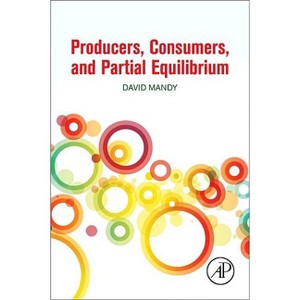
Producers, Consumers, and Partial Equilibrium - by  David Mandy (Paperback) - 1 of 1

Producers, Consumers, and Partial Equilibrium - by David Mandy (Paperback)

$59.95

In Stock

Free & easy returns

Free & easy returns

Return this item by mail or in store within 90 days for a full refund.
Eligible for registries and wish lists

About this item

Highlights

  • Producers, Consumers, and Partial Equilibrium provides a systematic and accessible presentation of the full formal details in the core theories of producer and consumer choice under conditions of price taking; and covers the standard theories of competitive, monopoly, and oligopoly partial equilibrium among these economic actors.
  • Author(s): David Mandy
  • 422 Pages
  • Business + Money Management, Business Mathematics

Description


About the Book


Producers, Consumers, and Partial Equilibrium provides a systematic and accessible presentation of the full formal details in the core theories of producer and consumer choice under conditions of price taking; and covers the standard theories of competitive, monopoly, and oligopoly partial equilibrium among these economic actors. The book pulls together foundational content from many classic sources and organizes it in a self-contained format that rigidly adheres to optimization as the central behavioral postulate and analytical tool for economic theory. The book maintains a sharp focus on the properties of outcomes from optimizing behavior in varying environments. These properties are the refutable hypotheses from each optimization behavioral postulate, and they form the core content of this positive economic theory. In so doing, the book presents and documents the underlying formal structure of the theory with a higher degree of integration and completeness than is typical of Ph. D. textbooks in microeconomics.


Book Synopsis


Producers, Consumers, and Partial Equilibrium provides a systematic and accessible presentation of the full formal details in the core theories of producer and consumer choice under conditions of price taking; and covers the standard theories of competitive, monopoly, and oligopoly partial equilibrium among these economic actors. The book pulls together foundational content from many classic sources and organizes it in a self-contained format that rigidly adheres to optimization as the central behavioral postulate and analytical tool for economic theory.

The book maintains a sharp focus on the properties of outcomes from optimizing behavior in varying environments. These properties are the refutable hypotheses from each optimization behavioral postulate, and they form the core content of this positive economic theory. In so doing, the book presents and documents the underlying formal structure of the theory with a higher degree of integration and completeness than is typical of Ph.D. textbooks in microeconomics.


Review Quotes


"This textbook of advanced level covers almost all themes of modern microeconomic theory...presents state-of-the-art models and the mathematical apparatus of microeconomics...All chapters contain bibliographic notes and many exercises." --Zentralblatt MATH

"I wish I had David Mandy's book, Producers, Consumers, and Partial Equilibrium, during my many years of teaching the core theories of consumer and producer choice to graduate students. Working through the elegant and rigorous treatment plus the many exercises in Mandy's book will give the student a very solid foundation of understanding of this core material." --William A. Brock, University of Wisconsin, Madison and University of Missouri, Columbia

"This text is much more self-contained than many other modern treatment of core microeconomic theory. First-year graduate students will find this a great resource tying optimization and economics in a clear and logical development." --Jonathan Hamilton, University of Florida

"Producers, Consumers and Partial Equilibrium provides a rigorous, in depth, and self-contained treatment of the mathematics and fundamental results from classical microeconomic theory of consumer and producer behavior in a partial equilibrium context. Mandy's clear and logical presentation, together with the numerous exercises at the end of each chapter, make this book indispensable reading for doctoral students in Economics and related disciplines." --Carlos Martins-Filho, University of Colorado, Boulder

"Mandy takes students through the foundations of neoclassical economics. He shows how basic tools derived from optimization theory, namely, contemporary duality techniques, unify arguments whether they concern producer or consumer decisions. In all cases the ultimate objective is to derive comparative statics results in a systematic manner. Mandy accomplishes this task so well that his book could by profitably used by students learning this material on their own." --Robert Becker, Indiana University

"David Mandy has written an elegant book that deeply investigates both the necessary mathematical tools to study neoclassical models and the application of those tools to many economic environments. It will be an excellent text for both the "math camp" and first semester Ph.D. courses in economics." --Gary Biglaiser, University of North Carolina


Dimensions (Overall): 9.0 Inches (H) x 6.0 Inches (W) x .94 Inches (D)
Weight: 1.36 Pounds
Suggested Age: 22 Years and Up
Number of Pages: 422
Genre: Business + Money Management
Sub-Genre: Business Mathematics
Publisher: Academic Press
Format: Paperback
Author: David Mandy
Language: English
Street Date: November 4, 2016
TCIN: 1009183881
UPC: 9780128110232
Item Number (DPCI): 247-18-6862
Origin: Made in the USA or Imported
If the item details aren’t accurate or complete, we want to know about it.

Shipping details

Estimated ship dimensions: 0.94 inches length x 6 inches width x 9 inches height
Estimated ship weight: 1.36 pounds
We regret that this item cannot be shipped to PO Boxes.
This item cannot be shipped to the following locations: American Samoa (see also separate entry under AS), Guam (see also separate entry under GU), Northern Mariana Islands, Puerto Rico (see also separate entry under PR), United States Minor Outlying Islands, Virgin Islands, U.S., APO/FPO, Alaska, Hawaii

Return details

This item can be returned to any Target store or Target.com.
This item must be returned within 90 days of the date it was purchased in store, delivered to the guest, delivered by a Shipt shopper, or picked up by the guest.
See the return policy for complete information.

Q: What core theories does the book cover?

submitted by AI Shopping Assistant - 1 month ago
  • A: The book covers theories of producer and consumer choice, competitive, monopoly, and oligopoly partial equilibrium.

    submitted byAI Shopping Assistant - 1 month ago
    Ai generated

Q: What makes this book different from other microeconomic textbooks?

submitted by AI Shopping Assistant - 1 month ago
  • A: It offers a more self-contained approach, tightly integrating fundamental microeconomic concepts with optimization techniques.

    submitted byAI Shopping Assistant - 1 month ago
    Ai generated

Q: Who is the intended audience for this book?

submitted by AI Shopping Assistant - 1 month ago
  • A: The book is aimed at graduate students, particularly those studying economics and related disciplines.

    submitted byAI Shopping Assistant - 1 month ago
    Ai generated

Q: What type of exercises does the book include?

submitted by AI Shopping Assistant - 1 month ago
  • A: The book contains numerous exercises at the end of each chapter to reinforce understanding of the material.

    submitted byAI Shopping Assistant - 1 month ago
    Ai generated

Q: How does the book present complex economic theories?

submitted by AI Shopping Assistant - 1 month ago
  • A: It provides a systematic, accessible format with a focus on optimization as the key analytical tool.

    submitted byAI Shopping Assistant - 1 month ago
    Ai generated

Additional product information and recommendations

Discover more options

Trending Business & Law Books

Get top deals, latest trends, and more.

Privacy policy