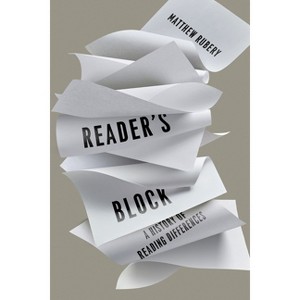
Reader's Block - by Matthew Rubery (Hardcover)
In Stock
About this item
Highlights
- What does the term "reading" mean?
- About the Author: Matthew Rubery is Professor of Modern Literature at Queen Mary University of London.
- 288 Pages
- Literary Criticism, General
Description
About the Book
"What does the term "reading" mean to you? This alternative history of reading tells the stories of atypical readers and the impact had on their lives by neurological conditions affecting their ability to make sense of the printed word: from dyslexia, hyperlexia, and alexia to synesthesia, hallucinations, and dementia. The book's focus on neurodiversity aims to transform our understanding of the very concept of reading. Drawing on personal testimonies gathered from literature, film, life writing, social media, scientific journals, medical case studies, and other sources to express how cognitive differences have shaped people's experiences both on and off the page, Matthew Rubery contends that there is no single activity known as reading. Instead, there are multiple ways of reading (and, for that matter, not reading) despite the ease with which we use the term in conversation and act as if everyone does it in essentially the same fashion. Pushing us to rethink what it means to read, Reader's Block moves toward an understanding of reading as a spectrum that is capacious enough to accommodate the full range of activities documented in this fascinating and highly original book"--Book Synopsis
What does the term "reading" mean? Matthew Rubery's exploration of the influence neurodivergence has on the ways individuals read asks us to consider that there may be no one definition.
This alternative history of reading tells the stories of "atypical" readers and the impact had on their lives by neurological conditions affecting their ability to make sense of the printed word: from dyslexia, hyperlexia, and alexia to synesthesia, hallucinations, and dementia. Rubery's focus on neurodiversity aims to transform our understanding of the very concept of reading.
Drawing on personal testimonies gathered from literature, film, life writing, social media, medical case studies, and other sources to express how cognitive differences have shaped people's experiences both on and off the page, Rubery contends that there is no single activity known as reading. Instead, there are multiple ways of reading (and, for that matter, not reading) despite the ease with which we use the term. Pushing us to rethink what it means to read, Reader's Block moves toward an understanding of reading as a spectrum that is capacious enough to accommodate the full range of activities documented in this fascinating and highly original book.
Read it from cover to cover, out of sequence, or piecemeal. Read it upside down, sideways, or in a mirror. For just as there is no right way to read, there is no right way to read this book. What matters is that you are doing something with it--something that Rubery proposes should be called "reading."
Review Quotes
"Matthew Rubery's... remarkably well-researched catalogue of neurodivergent reading experiences reveals how many different ways brains can engage with texts, demonstrating that this seemingly quotidian activity is neither unitary nor widely understood."--Timothy Aubry, American Literary History
"Thinking about reading in terms of the different reading behaviors these essays about atypical readers document can help one achieve a broader, more inclusive understanding of what read actually means.... Recommended."--J. F. Andrews, CHOICE
"By its very nature, Reader's Block is designed for casual reading--and particularly for people interested in science, history, literature and neurodiversity."--Matthew Rozsa, Salon
"Rubery uncovers the hidden history of neurodiverse reading (and non-reading). Drawing upon everything from clinical studies to life writing, this is a brilliant and remarkably original work that challenges and subverts a whole set of received wisdoms about how readers engage with books. After Reader's Block, you will never again make cozy assumptions about how and why people read."--Shafquat Towheed, coeditor of The History of Reading
"A thoughtful and timely survey of neuro-divergent readers' singular, complex, sometimes fraught relationship with the written word."--Daniel Tammet, author of Every Word is a Bird We Teach to Sing
"An inclusive, beautifully formulated invitation to think of reading as a cluster of practices as prolific as the minds and the texts nourished in their combination. Rubery is one of the most sensitive and original scholars working with literature today."--Christina Lupton, author of Love and the Novel
"By constructing a detailed map of mis-reading, Rubery argues for the value of non-normative reading experiences. Some differences are disabling, he recognizes, but others make visible aspects of reading that go unnoticed and unappreciated when they function smoothly."--Paul Armstrong, author of Stories and the Brain
"Rubery gives us fresh eyes to grasp the semi-miraculous nature of the reading act in all its complexity and potential for transforming the life of every reader and the species itself."--Maryanne Wolf, author of Reader, Come Home
"This is a fascinating, innovative, and skillful book which presents its deep research and learning fluently and lightly. Thought-provoking, timely, and moving, Reader's Block is essential reading for those interested in disability studies and the history of the book."--Sophie Ratcliffe, author of The Lost Properties of Love
About the Author
Matthew Rubery is Professor of Modern Literature at Queen Mary University of London. He is the author of The Untold Story of the Talking Book (2016) and co-editor of Further Reading (2020).Shipping details
Return details
Q: Who is the author of the book?
A: Matthew Rubery is the author, serving as a Professor of Modern Literature at Queen Mary University of London.
submitted byAI Shopping Assistant - 20 days agoAi generated
Q: What is the central theme of the book?
A: The book explores the concept of reading through the lens of neurodiversity, highlighting diverse reading experiences shaped by various neurological conditions.
submitted byAI Shopping Assistant - 20 days agoAi generated
Q: What types of readers does the book focus on?
A: The book focuses on atypical readers impacted by neurological conditions like dyslexia and synesthesia, reflecting on their unique reading experiences.
submitted byAI Shopping Assistant - 20 days agoAi generated
Q: What is the book's approach to understanding reading?
A: It presents reading as a spectrum with multiple interpretations, challenging the conventional notion of a singular reading experience.
submitted byAI Shopping Assistant - 20 days agoAi generated
Q: Does the book follow a traditional narrative structure?
A: No, it encourages various reading approaches, allowing readers to engage with it piecemeal or out of sequence.
submitted byAI Shopping Assistant - 20 days agoAi generated