Target New ArrivalsGift Ideas for DadClothing, Shoes & AccessoriesHome & DecorKitchen & DiningOutdoor Living & GardenGroceryHousehold EssentialsBabyBeautyPersonal CareSports & OutdoorsHealthWellnessLuggageSchool & Office SuppliesToysElectronicsVideo GamesMovies, Music & BooksParty SuppliesGift IdeasGift CardsPetsUlta Beauty at TargetShop by CommunityTarget OpticalDealsClearanceNew ArrivalsGift Ideas for DadBack to SchoolCollegeTop DealsTarget Circle DealsWeekly AdShop Order PickupShop Same Day DeliveryRegistryRedCardTarget CircleFind Stores
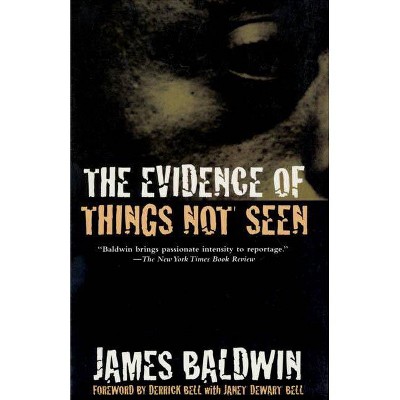
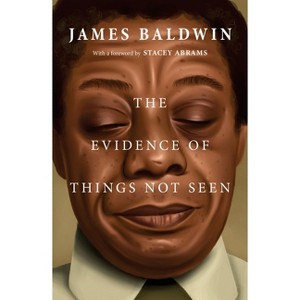
The Evidence of Things Not Seen - by  James Baldwin (Paperback) - 1 of 1

The Evidence of Things Not Seen - by James Baldwin (Paperback)

$11.39Save $6.60 (37% off)

In Stock

Free & easy returns

Free & easy returns

Return this item by mail or in store within 90 days for a full refund.
Eligible for registries and wish lists

About this item

Highlights

  • Playboy Best Nonfiction award for 1981 "To grapple with the pervasiveness of American racism, we can always turn to James Baldwin.
  • About the Author: James Baldwin (1924-1987) was a novelist, essayist, playwright, poet, and social critic.
  • 144 Pages
  • Social Science, Ethnic Studies

Description


About the Book


"The Evidence of Things Not Seen, award-winning author James Baldwin's searing 1985 indictment of the nation's racial stagnation, is contextualized anew by an introduction from New York Times bestselling author and political leader Stacey Abrams. In this essential work, James Baldwin examines the Atlanta child murders that took place over twenty-two months in 1979 and 1980. Examining this incident with a reporter's skill and an essayist's insight, he notes the significance of Atlanta as the site of these brutal killings-a city that claimed to be "too busy to hate"-and the permeation of race throughout the case: the Black administration in Atlanta; the murdered Black children; and Wayne Williams, the Black man tried for the crimes. In Baldwin's hands, this specific set of events has transcended its era and remains as relevant today as ever. Rummaging through the ruins of American race relations, Baldwin addresses all the hard-to-face issues that have brought us to a moment in history when we are forced to reckon with some of the country's most ingrained, foundational issues and when, too often, public officials fail to ask real questions about "justice for all." In this, his last book, Baldwin also reveals his optimistic faith in America's ability to move toward repair: "This is the only nation in the world that can hope to liberate-to begin to liberate-mankind from the strangling idea of the national identity and the tyranny of the territorial dispute. I know this sounds remote, now, and that I will not live to see anything resembling this hope come to pass. Yet, I know that I have seen it-in fire and blood and anguish, true, but I have seen it. I speak with the authority of the issue of the slave born in the country once believed to be: the last best hope of earth.""--


Book Synopsis


Playboy Best Nonfiction award for 1981

"To grapple with the pervasiveness of American racism, we can always turn to James Baldwin. You cannot help but admire his words in this volume as they remain as relevant today as when they first appeared." --Ibram X. Kendi, author of How to Be an Antiracist

In his last book, Baldwin excavates American race relations to expose the hard-to-face, ingrained issues and demands that require a continuous, civic reckoning. With a new forward from Fair Fight Action founder Stacey Abrams.

Over twenty-two months in 1979 and 1981 nearly two dozen children were unspeakably murdered in Atlanta despite national attention and outcry; they were all Black. James Baldwin investigated these murders, the Black administration in Atlanta, and Wayne Williams, the Black man tried for the crimes. Because there was only evidence to convict Williams for the murders of two men, the children's cases were closed, offering no justice to the families or the country. Baldwin's incisive analysis implicates the failures of integration as the guilt party, arguing, "There could be no more devastating proof of this assault than the slaughter of the children."

As Stacey Abrams writes in her foreword, "The humanity of black children, of black men and women, of black lives, has ever been a conundrum for America. Forty years on, Baldwin's writing reminds us that we have never resolved the core query: Do black lives matter? Unequivocally, the moral answer is yes, but James Baldwin refuses such rhetorical comfort."


Review Quotes


"To grapple with the pervasiveness of American racism, we can always turn to James Baldwin. You cannot help but admire his words in this volume as they remain as relevant today as when they first appeared."
--Ibram X. Kendi, author of How to Be an Antiracist and Stamped from the Beginning

"Baldwin's insightful depiction of Atlanta seeing itself as separate from Georgia's politics has a heartbeat that is still pounding in today's political climate."
--Kimberly Jones, activist and author of How We Can Win


About the Author


James Baldwin (1924-1987) was a novelist, essayist, playwright, poet, and social critic. His first novel, Go Tell It on the Mountain, appeared in 1953 to excellent reviews, and his essay collections Notes of a Native Son and The Fire Next Time were bestsellers that made him an influential figure in the growing civil rights movement. Baldwin spent much of his life in France, where he moved to escape the racism and homophobia of the United States. He died in France in 1987, a year after being made a Commander of the French Legion of Honor.
Dimensions (Overall): 8.1 Inches (H) x 5.3 Inches (W) x .6 Inches (D)
Weight: .26 Pounds
Suggested Age: 22 Years and Up
Number of Pages: 144
Genre: Social Science
Sub-Genre: Ethnic Studies
Publisher: Holt Paperbacks
Theme: African American Studies
Format: Paperback
Author: James Baldwin
Language: English
Street Date: January 17, 2023
TCIN: 86722591
UPC: 9781250844897
Item Number (DPCI): 247-39-2576
Origin: Made in the USA or Imported
If the item details aren’t accurate or complete, we want to know about it.

Shipping details

Estimated ship dimensions: 0.6 inches length x 5.3 inches width x 8.1 inches height
Estimated ship weight: 0.26 pounds
We regret that this item cannot be shipped to PO Boxes.
This item cannot be shipped to the following locations: American Samoa (see also separate entry under AS), Guam (see also separate entry under GU), Northern Mariana Islands, Puerto Rico (see also separate entry under PR), United States Minor Outlying Islands, Virgin Islands, U.S., APO/FPO, Alaska, Hawaii

Return details

This item can be returned to any Target store or Target.com.
This item must be returned within 90 days of the date it was purchased in store, delivered to the guest, delivered by a Shipt shopper, or picked up by the guest.
See the return policy for complete information.

Q: How does Baldwin address the concept of justice?

submitted by AI Shopping Assistant - 2 months ago
  • A: Baldwin critiques the failures of integration and the lack of justice for the families of the murdered children.

    submitted byAI Shopping Assistant - 2 months ago
    Ai generated

Q: What historical events does the book analyze?

submitted by AI Shopping Assistant - 2 months ago
  • A: The book analyzes the Atlanta child murders that occurred between 1979 and 1981, involving nearly two dozen Black children.

    submitted byAI Shopping Assistant - 2 months ago
    Ai generated

Q: Who wrote the introduction for this edition?

submitted by AI Shopping Assistant - 2 months ago
  • A: The introduction is written by Stacey Abrams, a New York Times bestselling author and political leader.

    submitted byAI Shopping Assistant - 2 months ago
    Ai generated

Q: What themes does Baldwin explore in this work?

submitted by AI Shopping Assistant - 2 months ago
  • A: Baldwin explores themes of racial stagnation, justice, and the impact of systemic racism on American society.

    submitted byAI Shopping Assistant - 2 months ago
    Ai generated

Q: What is significant about the setting of Atlanta?

submitted by AI Shopping Assistant - 2 months ago
  • A: Atlanta is depicted as a city claiming to be 'too busy to hate,' yet it was the site of these brutal murders.

    submitted byAI Shopping Assistant - 2 months ago
    Ai generated

Additional product information and recommendations

Discover more options

Get top deals, latest trends, and more.

Privacy policy